
Seasonal
30 New Year Wreath Ideas in Gold, Silver and Black for a Glam Front Door
Nov 22, 2026
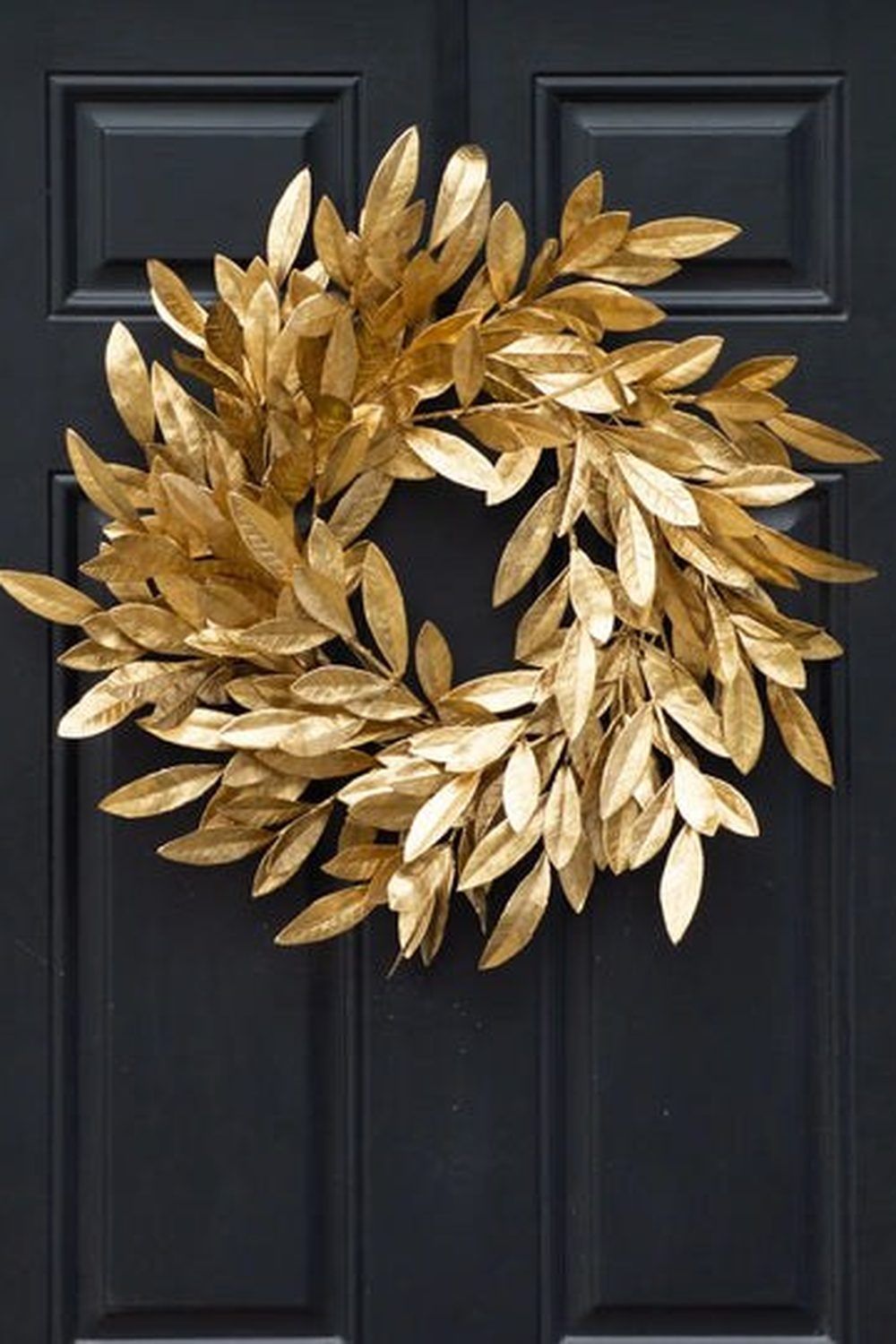
30 New year wreath ideas — glam gold, silver and black wreaths for the…
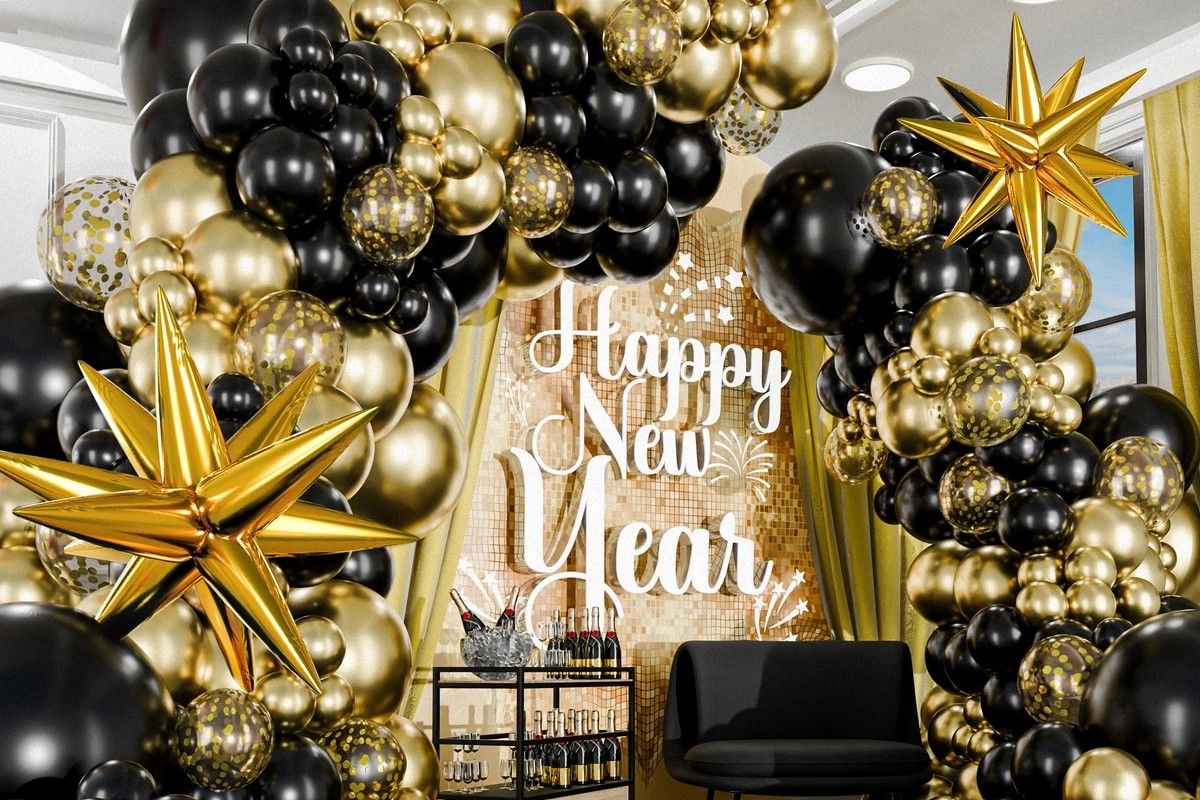
Every New Year party ends up in one corner: the one with the backdrop. These 35 new year photo backdrop ideas build that corner properly — shimmer curtains, balloon arches, giant clocks, 2027 in foil, fairy-light walls — in gold, black, white and silver, so every photograph looks like the party felt. No photographer needed, just a wall and an hour.
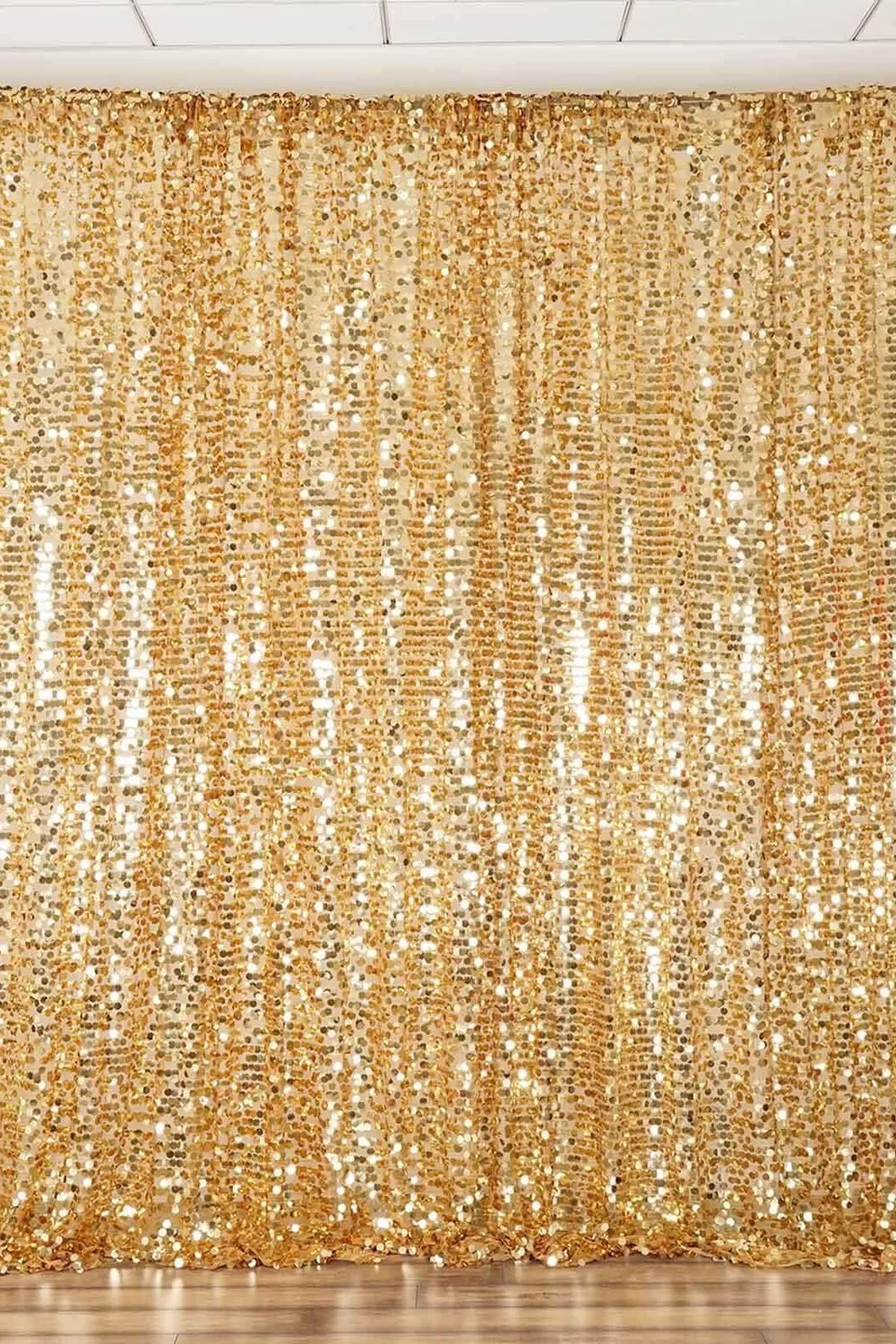
One wall of gold sequins — the backdrop that makes every photo look expensive.
The sequin curtain is the backdrop all others are measured by: a full wall of gold shimmer that catches light from every angle and flatters everyone who stands in front of it. Hang two curtain panels side by side on a plain wall or a garment rail, let them fall to the floor, and the corner is finished — no other decoration is required, and photographs come out looking like a hired booth.
Styling tip: steam or shake the panels out the day before so they hang flat; a creased sequin curtain photographs every fold.
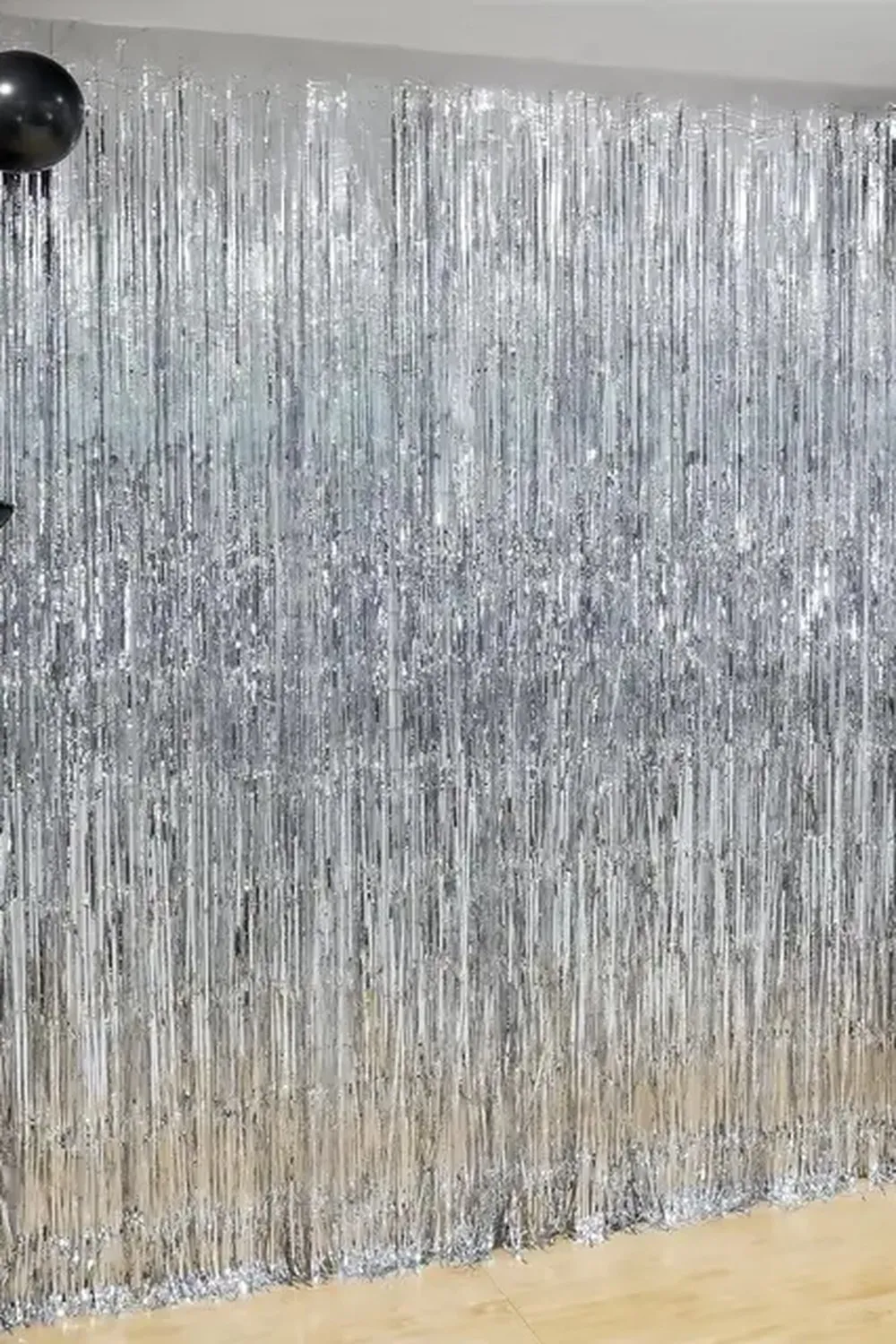
Silver fringe, doubled — two layers give the wall depth and movement.
A single fringe curtain can look thin in photographs; two layers, hung one over the other, give the wall real depth and a shimmer that moves when guests brush past. Silver suits a white-and-silver scheme or cools down a gold-heavy room, and the metallic strands hide the wall completely — which is the point, in a rented room or a tired corner.
Styling tip: hang the second layer a few inches lower than the first so both lengths show — the stepped hem reads as texture, not a mistake.
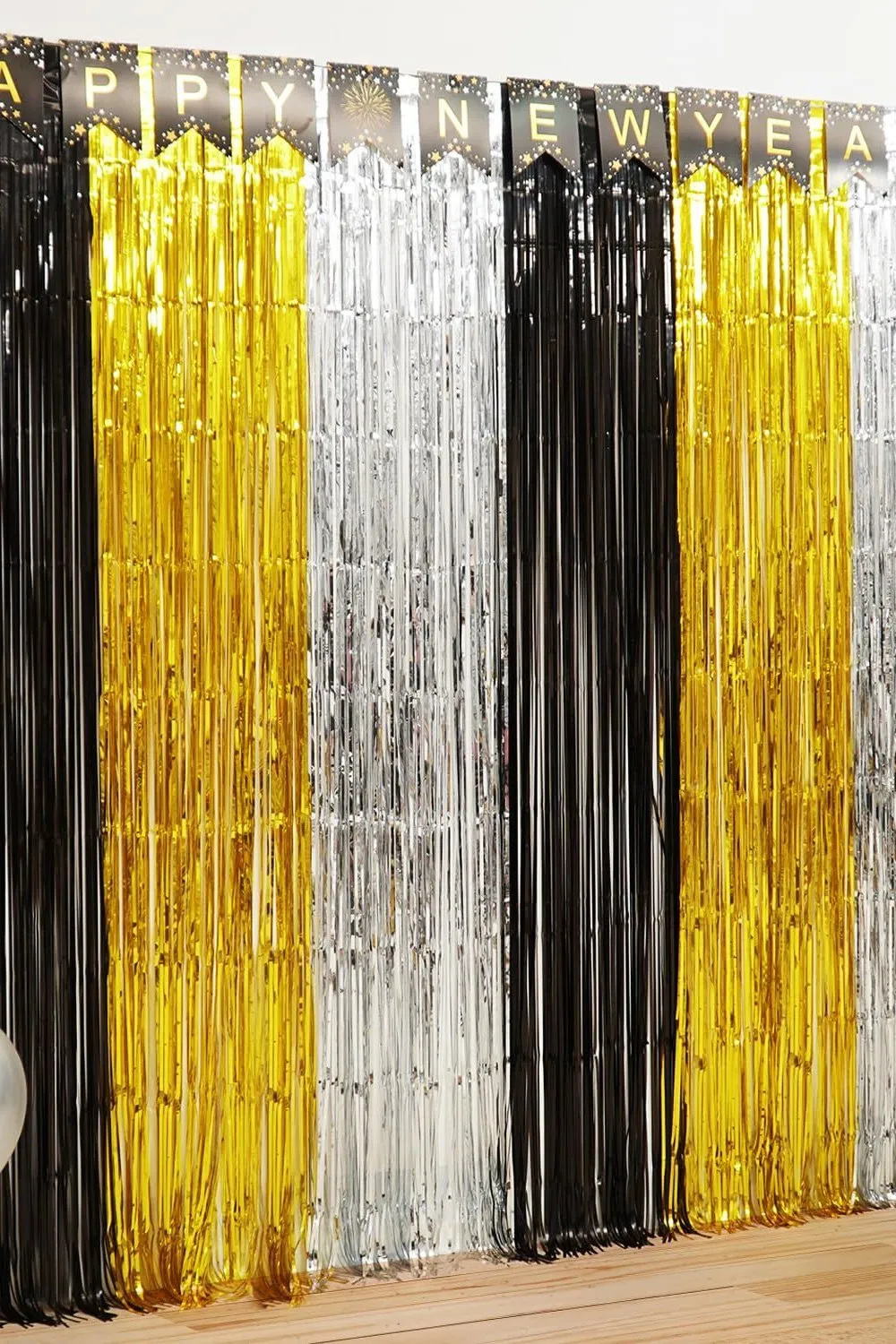
Half black, half gold — the two-tone wall that matches every outfit.
Black and gold is the New Year palette that never dates, and split down the middle it makes the most graphic backdrop in this list. Guests naturally pose on the side that suits their outfit, and the contrast photographs sharply even in dim party light. Use equal widths of each so the split sits dead center behind a couple or a group.
Styling tip: tape the top edge in one straight line across both curtains — a level top edge is what separates a designed wall from two curtains that met by chance.
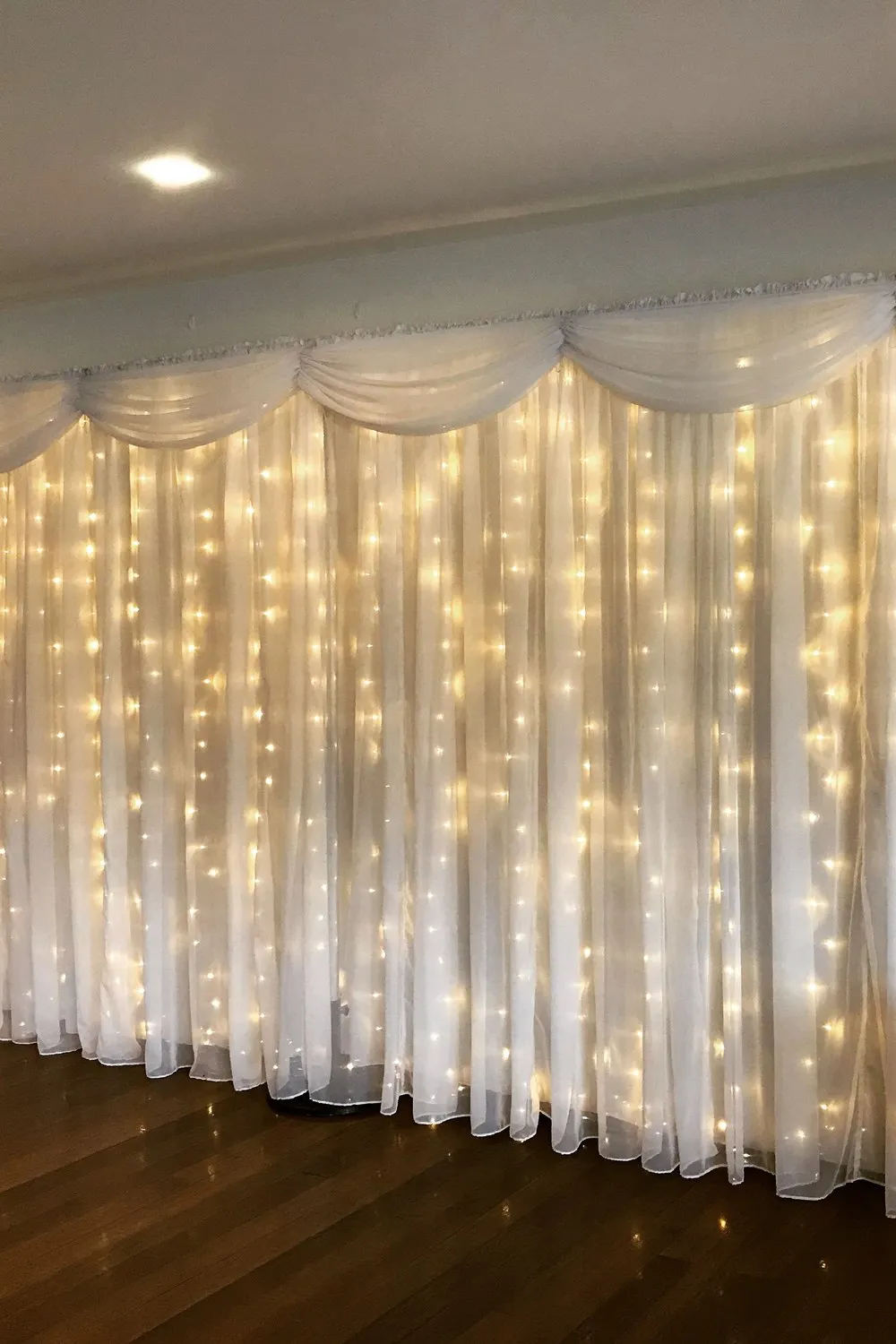
Light behind gauze — the softest backdrop, and the kindest to faces.
A sheer white curtain with warm fairy lights strung behind it is the backdrop photographers would choose: the fabric diffuses the lights into a soft glow that flatters every face and hides every wall mark. Hang the lights first on hooks or a rail, then the sheer in front, with a few inches of air between the layers so the glow spreads instead of spotting.
Styling tip: warm-white lights only — cool white behind sheer reads blue in photographs and turns skin gray.
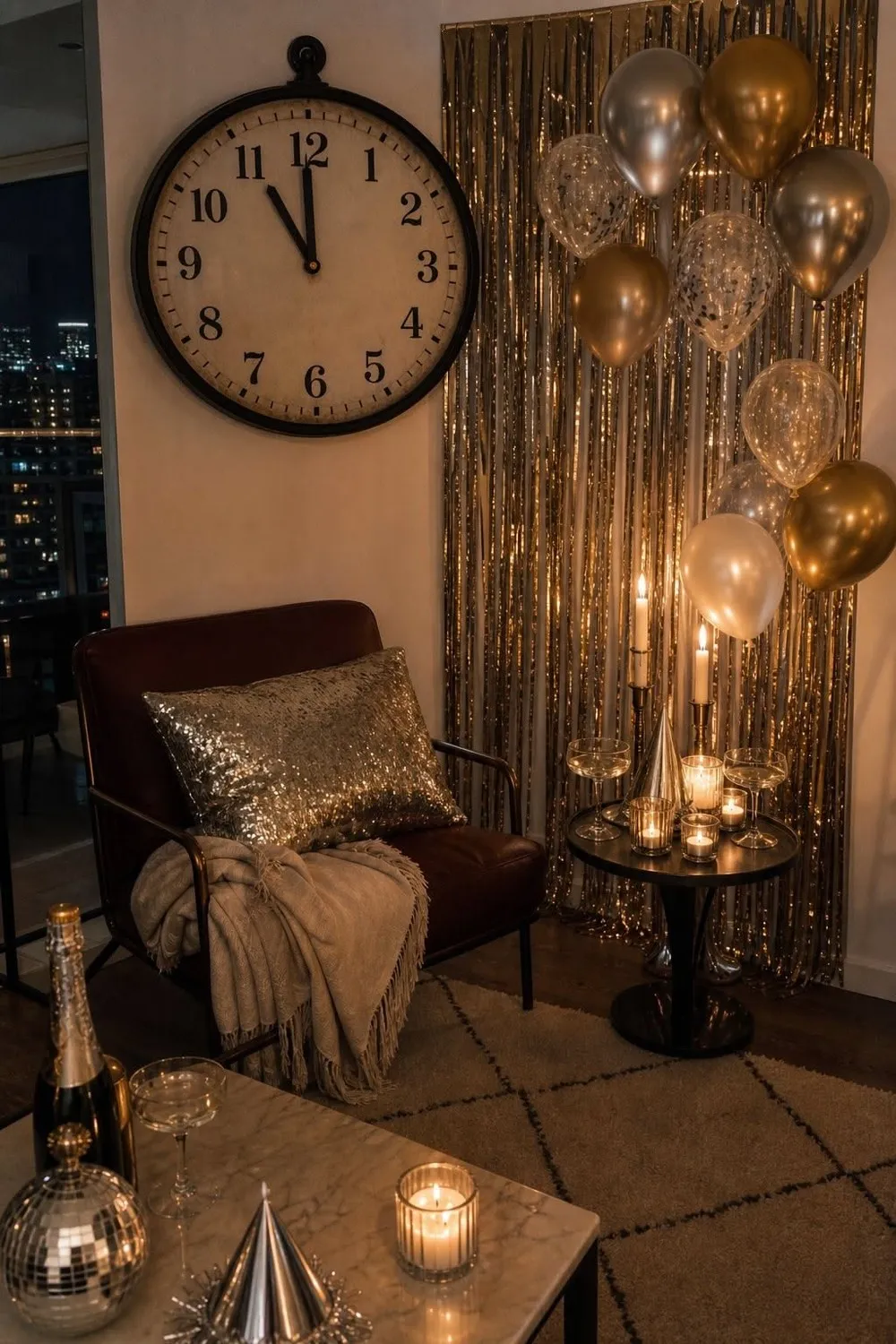
The curtain does the sparkle, the clock does the meaning — midnight, framed.
A gold tinsel curtain gains a story when a decorative clock hangs beside it: the wall says celebration, the clock says what for. Lean a large clock against the wall at one side rather than dead center, and guests pose beside it as the hands approach twelve. It is the simplest narrative backdrop in this list and the one that dates every photograph perfectly.
Styling tip: set the clock hands to five minutes before midnight and leave them there — every photo all evening tells the same almost-midnight story.
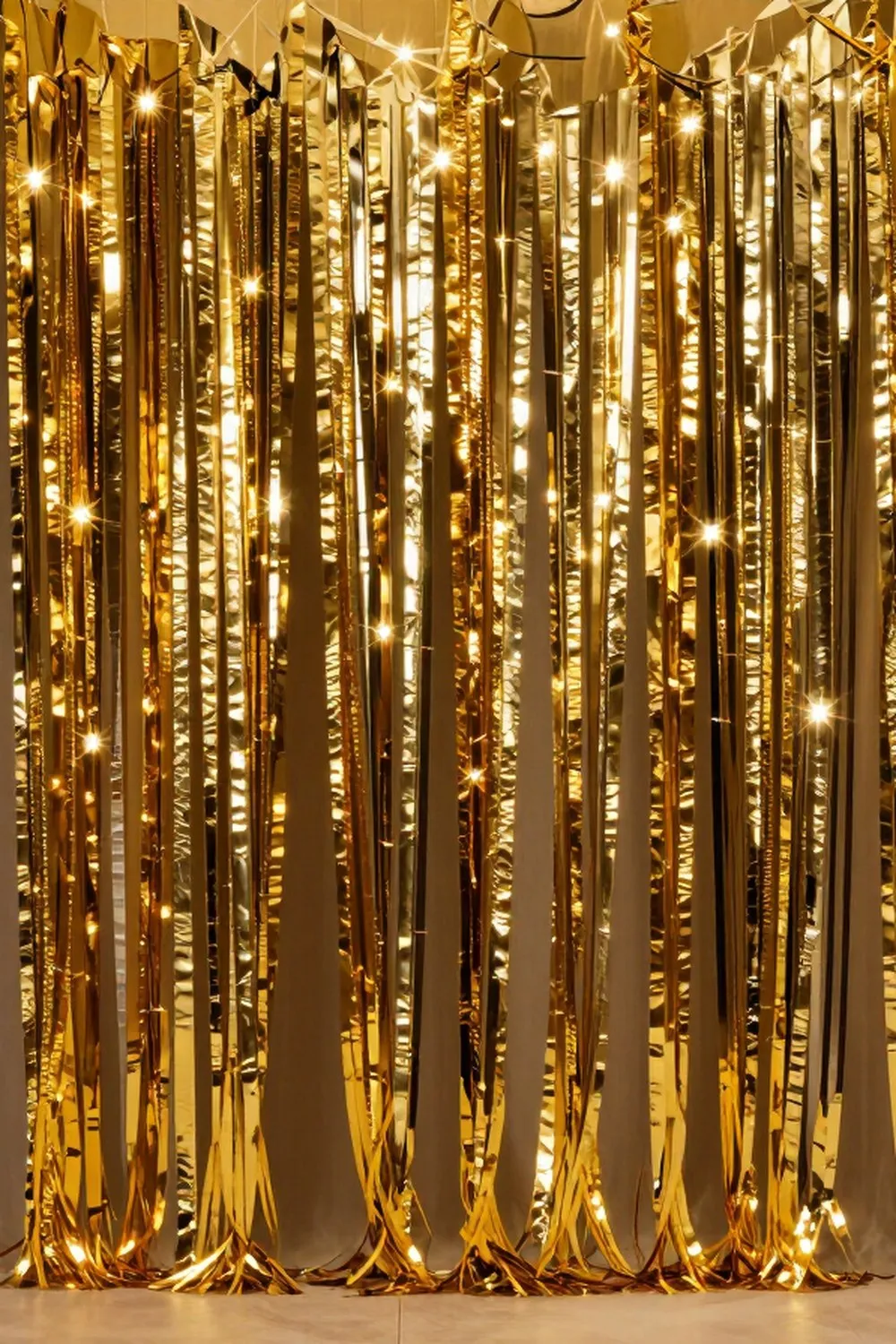
Champagne streamers — softer than gold, warmer than silver.
Metallic streamers in a champagne tone give a shimmer wall with the volume turned down: gentle shine, gentle color, and a backdrop that suits a dinner-party New Year as well as a loud one. Twist each streamer once as you hang it so the strands catch light along their length, and overlap them slightly so no wall peeks through.
Styling tip: streamers are the budget hero of backdrops — one pack covers a wall — but buy a spare pack; torn strands are replaced in seconds if a guest catches one.
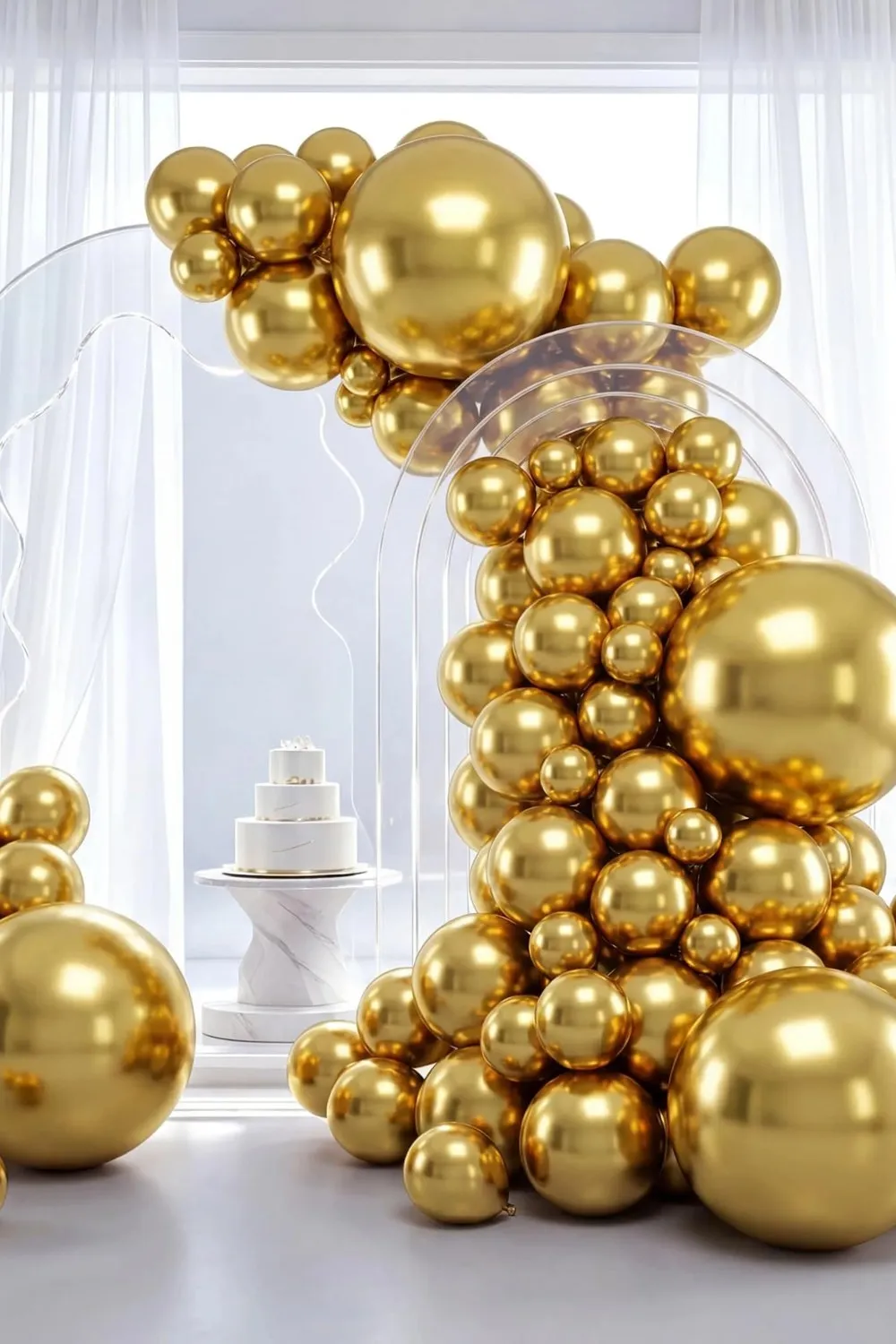
An arch of gold balloons around a plain wall — the frame is the backdrop.
A balloon arch turns any plain wall into a photo backdrop by framing it. Gold balloons in mixed sizes, built on a strip or a stand in an arch over the posing spot, leave the center empty for people — which is exactly where a backdrop should be plain. The arch reads festive from across the room and pulls guests toward the corner all evening.
Styling tip: mix three sizes (roughly 12, 7 and 5 inches) and cluster the smallest at the arch's two feet; a single-size arch looks like a shop opening.
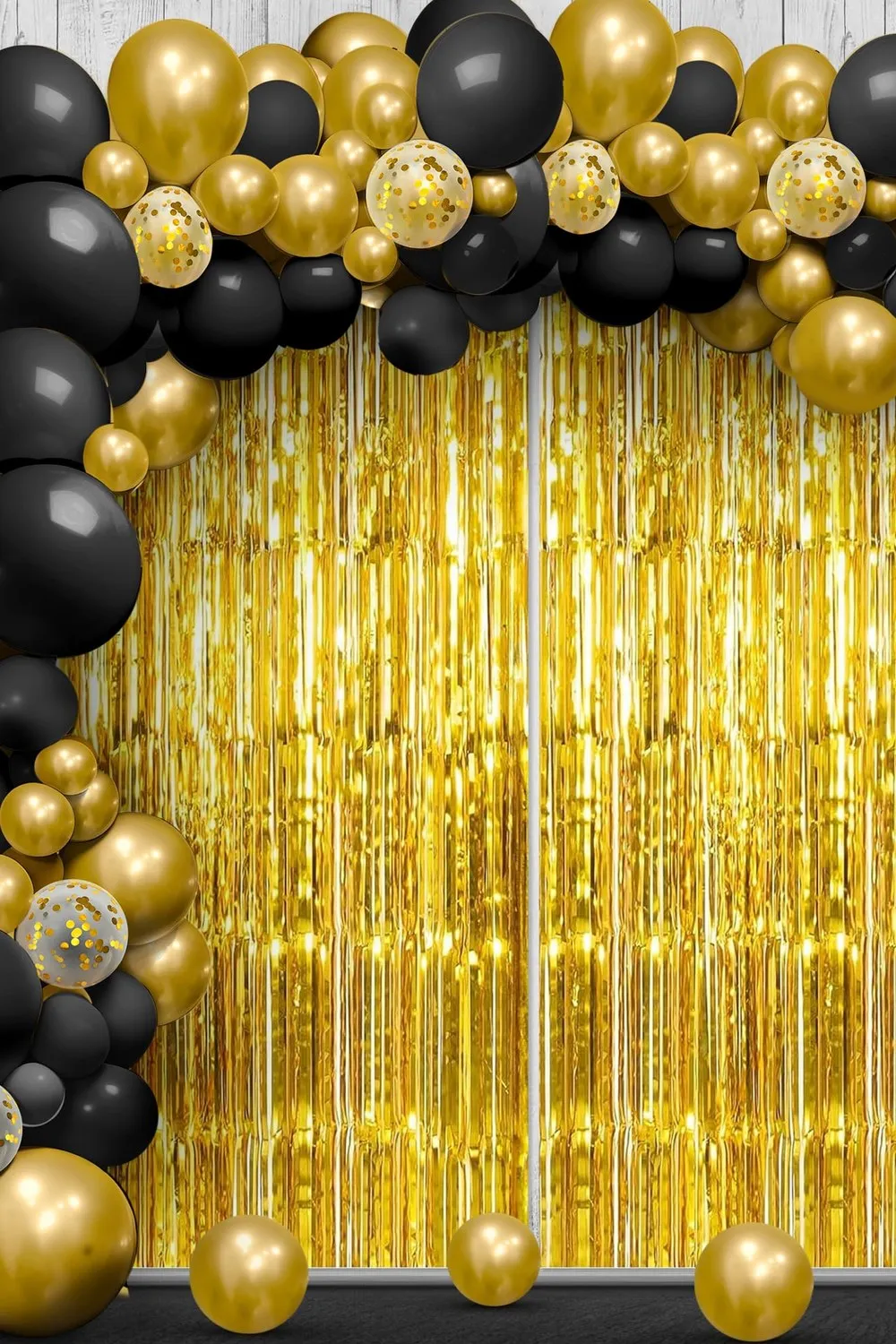
A garland along the top edge — backdrop dressing that leaves the wall free.
If a full arch is more balloon than the room wants, a garland along the top of the wall gives the same celebration with half the latex. Run it over a fringe or sequin curtain, or over a plain painted wall with a banner beneath; the eye reads the decorated top edge and accepts the whole wall as the backdrop. It is also the fastest balloon option to build — one strip, one hour.
Styling tip: add a few foil balloons among the latex at the garland's ends — the metallic shapes anchor the swag and photograph beautifully.
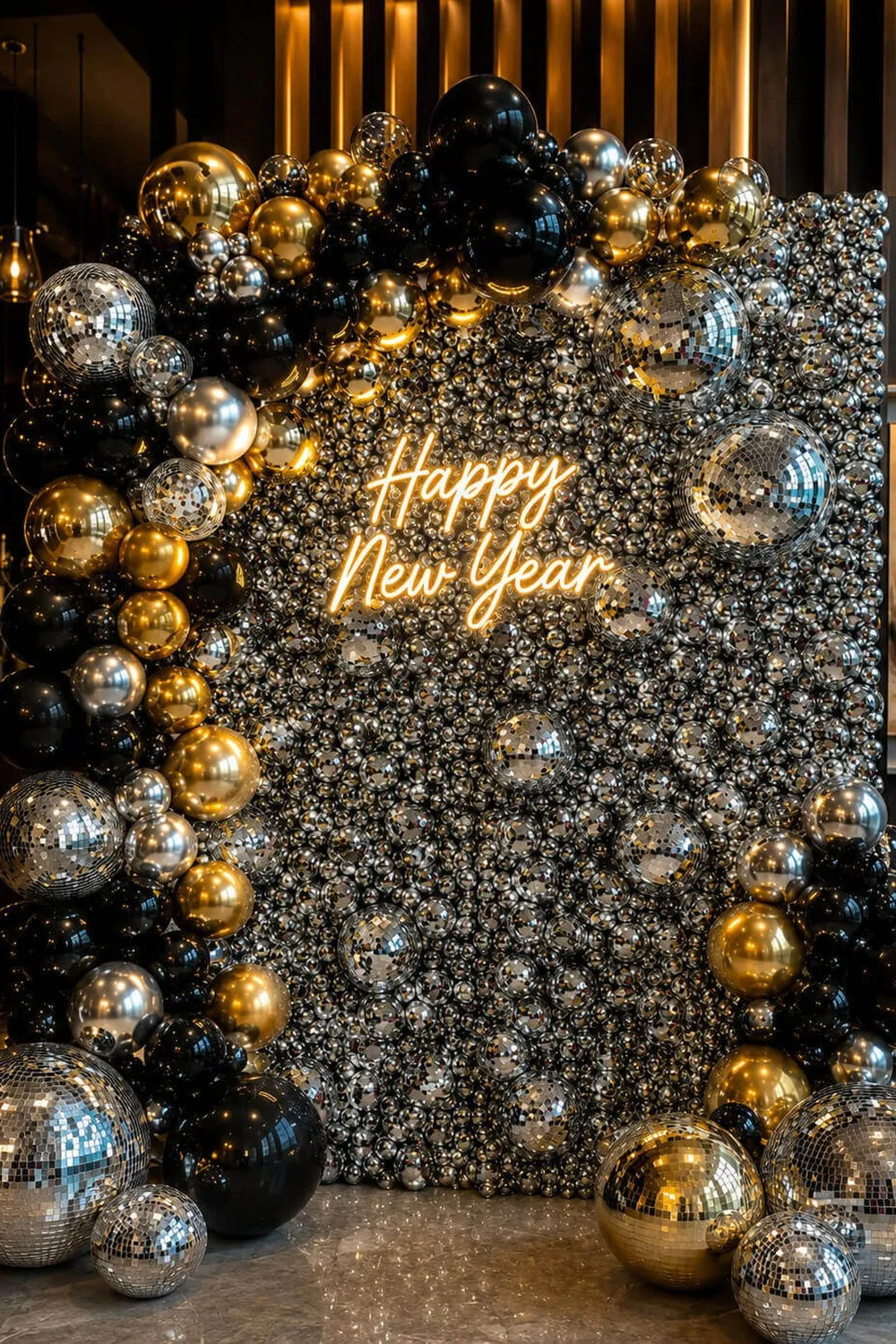
A whole wall of small gold balloons — texture you can stand in front of.
Covering a wall panel or a large board with mini gold balloons makes a backdrop with genuine three-dimensional texture: hundreds of small curves catching light in every direction. It is the most labor-intensive wall in this list and the most striking in photographs — guests look set into jewelry. Build it on a foam board or a rail-mounted panel so it can be assembled in advance and moved.
Styling tip: inflate minis to slightly different fullness; perfect uniformity looks printed, gentle variation looks rich.
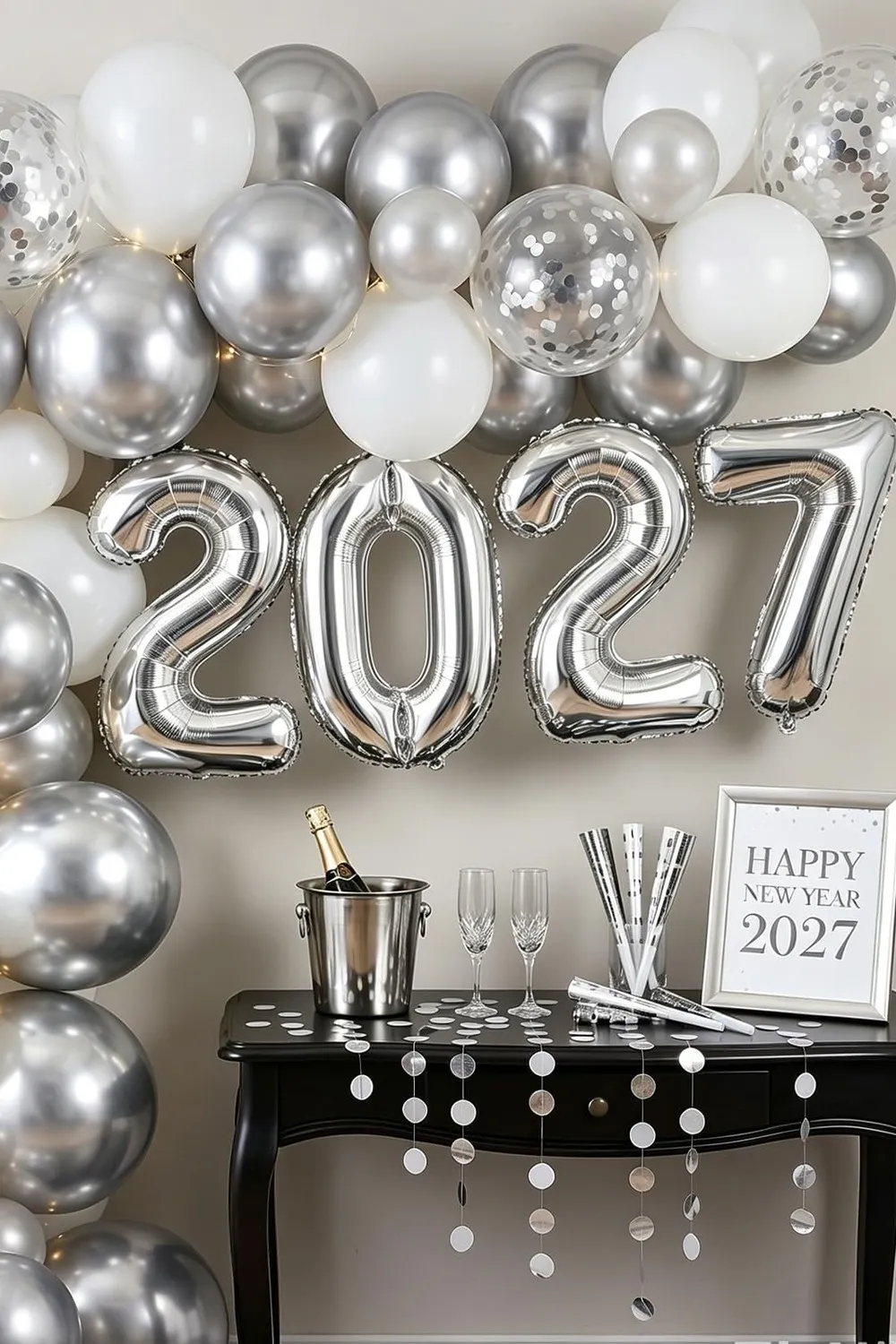
The year itself, in gold foil — the photograph dates itself.
Foil numbers reading 2027, fixed at eye level on a balloon wall or garland, are the hardest-working backdrop element there is: every photograph taken in front of them is instantly dated, captioned and ready to share. Metallic foil on black or white balloons keeps the palette grown-up; the numbers want to be big — 24 inches or more — so they read over shoulders.
Styling tip: weigh or tape foil numbers at two points each; a slowly rotating 2 is the classic New Year photo fail.
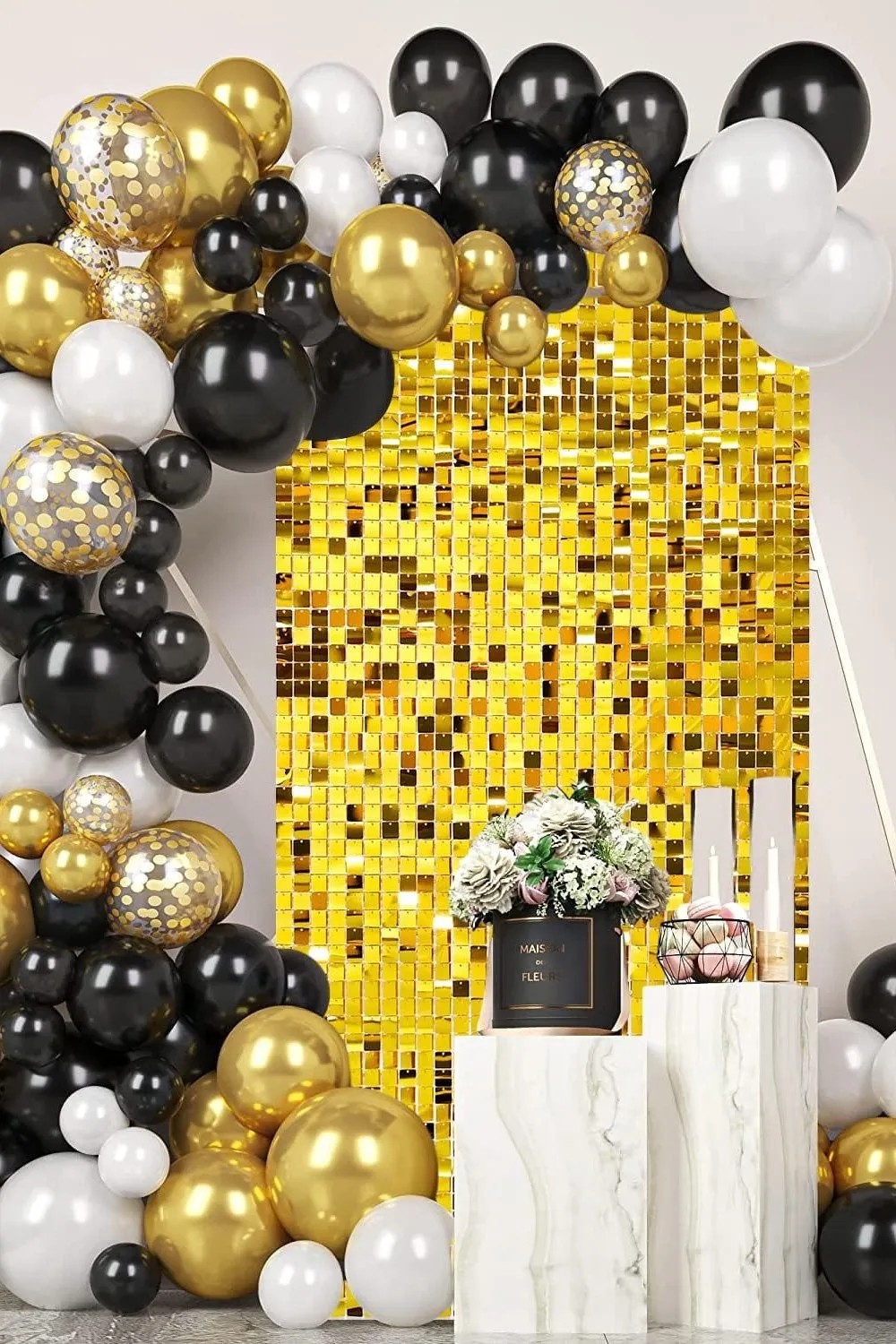
A wall of gold sequins, balloons piled at its edges.
A sequin wall is already the loudest surface in the room; what finishes it is a crowd of balloons piled around its edges — black, white and gold clusters climbing the sides and spilling at the base. The sequins give every photograph a glittering field, the balloons give it a frame, and the posing spot in the middle stays clear. It is the fastest route to a backdrop that looks hired-in.
Styling tip: build the balloon clusters unevenly — one side higher, one spilling lower — so the frame looks abundant rather than symmetrical, and keep the center of the sequin wall completely bare.

The corner arch — two walls of color meeting over the posing spot.
A corner takes an arch differently from a flat wall: the garland runs up one wall, across the corner and down the other, and the posing spot sits inside a genuine nook of color. Gold, black and white balloons in mixed sizes keep it in the party palette, and the corner shape photographs with more depth than any flat wall can. This is the backdrop for the room whose only spare space is a corner.
Styling tip: start the arch at floor level on both sides rather than at picture-rail height — a full frame around the subjects is what makes corner photos work.
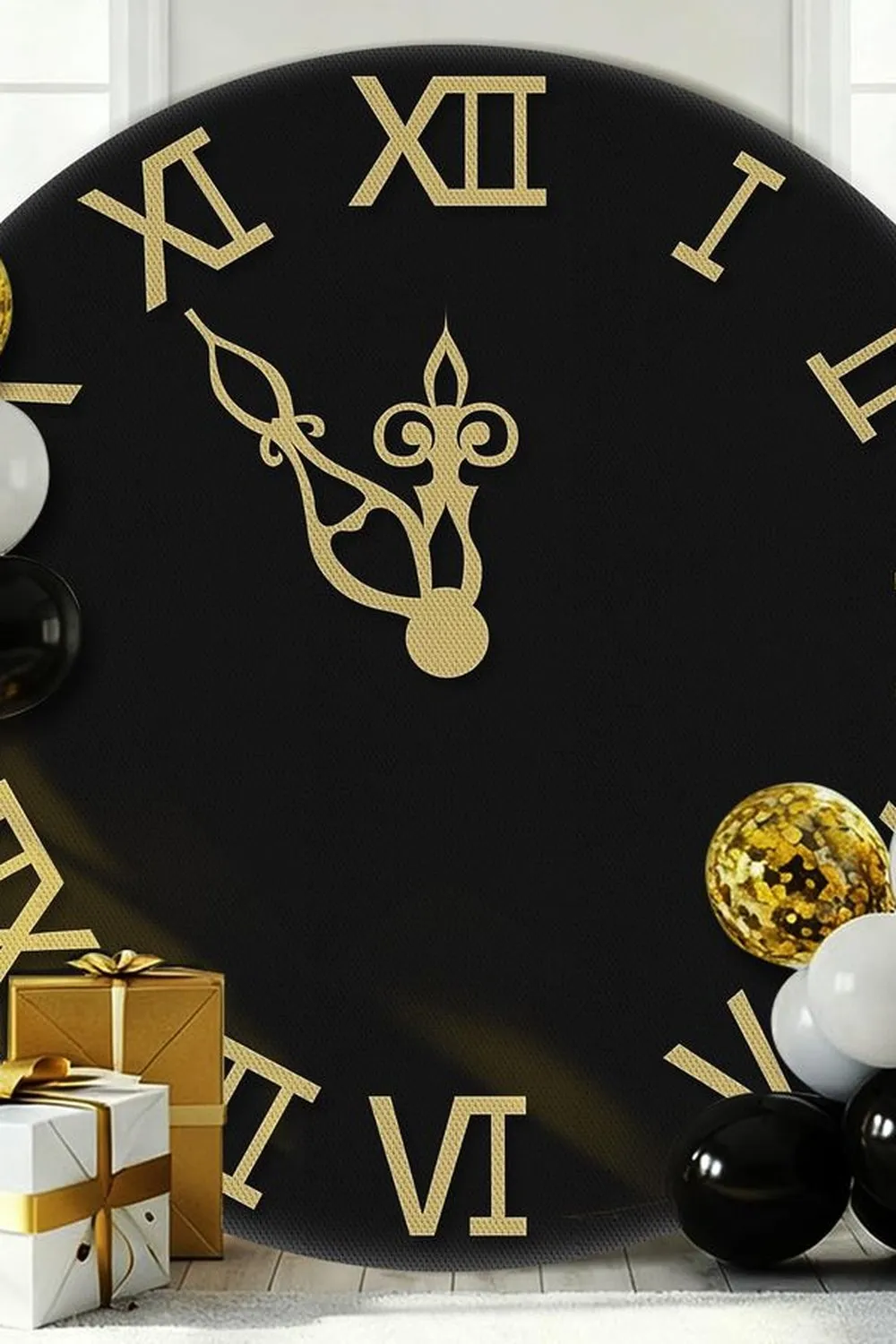
One enormous clock — the whole backdrop is a countdown.
A giant clock face — an oversized wall clock, or a printed face mounted on board — is the most literal New Year backdrop and one of the most effective: a single huge object that fills the frame behind every guest. Set the hands near midnight and the photograph needs no caption at all. A clock with a plain face and strong hands photographs best; fussy numerals blur into noise at party distance.
Styling tip: if you print the clock face, mount it on foam board rather than paper — paper curls under party warmth and the curl shows in every shot.
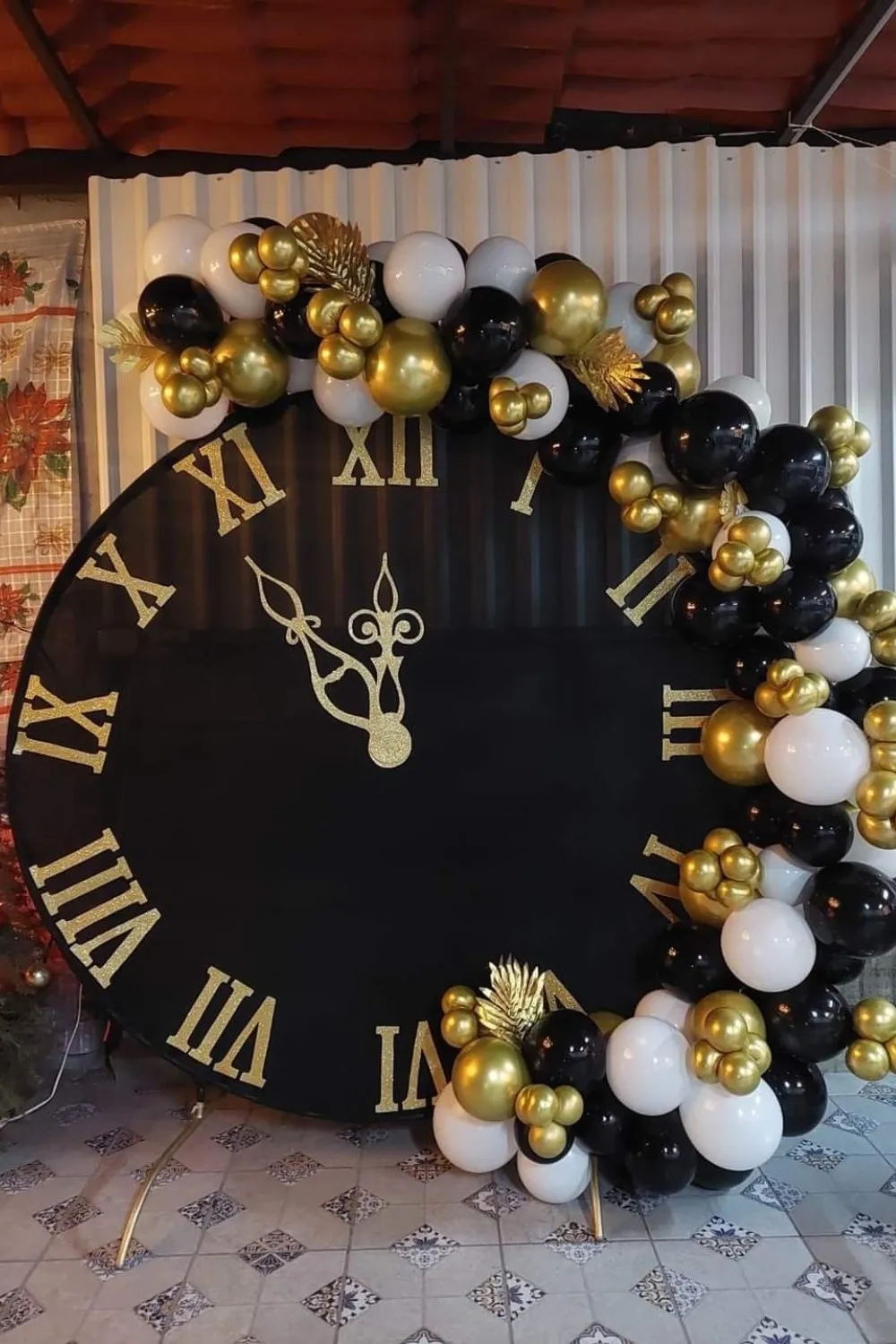
The clock, crowned — balloons ring the face like a wreath for midnight.
Ringing the giant clock with a garland of gold and black balloons combines this section's two heroes into one backdrop: the countdown at the center, the celebration around it. The ring frames faces beautifully — guests stand inside its lower curve — and the whole arrangement can be built on one wall panel in an afternoon. Keep the balloons small so the clock face stays the star.
Styling tip: leave a gap in the ring at the bottom center; a complete circle reads as a wreath, a broken one reads as a stage.
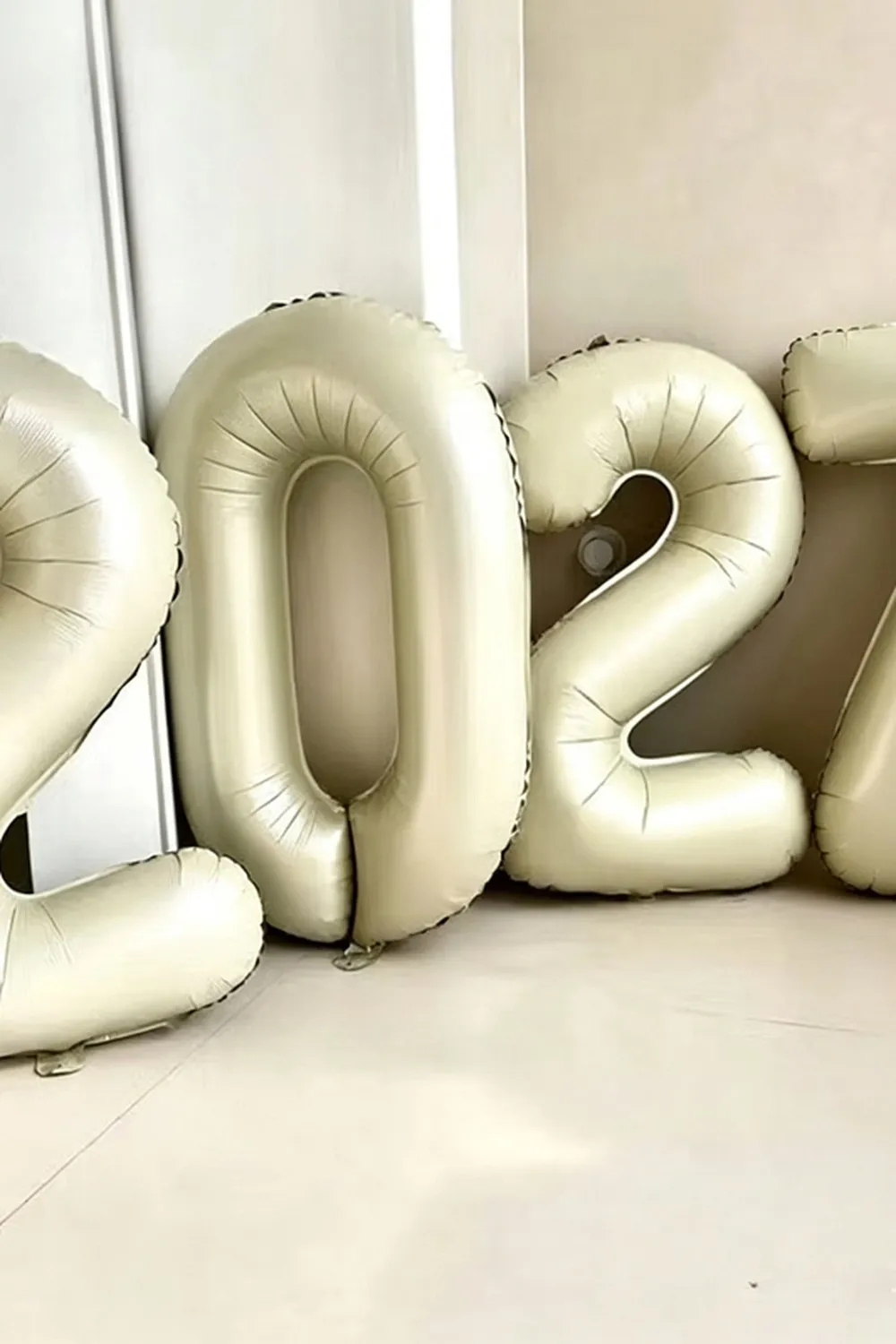
Just the numbers — minimal foil on a plain wall, nothing else needed.
For the minimalist party, the backdrop is only numbers: 2027 (or a 10-to-1 countdown row) in gold foil on an unadorned wall. The restraint is the style — photographs look editorial rather than decorated, and the setup takes twenty minutes. It works best on a dark wall, where foil letters glow, or on white, where they read as sculpture.
Styling tip: fix foil numbers with removable adhesive strips at the top and bottom of each digit; tape alone lets them drift out of line by midnight.

A clock in a halo of warm light — midnight, glowing.
A clock face surrounded by a loose halo of warm fairy lights is the evening version of the clock backdrop: as the room darkens, the backdrop brightens. The lights outline the clock and give photographs a glow that needs no flash. Run the lights in a rough circle or a starburst; precision is not the point, warmth is.
Styling tip: battery lights with a timer remove the trailing-cable problem — the backdrop wall rarely has a socket where you want one.
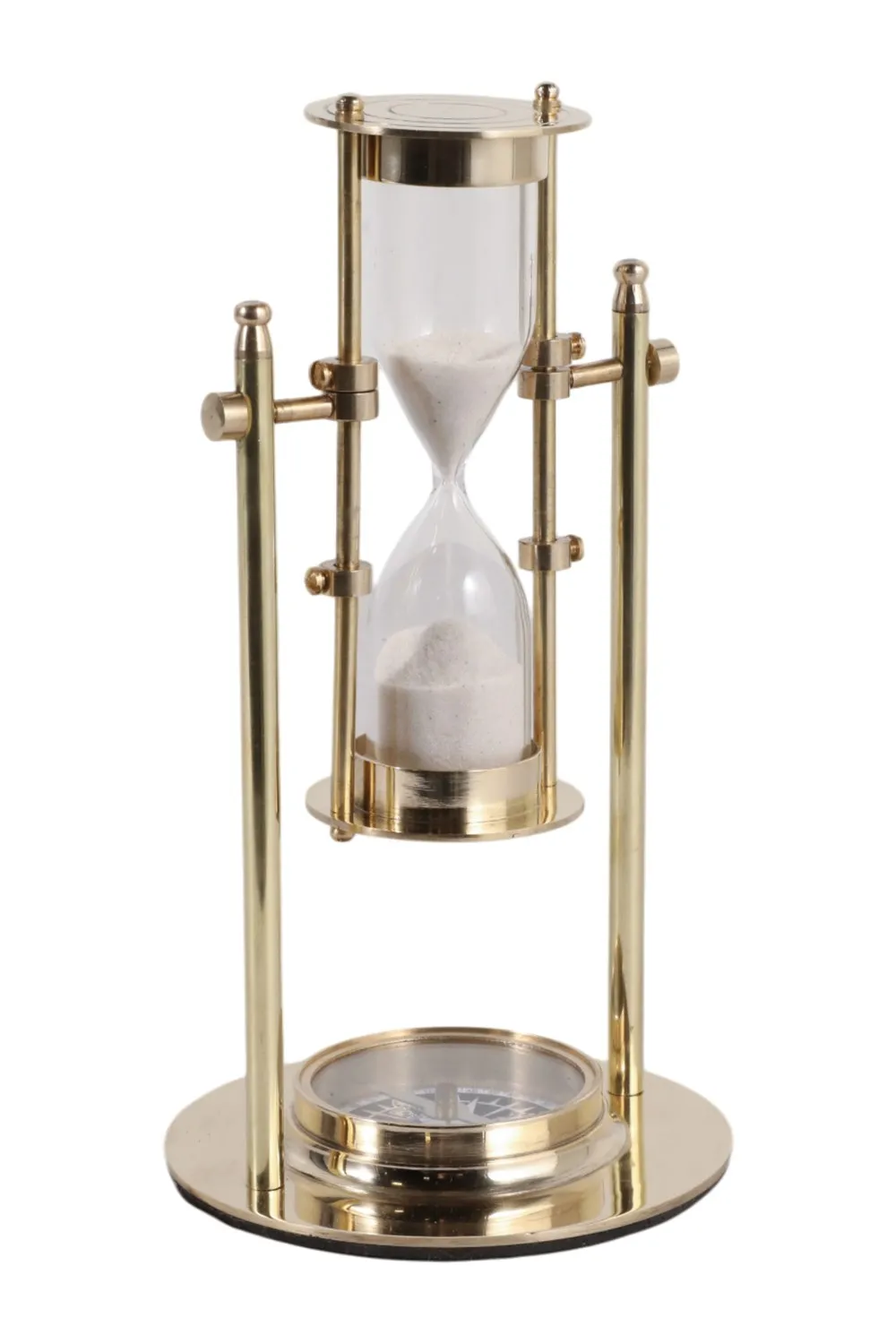
Time, standing by — a brass hourglass as the backdrop's punctuation.
A large brass hourglass on a small table or plinth beside the backdrop adds the countdown theme in three dimensions — a prop guests can stand with, gesture at, and photograph from the side. It suits the glam and vintage corners especially, and unlike balloons it survives to next year. Look for the largest hourglass you can find; small ones vanish in group photographs.
Styling tip: place the hourglass at the backdrop's edge, not its center — props work at the side, where a hand naturally rests near them.

Gold on black, nothing else — the boldest wall in the list.
A black backdrop — fabric, paper or a painted board — with 2027 in big gold letters or foil numbers is the highest-contrast backdrop here, and contrast is what makes phone photographs look professional. Black swallows the room behind the subjects; the gold year floats at head height; faces light up against the dark. It is also the most forgiving backdrop for a room that is not pretty.
Styling tip: matte black beats shiny black — gloss reflects the flash back as glare, matte disappears.
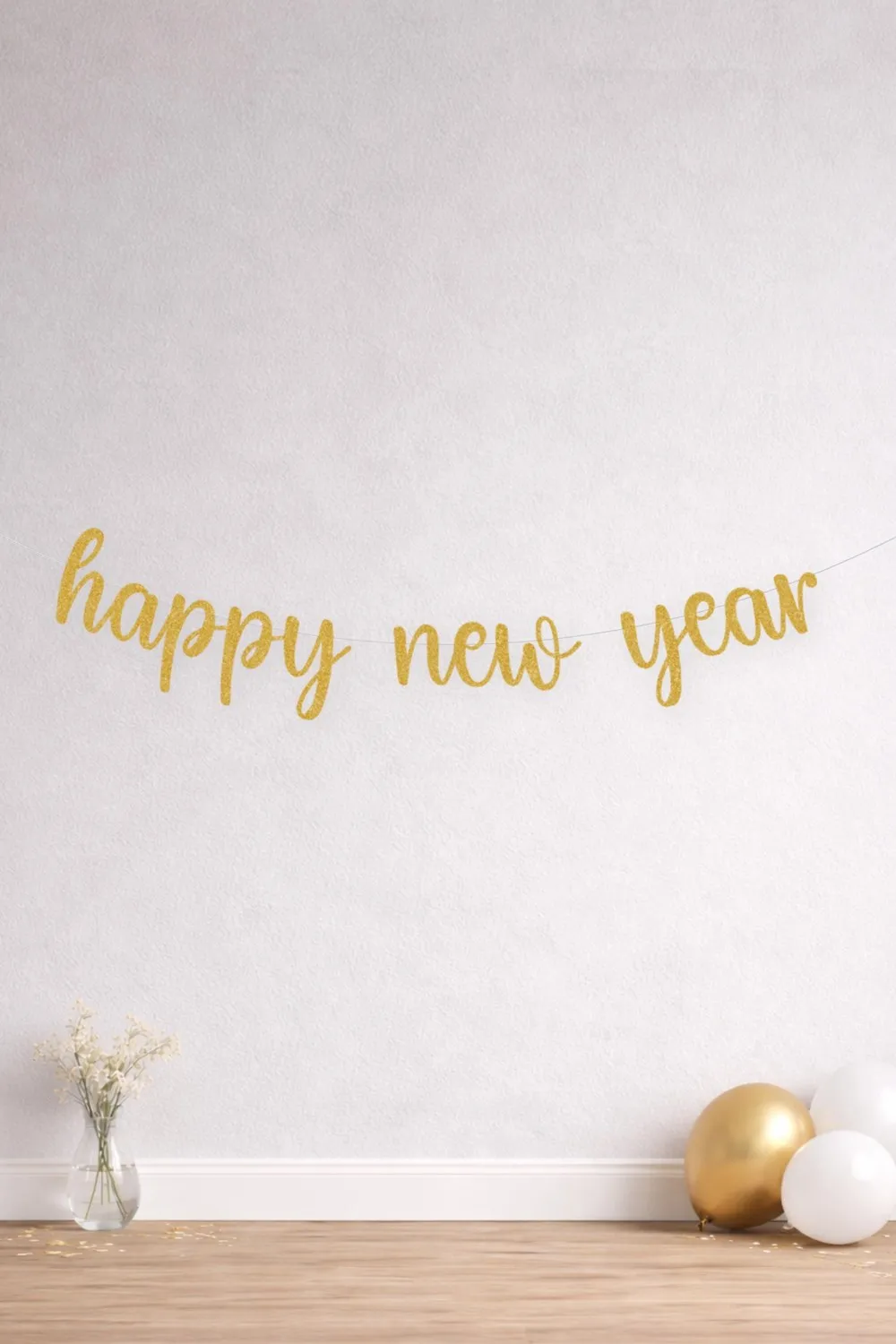
The greeting over the wall — words that finish any backdrop.
A Happy New Year banner strung across the top of a curtain, arch or plain wall is the finishing layer that turns decoration into a backdrop: it gives photographs a headline. Gold letters on a black or clear string keep it in palette. Hung with a gentle swag — slightly lower in the middle — it frames the tallest guest's head without crowding it.
Styling tip: hang the banner a hand's width above head height of the tallest expected guest; banners that touch hair in photos annoy everyone.
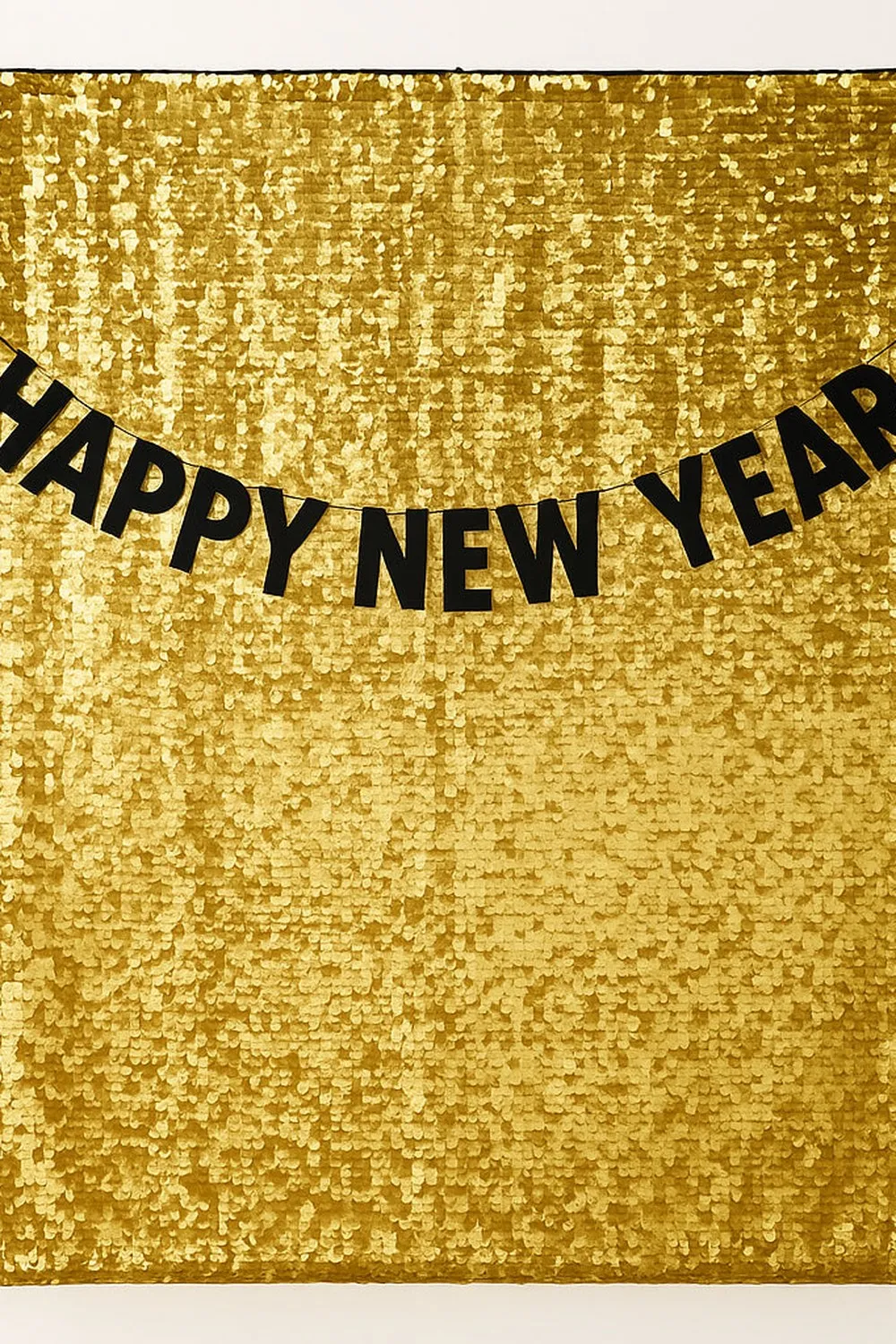
Words on shimmer — the banner gives the sequins something to say.
On a sequin wall, a gold letter banner might sound like gold on gold — but the flat letters read clearly against the textured shine precisely because they do not sparkle. The combination is the classic photo-booth look: glamour behind, message in front. Choose letters with a matte or satin finish and a dark string so the words float.
Styling tip: if the banner and wall are close in tone, outline the words by hanging them on black ribbon — definition is everything in a photograph.
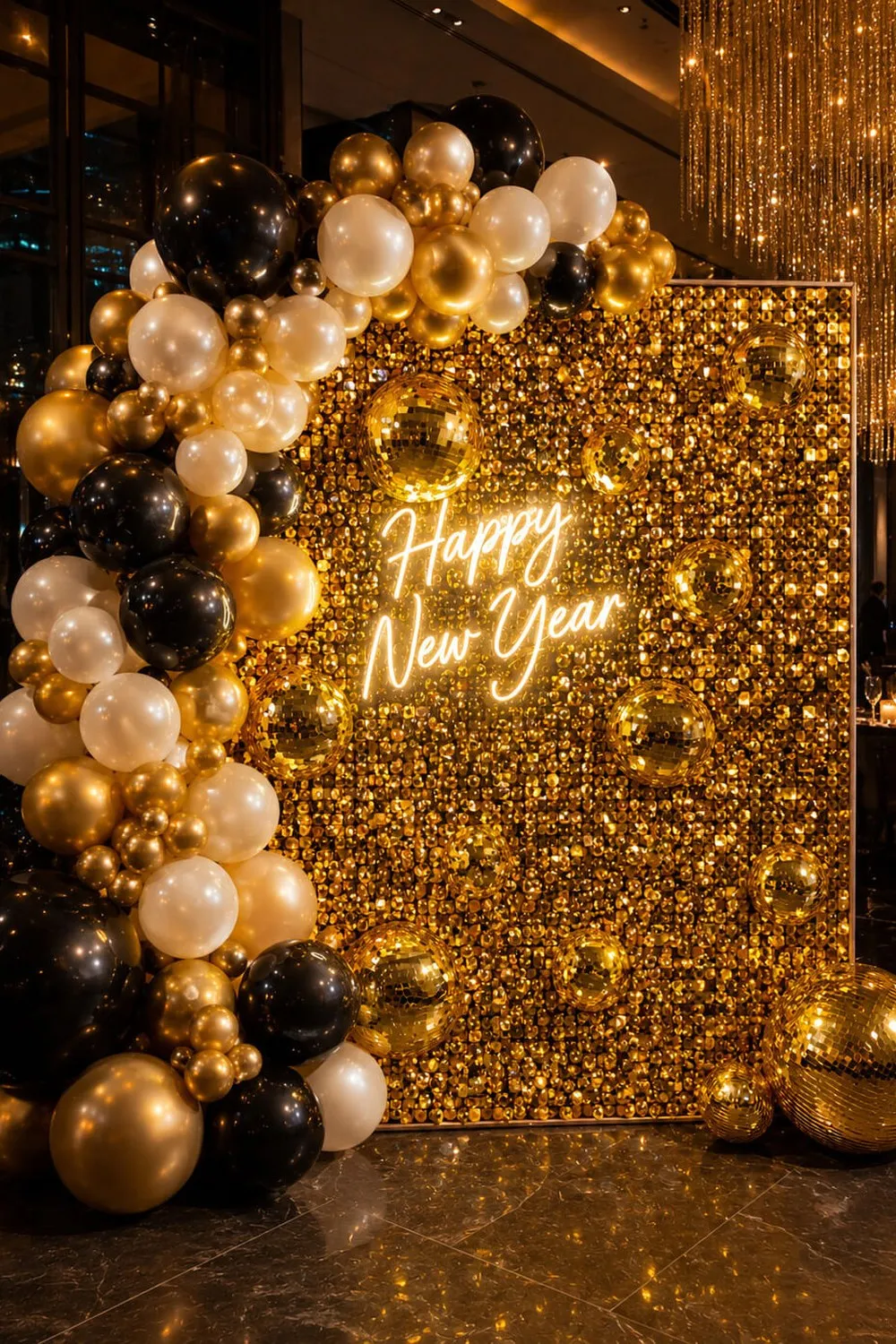
A neon word in the dark — the backdrop that lights the party's photos itself.
A neon (or LED neon-effect) Cheers sign on the backdrop wall gives the corner its own light source and its own caption in one object. Warm white or gold-toned neon suits the palette; the sign photographs as a glow behind shoulders and turns an ordinary wall into the place everyone queues for. Rent one if buying feels steep — sign hire is a whole New Year industry.
Styling tip: dim the room lights near the backdrop once the sign is on — neon needs a little darkness around it to bloom in photographs.
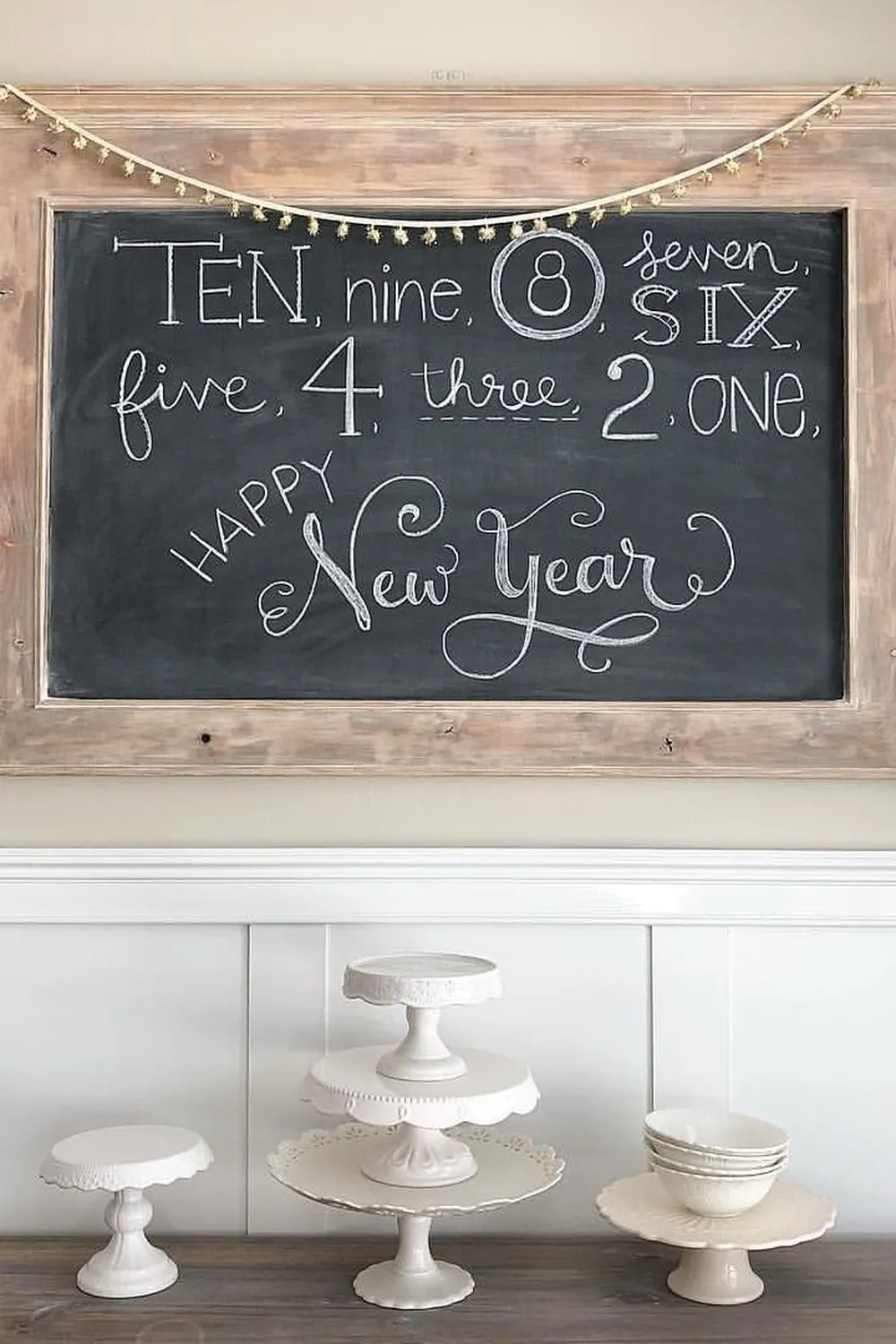
Days to go — the countdown, chalked down day by day.
A framed countdown board at the backdrop's edge — the kind you chalk up fresh each day — builds the party before it happens: every day of the final week, someone chalks the new number and the corner gets photographed again. On the night itself it stands as proof of the wait, and guests pose beside the number that finally reached zero.
Styling tip: start the board a week out and photograph each new number — by New Year's Eve you have a ready-made countdown series to post before the party even starts.
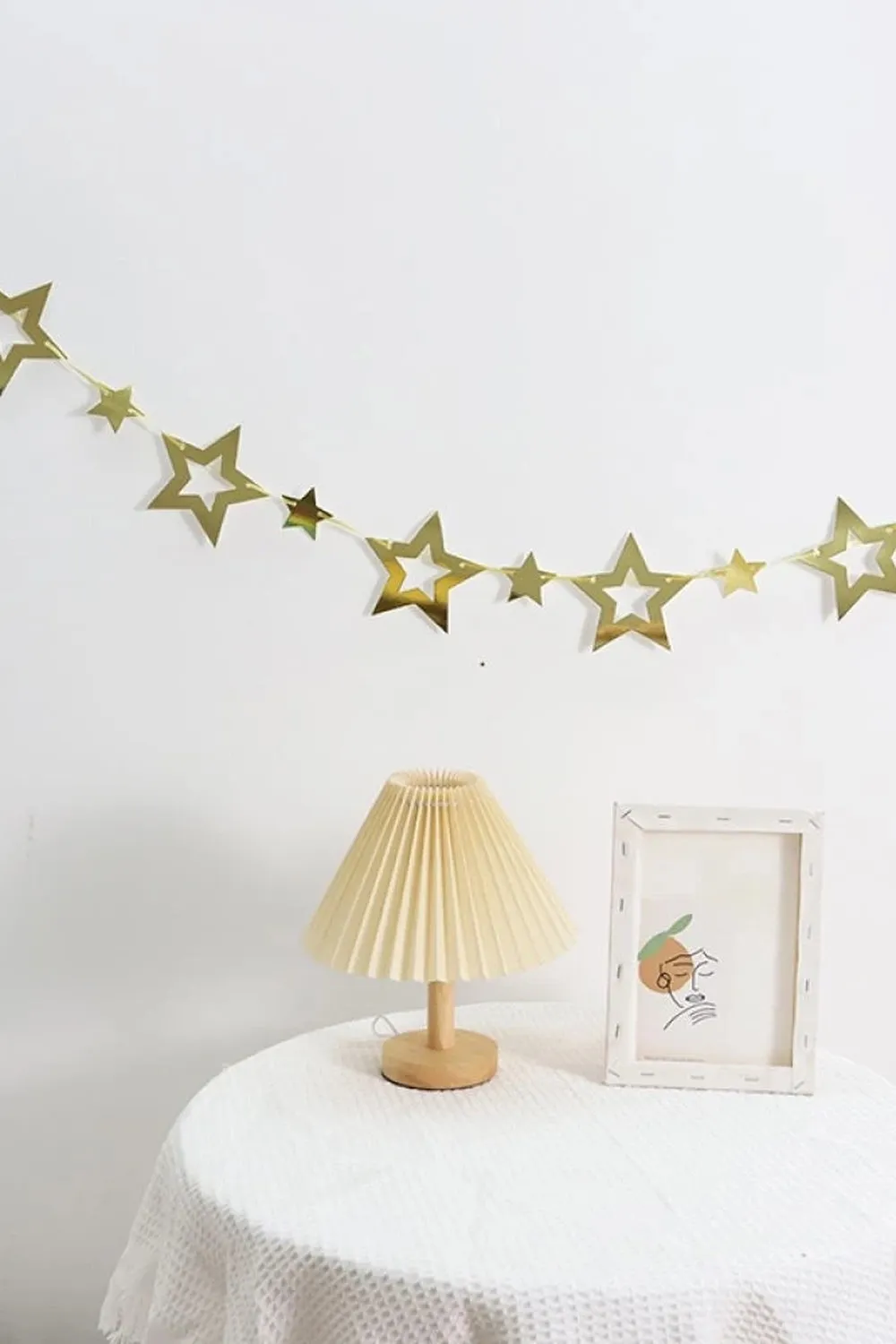
Stars on a string — the garland that works over every wall in this list.
A garland of gold stars strung across the backdrop — over curtains, balloons or bare wall — is the universal top layer: it adds the celestial note that suits midnight, catches light at every point, and takes two minutes to hang. Two swags crossing in a shallow X look richer than one straight line. Card, foil or wooden stars all work; foil catches the most light.
Styling tip: hang star garlands slightly in front of the wall on clear thread, so they cast tiny shadows and the wall gains depth in photographs.
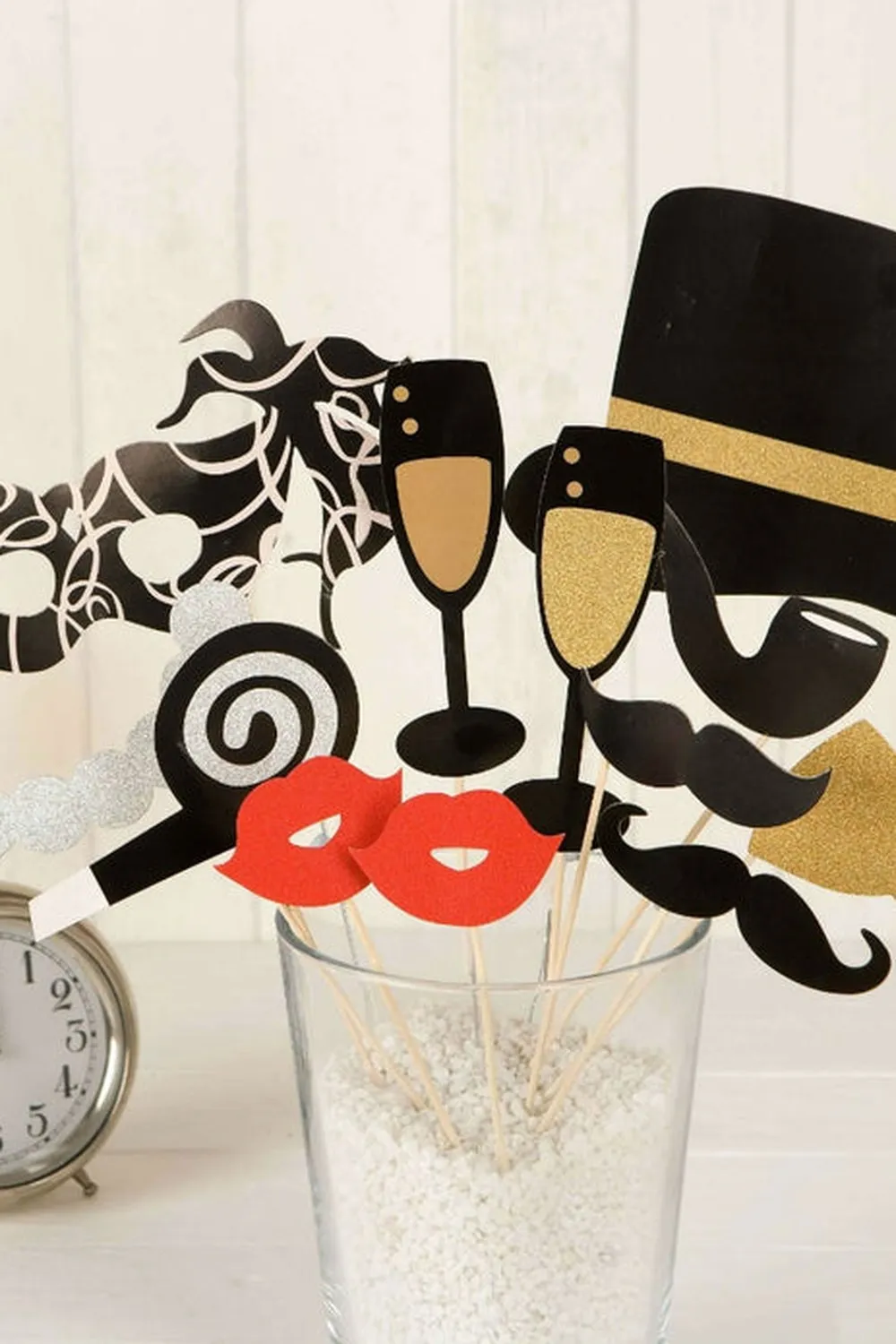
The props, waiting in a vase — glasses, hats and 2027 signs as objects.
Props on sticks — gold glasses, top hats, moustaches, 2027 signs, speech bubbles — are the backdrop's supporting cast, and they display best standing in a clear glass vase at the corner's edge like a bouquet. Guests help themselves, pose, and return them; the vase keeps them gathered instead of scattered across the room. As objects in a vase they decorate the corner even when nobody is posing.
Styling tip: include two or three word props ("Cheers", "2027", "Midnight") among the shapes — words are what make strangers' photos legible at a glance.
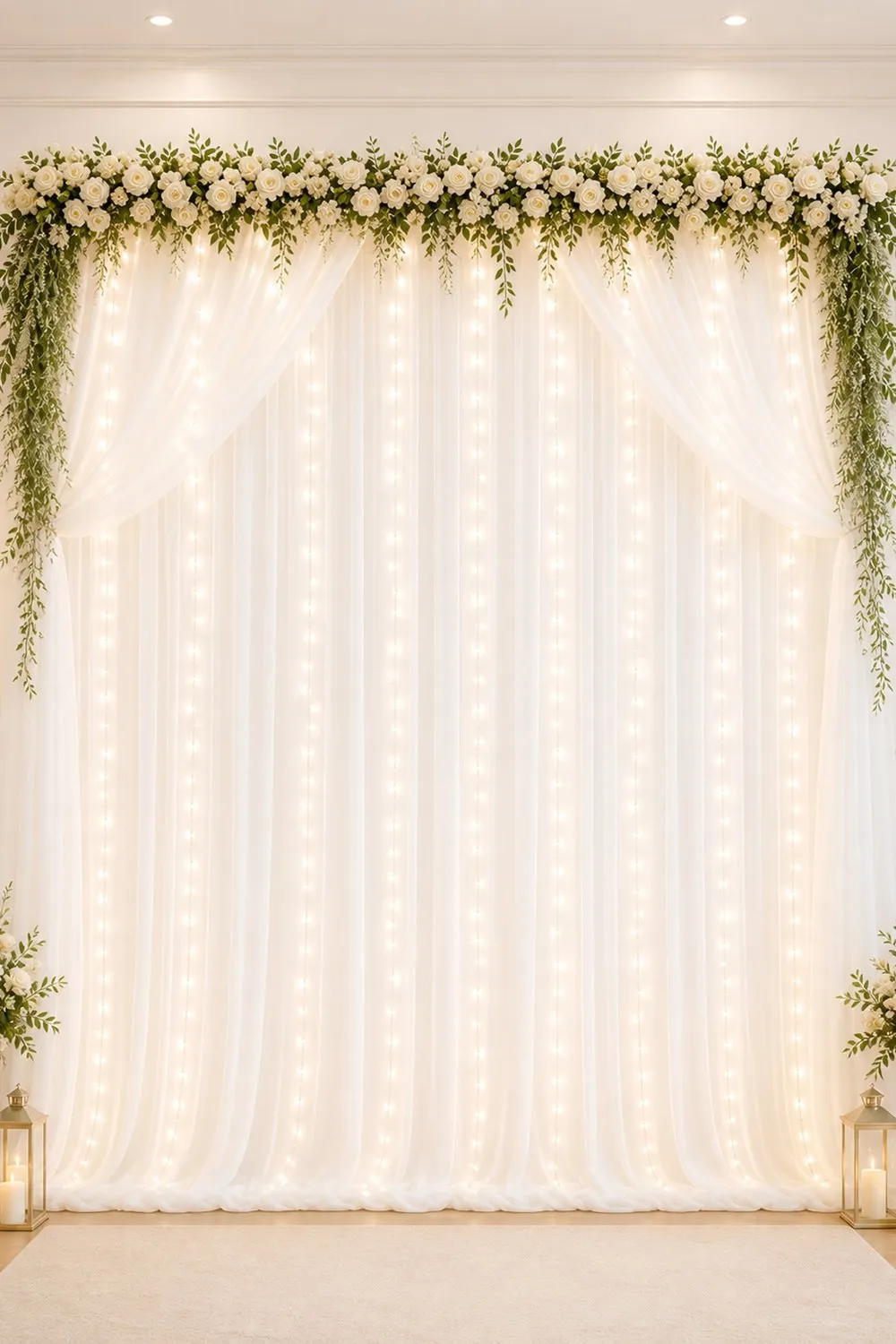
A wall made of light alone — hundreds of warm points behind every guest.
A full curtain of warm fairy lights — the cascading kind sold for windows — is a backdrop with nothing solid in it at all: just light, falling in strands, and every photograph taken in front of it looks like midnight. Hang it from a rail or picture hooks at ceiling height and let it pool very slightly at the floor. In a dark room it needs no other decoration; in a bright one, layer it over a dark curtain.
Styling tip: choose the steady or slow-twinkle setting for photographs — fast chasing modes blur into streaks whenever a guest moves.
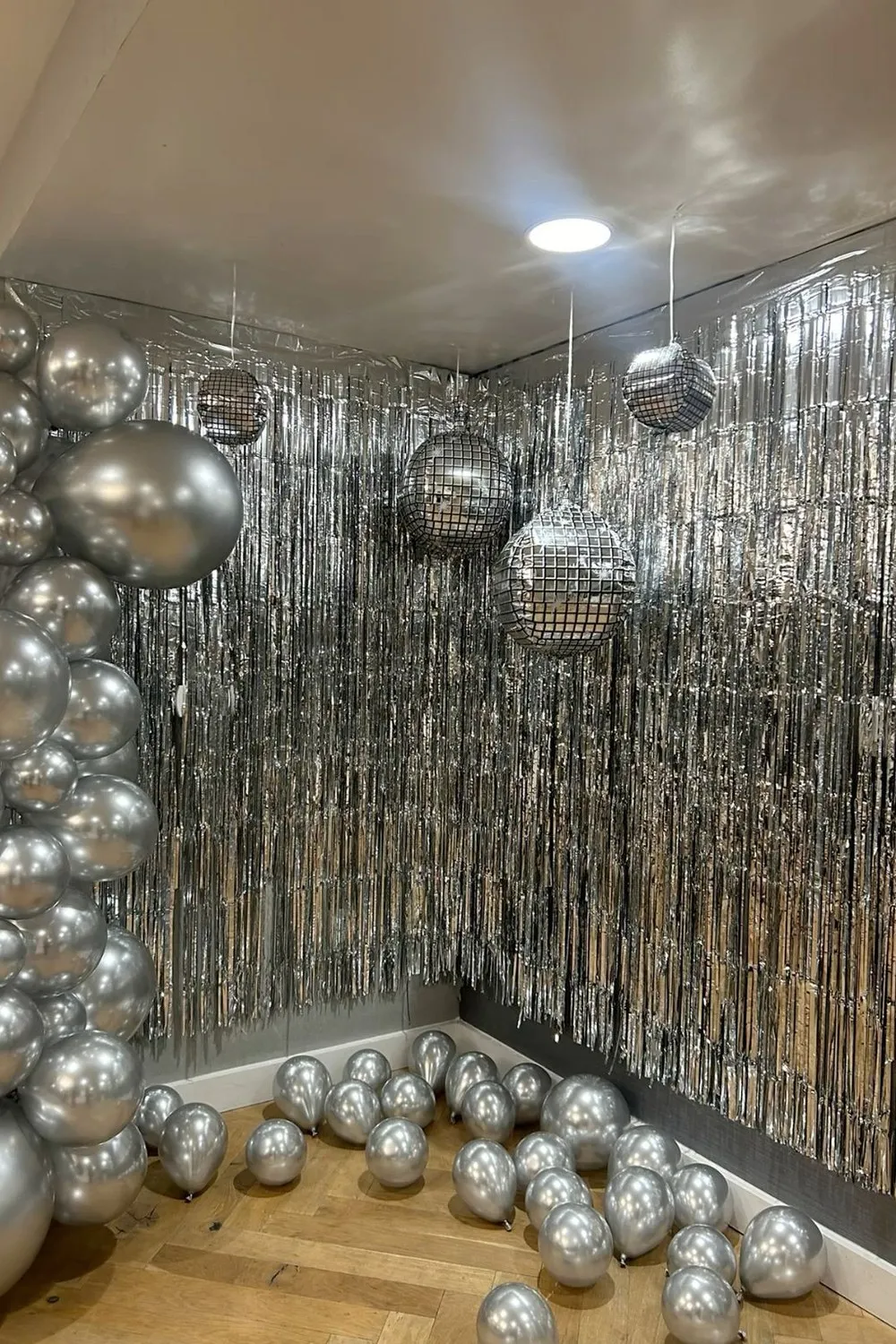
One mirror ball over the corner — moving light without a single wire in shot.
A disco ball hung above the photo corner throws moving flecks of light across the backdrop and the guests in front of it — the photographs sparkle without anyone holding a prop. One ball, 8–12 inches across, centred over the posing spot and lit by a lamp or the room's lights, is enough; it suits shimmer curtains and plain walls alike. Hang it from a proper hook — a falling mirror ball ends parties early.
Styling tip: angle one warm lamp toward the ball from the side; a disco ball in flat overhead light is just a silver sphere.
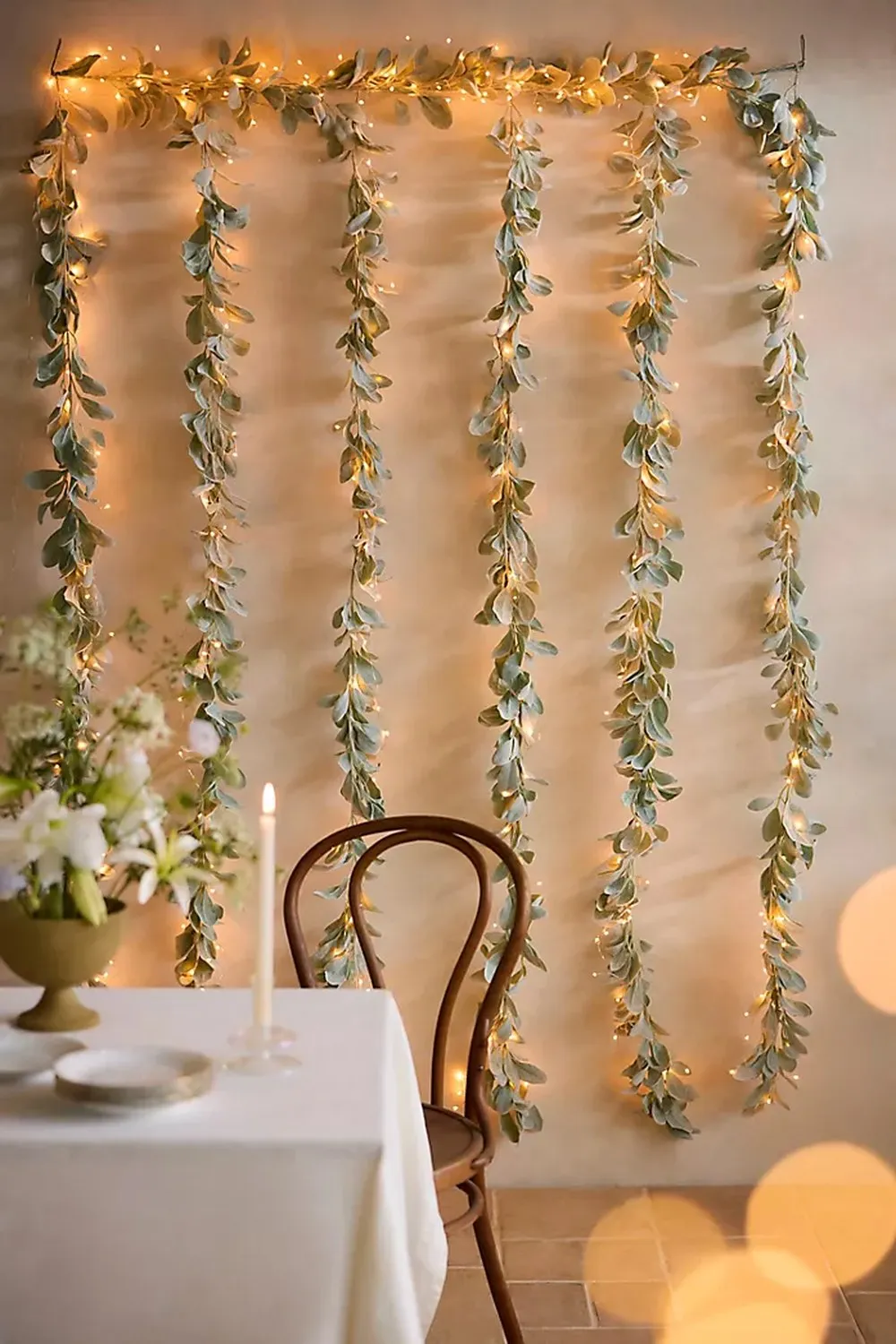
Lights in the leaves — the one green note in a gold and black list.
String lights woven through eucalyptus or evergreen garland on the wall soften the metallic palette with the only natural texture in this article — and it works: the green cools the gold, the lights warm the green, and photographs gain depth. It is the backdrop for the host whose party is more dinner than disco. Use battery lights so the garland hangs free of cables.
Styling tip: weave the lights behind the greenery, not in front — points of light emerging from leaves photograph as glow, not wiring.
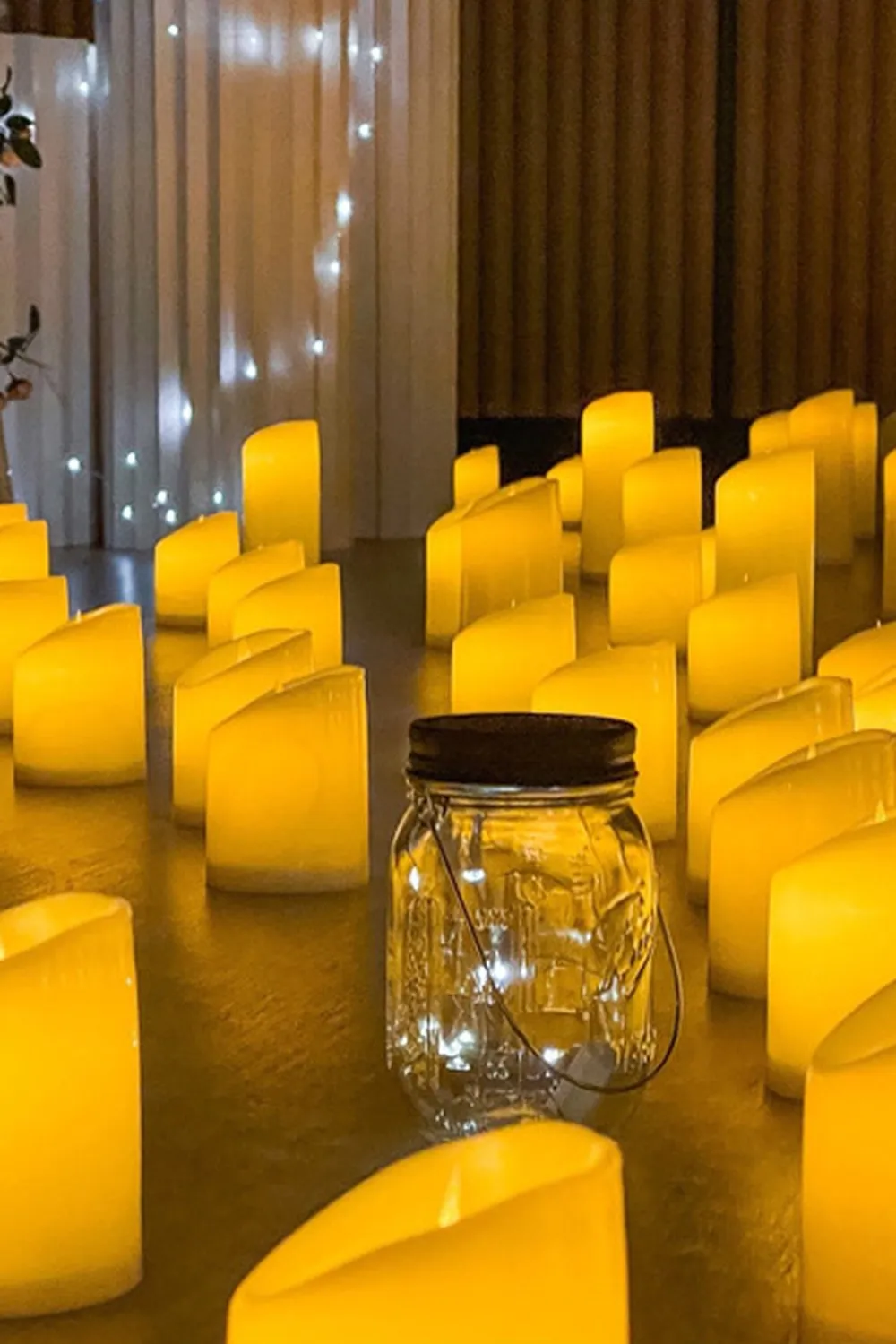
Light at ankle height — candles along the floor frame the full-length shot.
A line of flameless candles in glass holders along the floor at the backdrop's base frames full-length photographs and gives the corner a glow that rises instead of falling. The glass holders protect the flames-that-aren't from kicks, and the whole line can be switched on with one remote. Real candles do not belong on a party floor — flameless is not a compromise here, it is the only safe choice.
Styling tip: vary the holder heights in a gentle rhythm — tall, short, tall — so the line reads as styling, not as a row of jars.
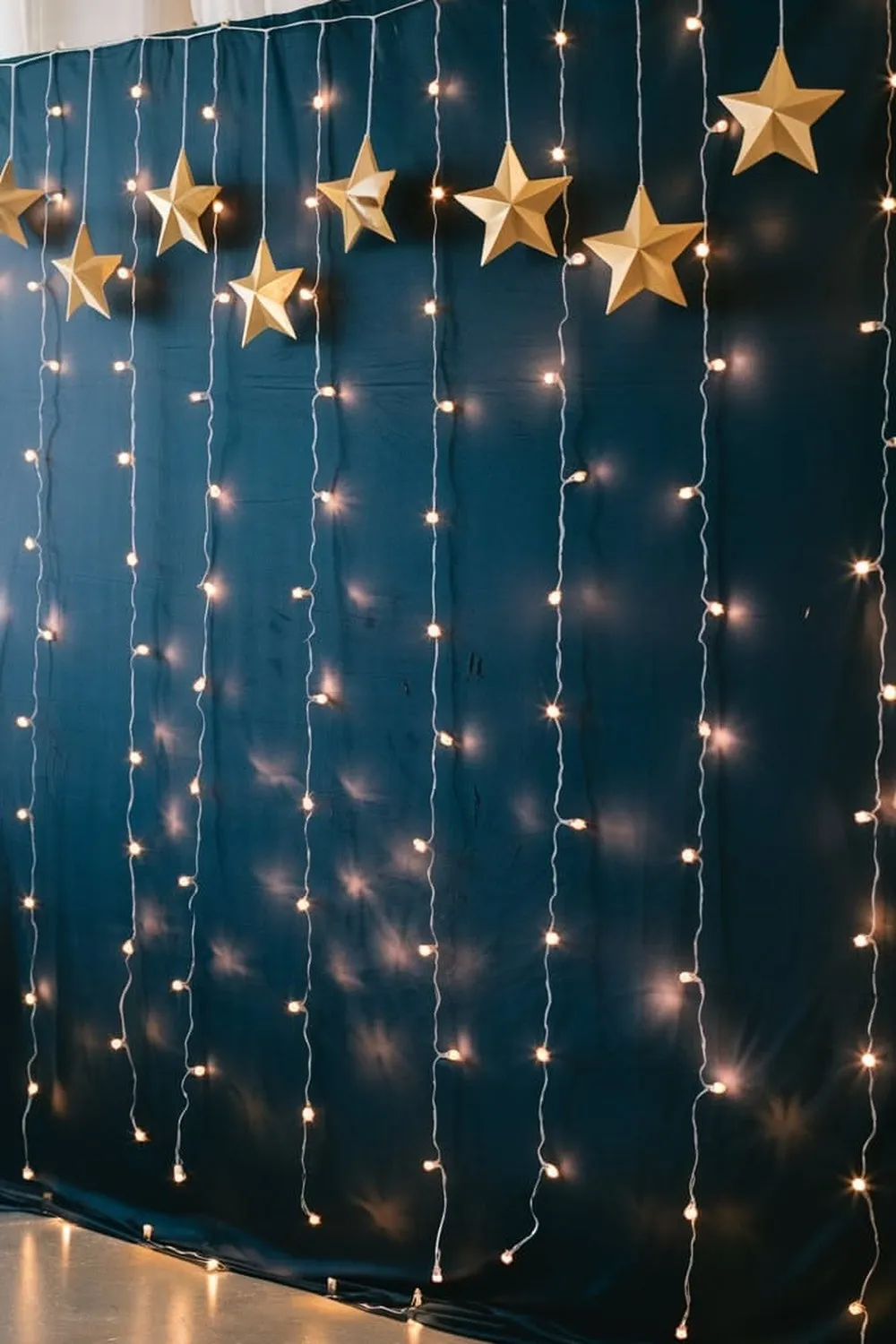
Stars on black — the night sky, indoors, at posing height.
Star-shaped lights scattered across a black backdrop make the simplest themed wall in this list: the sky at midnight, brought indoors. The stars do the decorating, the black does the hiding, and guests' faces light against the dark. Scatter unevenly, in loose clusters — a grid of stars looks like a product display, a drift of them looks like weather.
Styling tip: keep a few stars low, near shoulder height when seated, so seated group photos get the sky too.
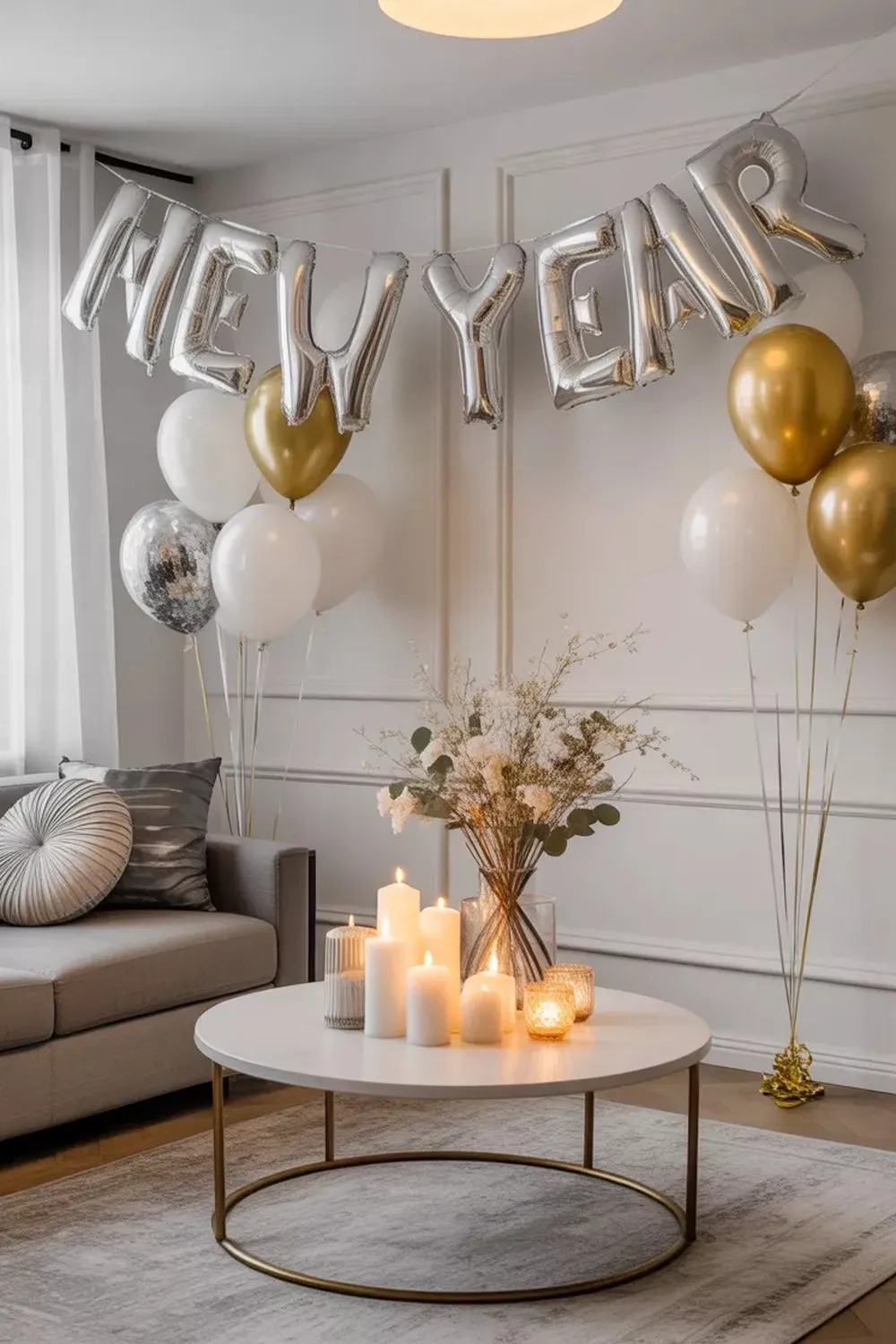
One curtain, one garland, one corner — the apartment-sized backdrop.
A small apartment gets its backdrop from one corner and three elements: a shimmer curtain on the corner's longest wall, a balloon garland along its top, and props in a vase at its edge. That is the whole recipe, and it photographs as richly as the big walls because the camera only ever sees the corner. Choose the corner furthest from the food — the backdrop should be a destination, not a thoroughfare.
Styling tip: move one piece of furniture out for the night rather than squeezing the backdrop around it; a clear corner photographs twice as large.
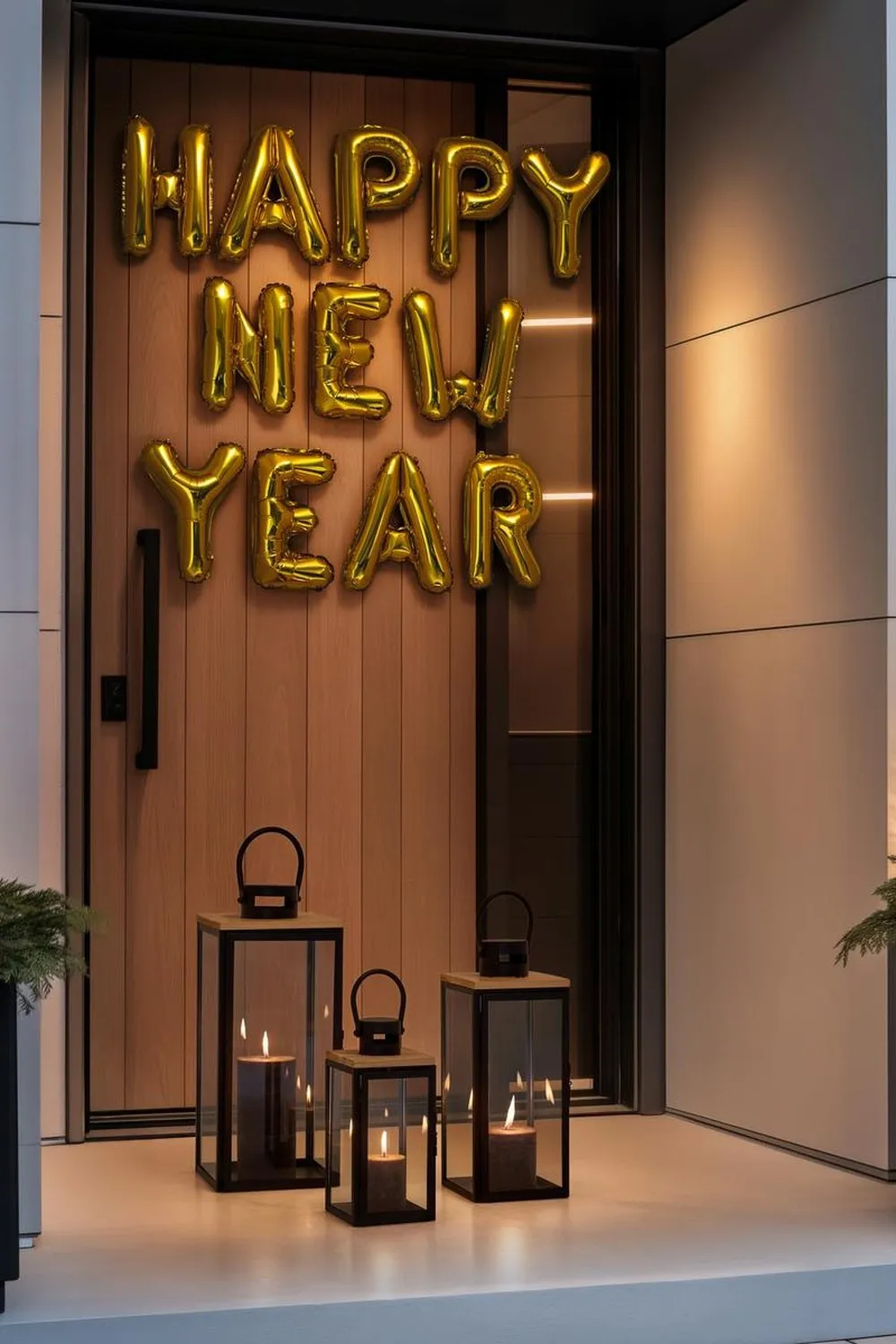
The porch as a photo booth — lanterns, balloons and real night behind.
A porch or balcony makes a backdrop with the one thing no wall can offer: real night sky behind the subjects. Hang a fringe curtain or balloon garland across the porch rail or door frame, line the steps with lanterns, and let the darkness do the rest. Balloons need weighting outdoors — one gust rearranges an arch — and battery lights replace anything mains-powered near dew.
Styling tip: photograph the porch corner at dusk before the party; if it reads well in the blue hour, it will glow at midnight.
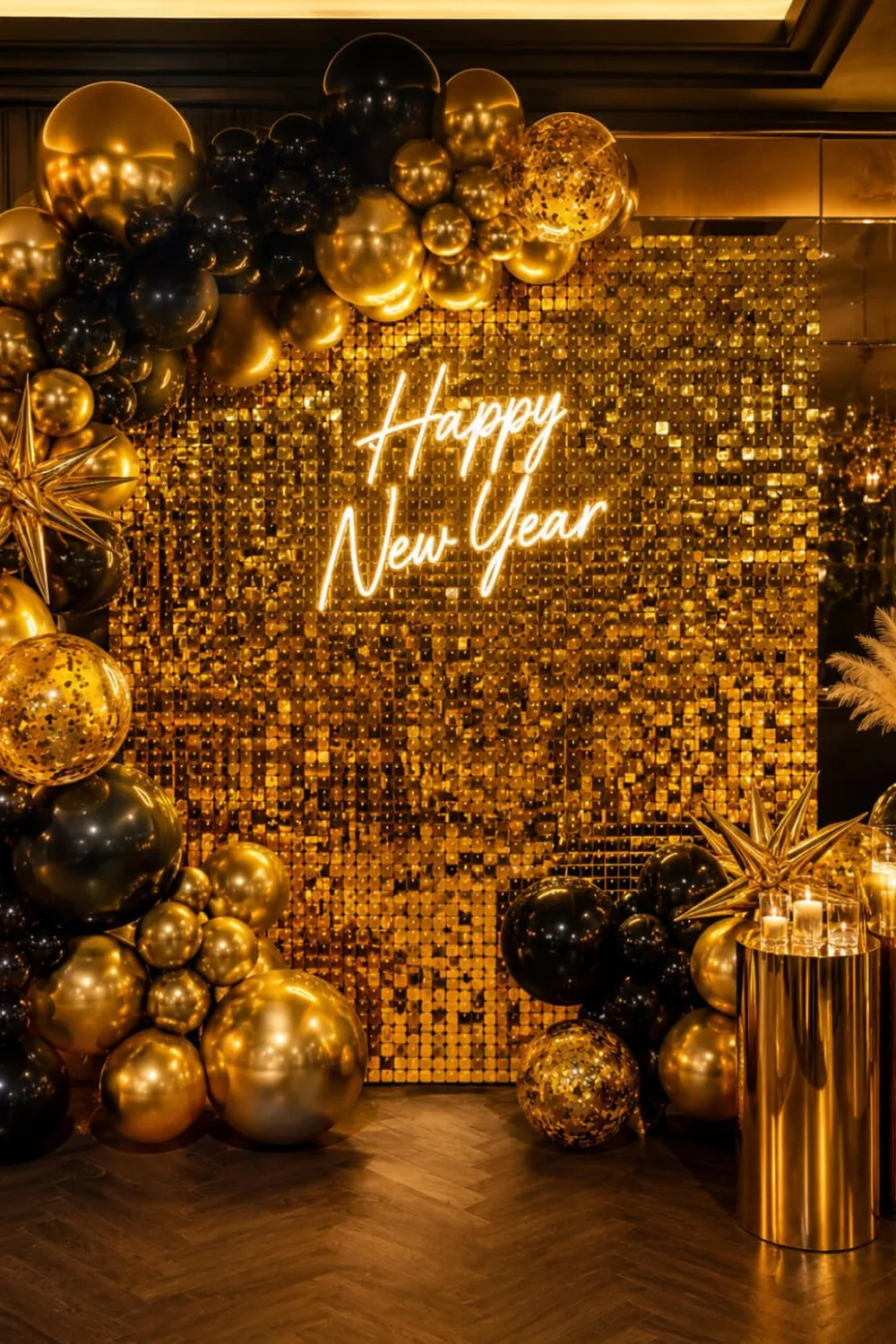
Sequin wall, black balloons, gold numbers — the full glam corner.
The glam corner stacks the list's richest elements in one place: a gold sequin curtain, black and gold balloons at its edges, foil numbers at its center and flameless candles at its base. It is the backdrop as a jewel box, and it suits the party where people dress up. Build it in layers and stop one layer early — glam tips into clutter with a single element too many.
Styling tip: keep one element matte (the black balloons, ideally) so the shine has something to contrast against; all-gloss photographs as glare.
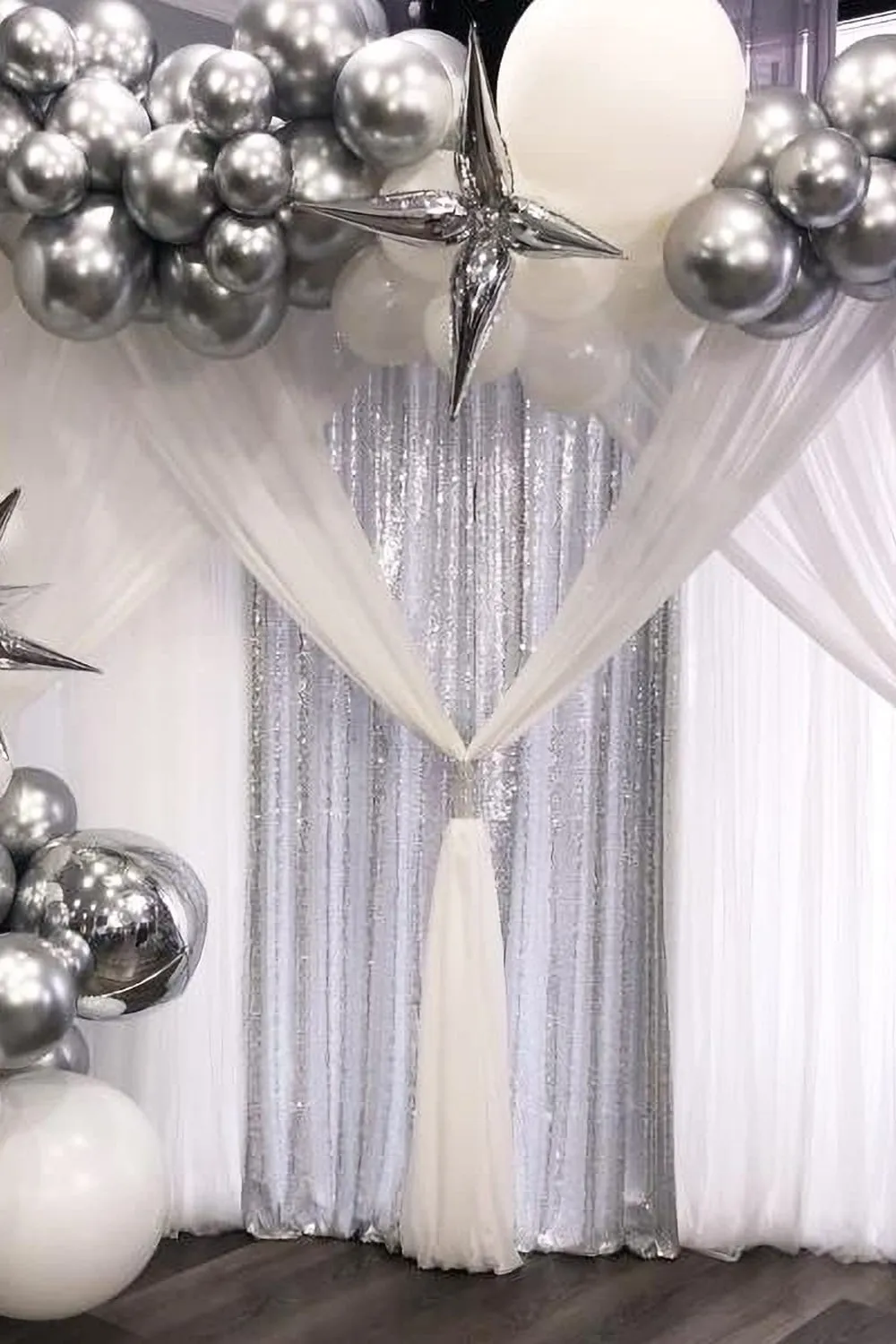
The winter-white corner — silver fringe, white balloons, cool light.
White and silver is the palette for the host who finds gold loud: a silver fringe curtain, white and clear confetti balloons, and cool sparkle that reads as frost rather than treasure. Photographs come out bright and clean, and the corner suits a January-white room scheme. Warm it only with skin and candlelight — the coolness is the elegance.
Styling tip: add one strand of warm fairy lights at the base; a completely cool backdrop can make faces look pale in phone photos.
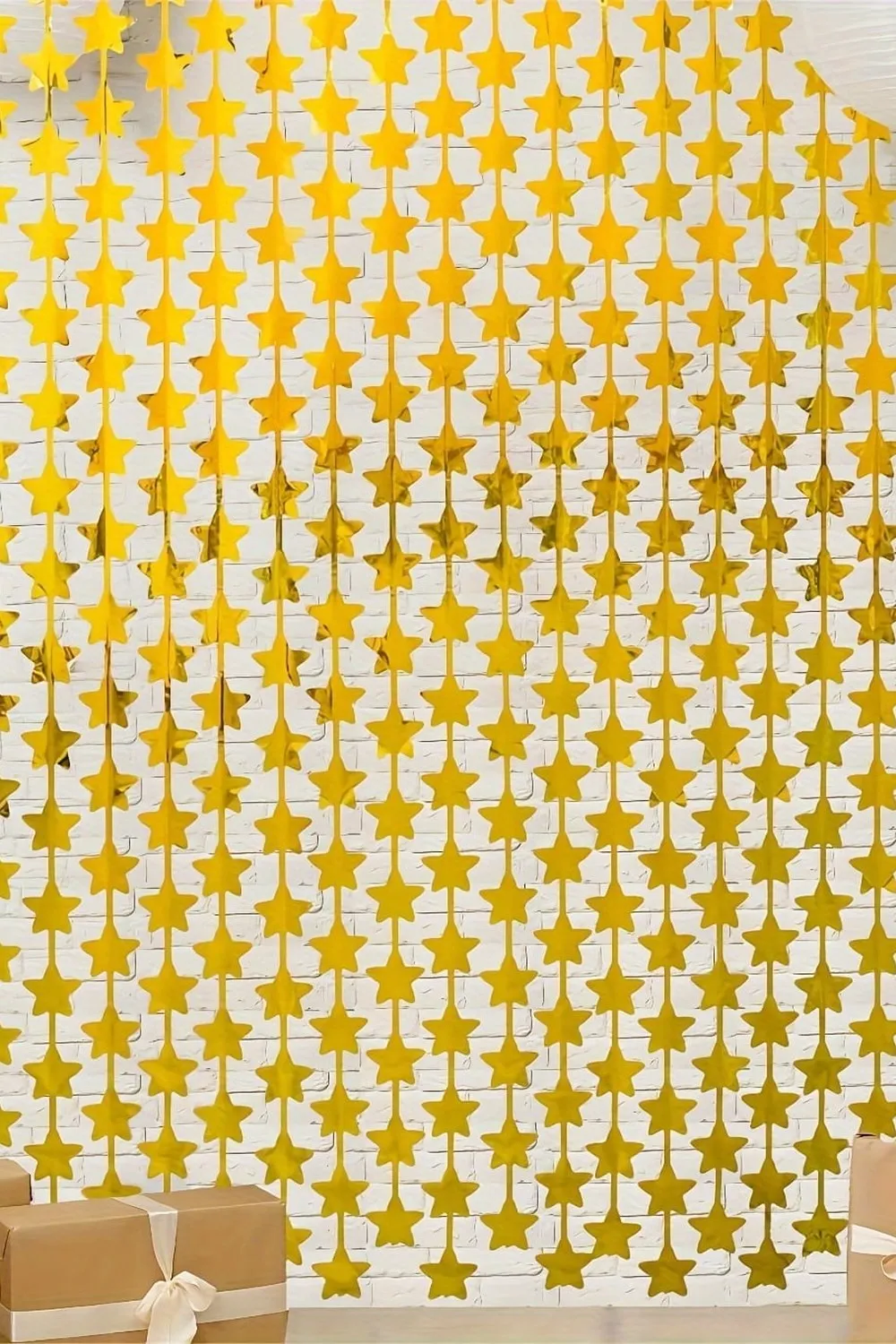
Stars low, balloons soft — a corner built at child height.
The children's corner is the adult backdrop rebuilt at half height: star garlands hung low, balloons in clusters on the floor rather than arches overhead, and props sized for small hands in a basket instead of a vase. Set up empty, it photographs as a small stage; in use, it keeps the youngest guests posing happily in one safe, soft place — no glass, no candles, nothing to pull down.
Styling tip: put a small rug inside the corner — it marks the posing spot for children far better than instructions do.
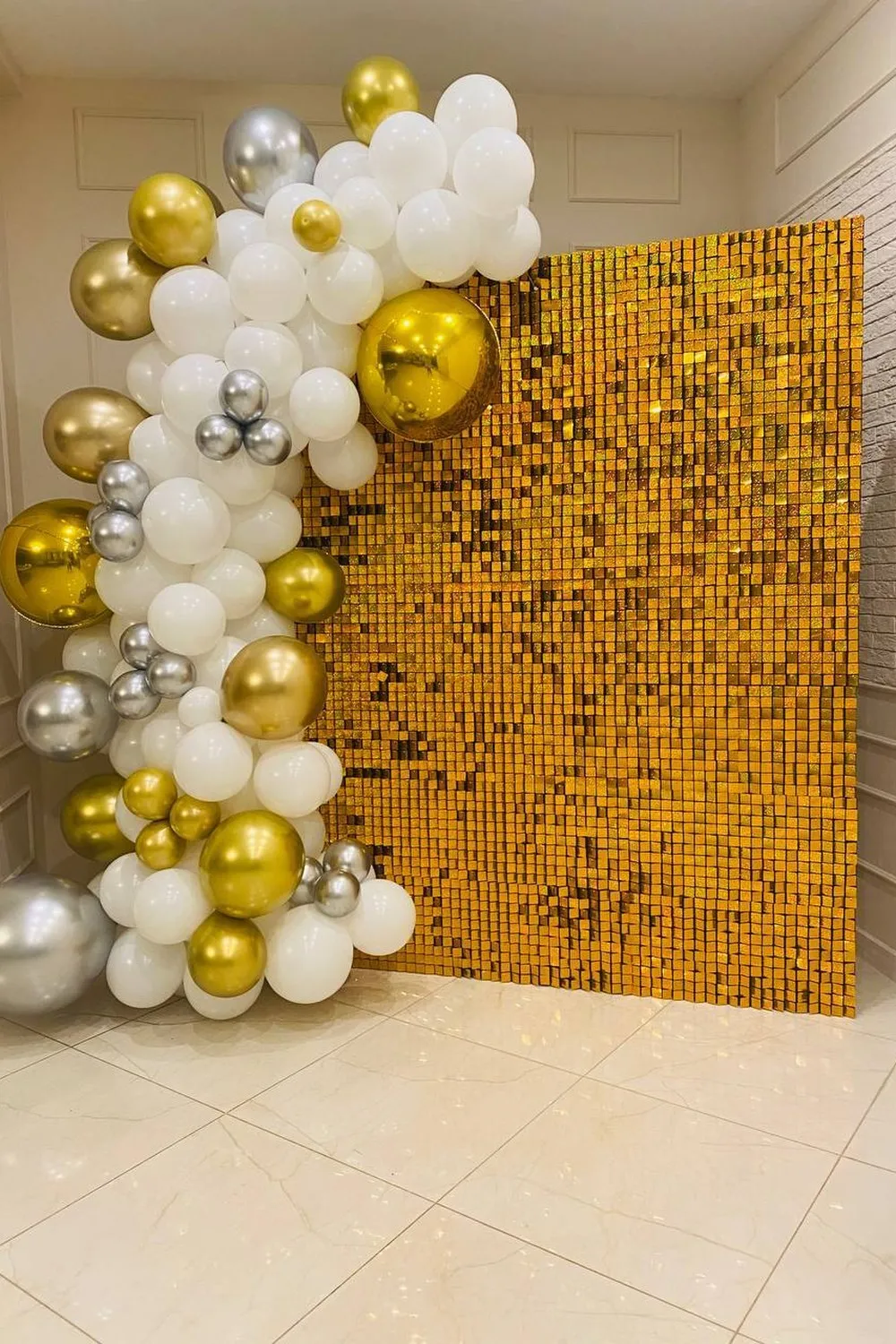
Everything in one frame — the corner dressed, lit and waiting.
The last idea is the whole article in one corner: a balloon arch in gold and white framing the wall, star balloons catching the light, a small stand dressed and ready beside the posing spot. Set up and photographed empty at the start of the evening, it is both the party's promise and its proof — the picture of the corner before anyone steps in is the one that shows the work, and the hundred pictures after it show the party. Build your corner early, take this photograph, then let the night happen.
Styling tip: take the empty-corner photograph in the evening light it will actually be used in — midday tests lie about glow.
One clear hero wall, warm light, and the year in foil numbers or a clock; the rest is framing. If everything shouts, nothing photographs.
One curtain wall in a corner, a balloon garland along the top, props in a vase beside it — the camera only sees the corner, so the corner is all you decorate.
Keep them mini or in an arch, in gold, black and white only, with one metallic hero element. Color is what makes balloons read young; the palette makes them read glamorous.
The wall itself plus about two steps of clear floor in front of it, so a small group can stand, turn and pose without touching the backdrop.
Warm light in or behind the backdrop — fairy lights, a neon sign, flameless candles — and the room's main light dimmed a little. Avoid a camera flash against sequins or foil; it bounces straight back.
A New Year party forgets its playlist and remembers its photographs. One wall, built with an hour's care — a curtain, a clock, a garland of balloons, warm light — becomes the place the whole night gathers, and every picture taken there looks like the party felt. Save your favorite new year photo backdrop ideas from this list, and follow TheStylingHub on Pinterest for fresh New Year ideas all season long.
Seasonal
Nov 22, 2026
30 New year wreath ideas — glam gold, silver and black wreaths for the…
Seasonal
Nov 21, 2026
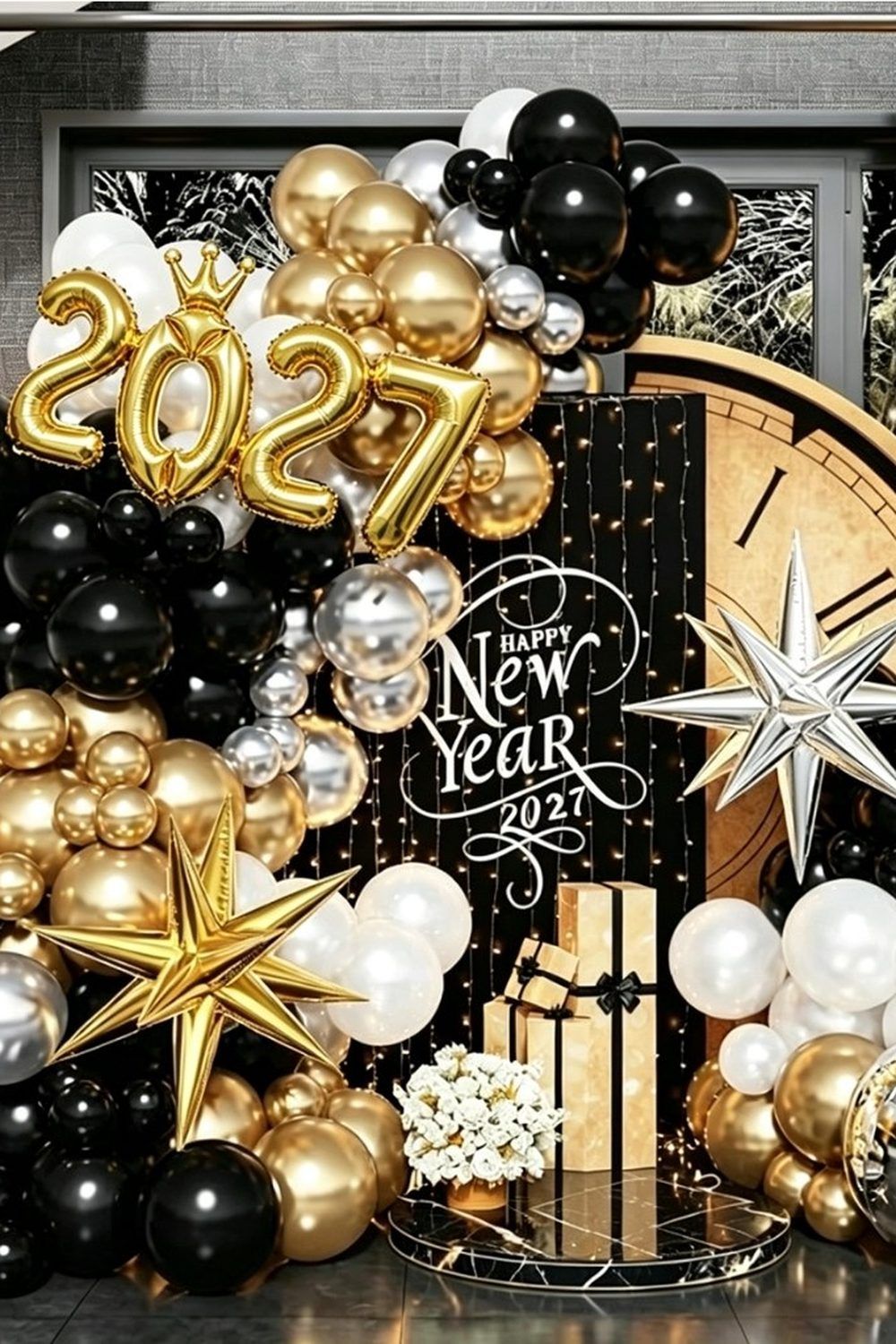
32 New year balloon decor ideas — arches, garlands, giant number balloons and a…
Seasonal
Nov 19, 2026
32 January decor ideas for 2027 — a calm, light reset after Christmas: cleared…