
35 Christmas Village Display Ideas That Glow After Dark
A Christmas village changes personality twice a day — a charming little town in daylight, a glowing place with every window amber after dark — and these 35 christmas village display ideas, covering where to put it, how to light it and how to lay its snow and streets, are built for that glow, because the glow is the whole point.
Where to Build It: Mantels, Consoles & Shelves
1. The Mantel Village: A Whole Town Above the Fire
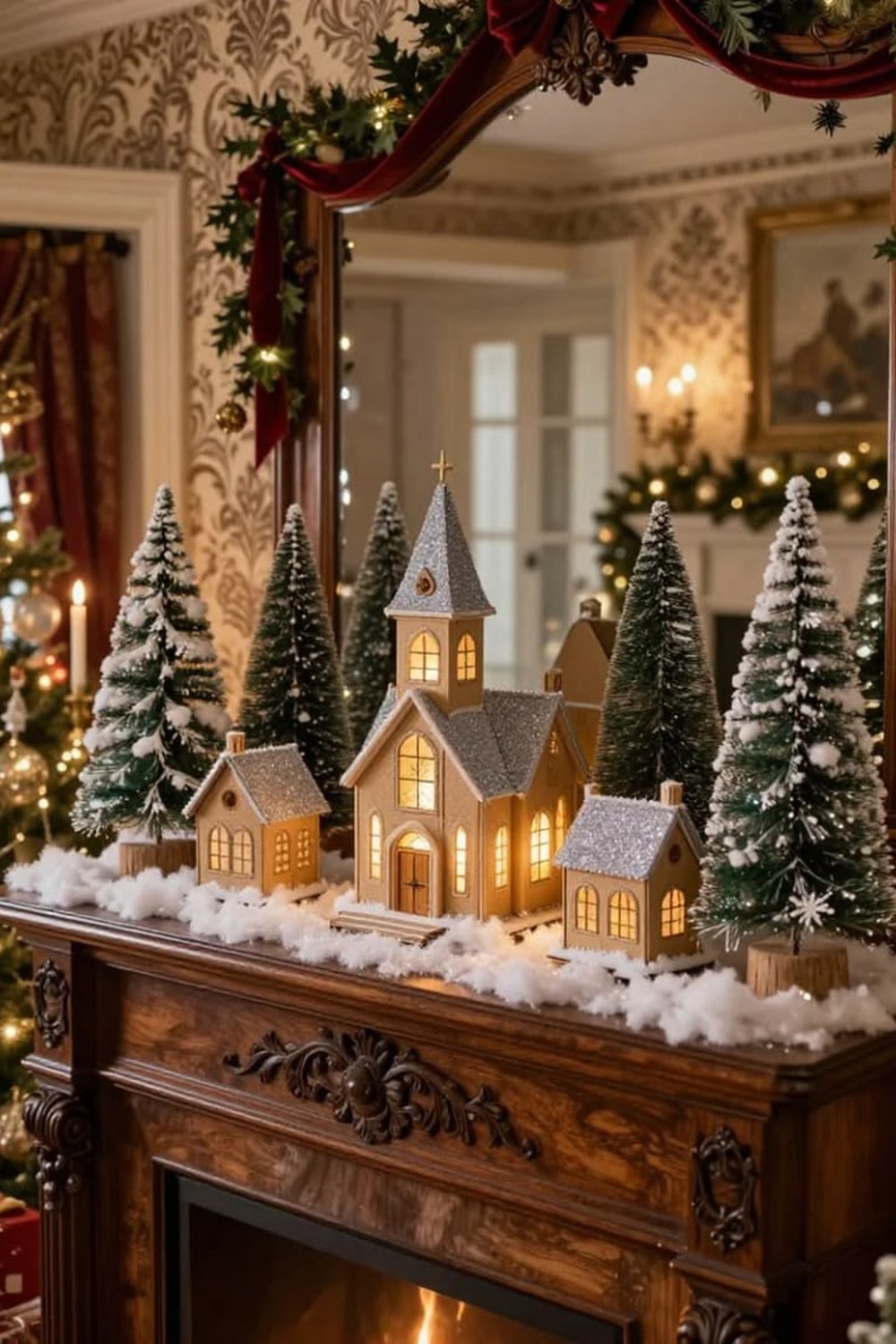
The classic address — a row of lit cottages where the stockings would usually rule.
The mantel is the natural capital city of a Christmas village: eye level, close to candlelight, and seen from every seat in the room. Lay a blanket of white batting along the shelf, stand the church or tallest house at the centre, and let smaller cottages step down toward each end among bottle brush trees and a slim garland run behind. By day it dresses the fireplace; after dark the windows and the firelight argue gently over which glows warmer.
Styling tip: leave the front two inches of the mantel completely clear. A village that crowds the edge looks precarious; a small margin of bare shelf makes the whole town look settled and safe.
2. The Console Table High Street: A Town You Walk Past
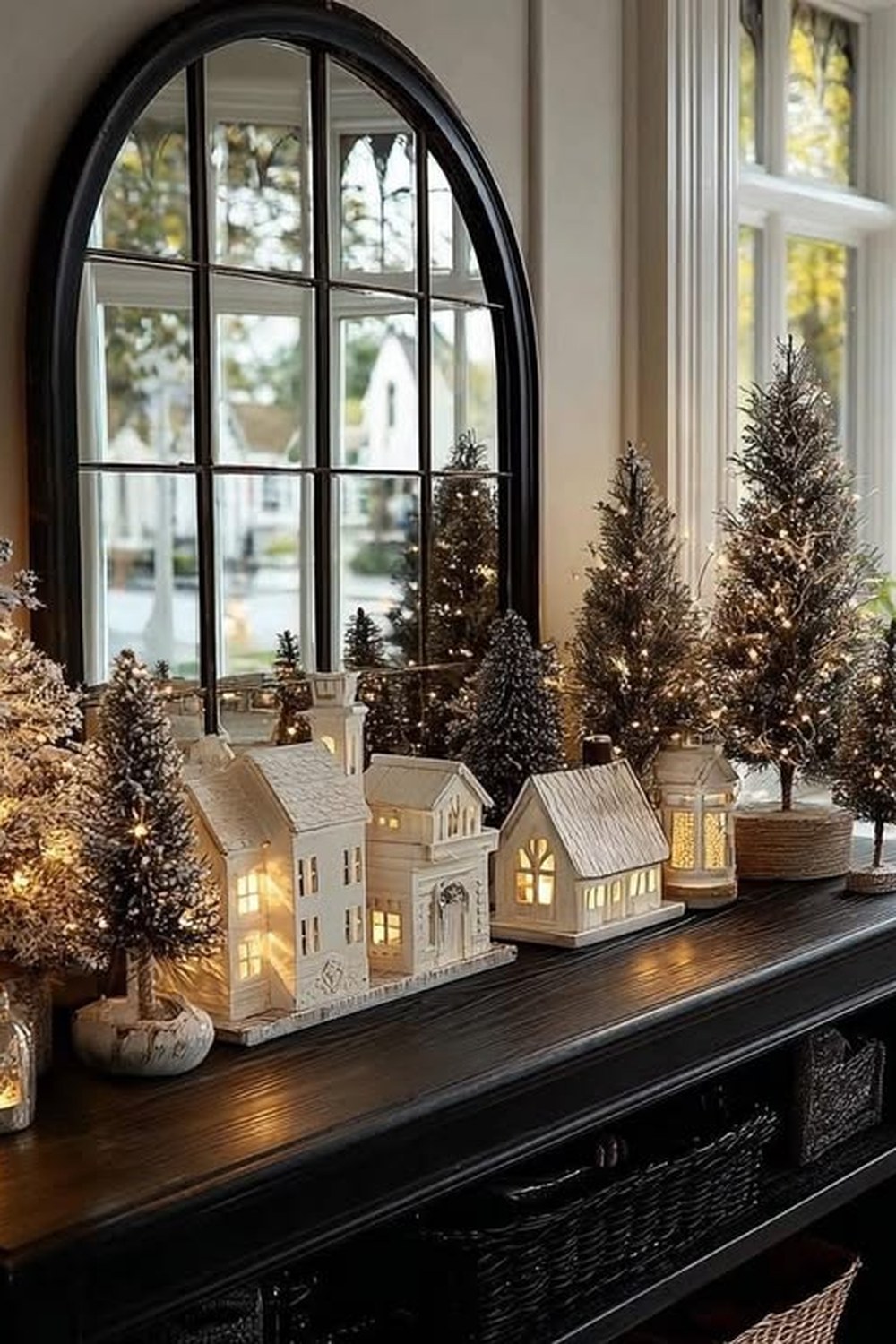
A hallway console makes a high street — shops and houses in a row, passed a dozen times a day.
A long, narrow console or hall table suits a village arranged as a street: buildings shoulder to shoulder along the back edge, a lane of "snow" in front of them, and mini lamp posts marking the kerb. Because a hallway is a place of passing rather than sitting, a linear display works beautifully here — the town unfolds as you walk its length, and its lit windows greet everyone at the door.
Styling tip: raise the back row of buildings on a hidden strip of wood or a row of books under the snow. Two storeys of rooftops read as a real street; one flat row reads as a shelf of ornaments.
3. The Tiered Village: Cake Stands and Risers for Hills
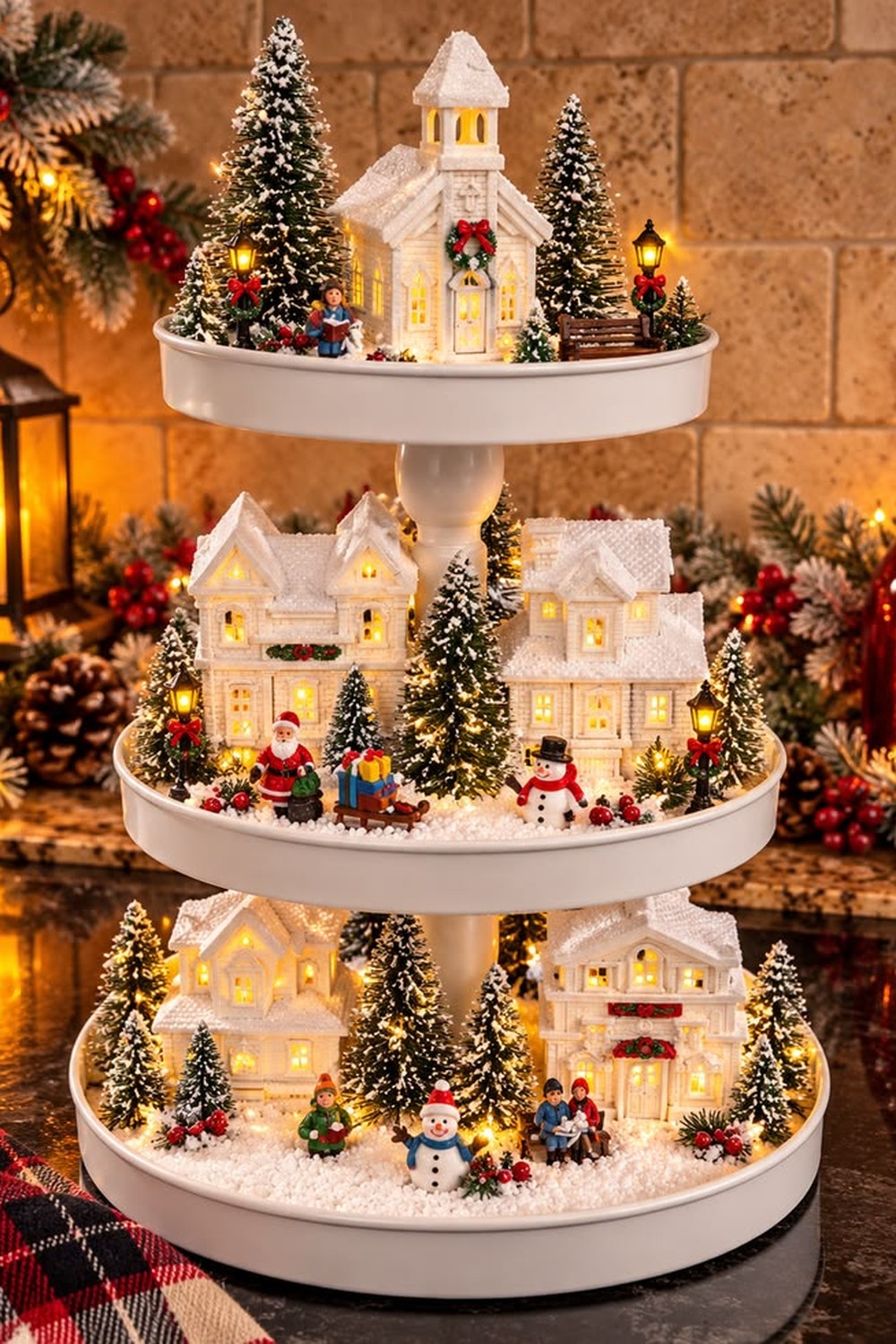
Flat villages look like stockrooms — give yours hills and the houses become a hillside town.
Tiering is the single biggest upgrade a village can get. Use cake stands, wooden crates, upturned bowls and sturdy books beneath the snow blanket to build three or four levels on a sideboard or table, with the church on the highest tier and cottages cascading down. The different heights create streets, corners and sightlines, and the higher windows catch the eye first — exactly as a real town on a hill does.
Styling tip: build the tiers first and drape the snow over them in one piece, smoothing it into the valleys. Snow added in patches afterwards shows every join; one continuous fall looks like weather.
4. The Windowsill Row: Silhouettes Against the Dusk
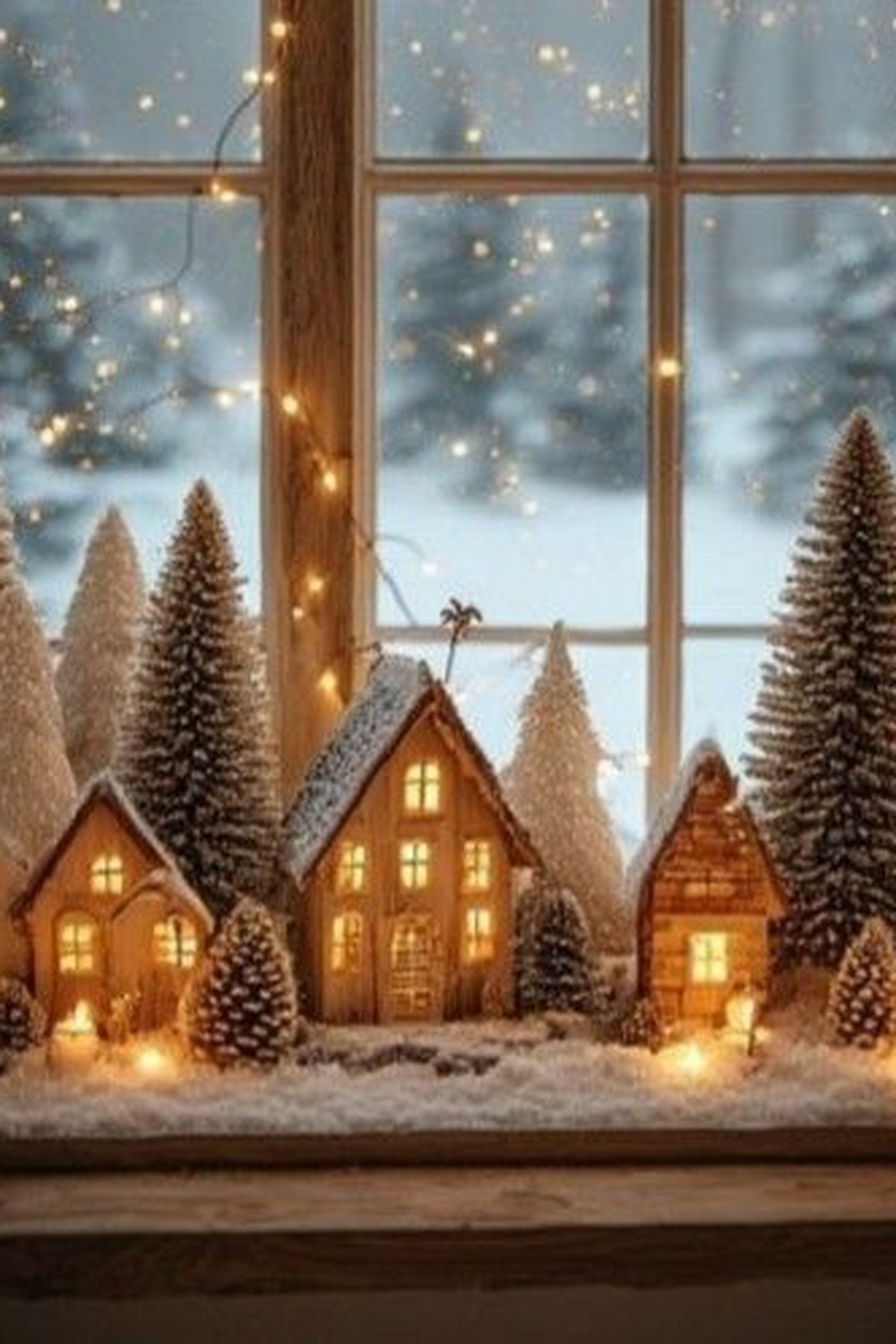
One row of houses on a deep sill — plain shapes by day, a lit street at dusk.
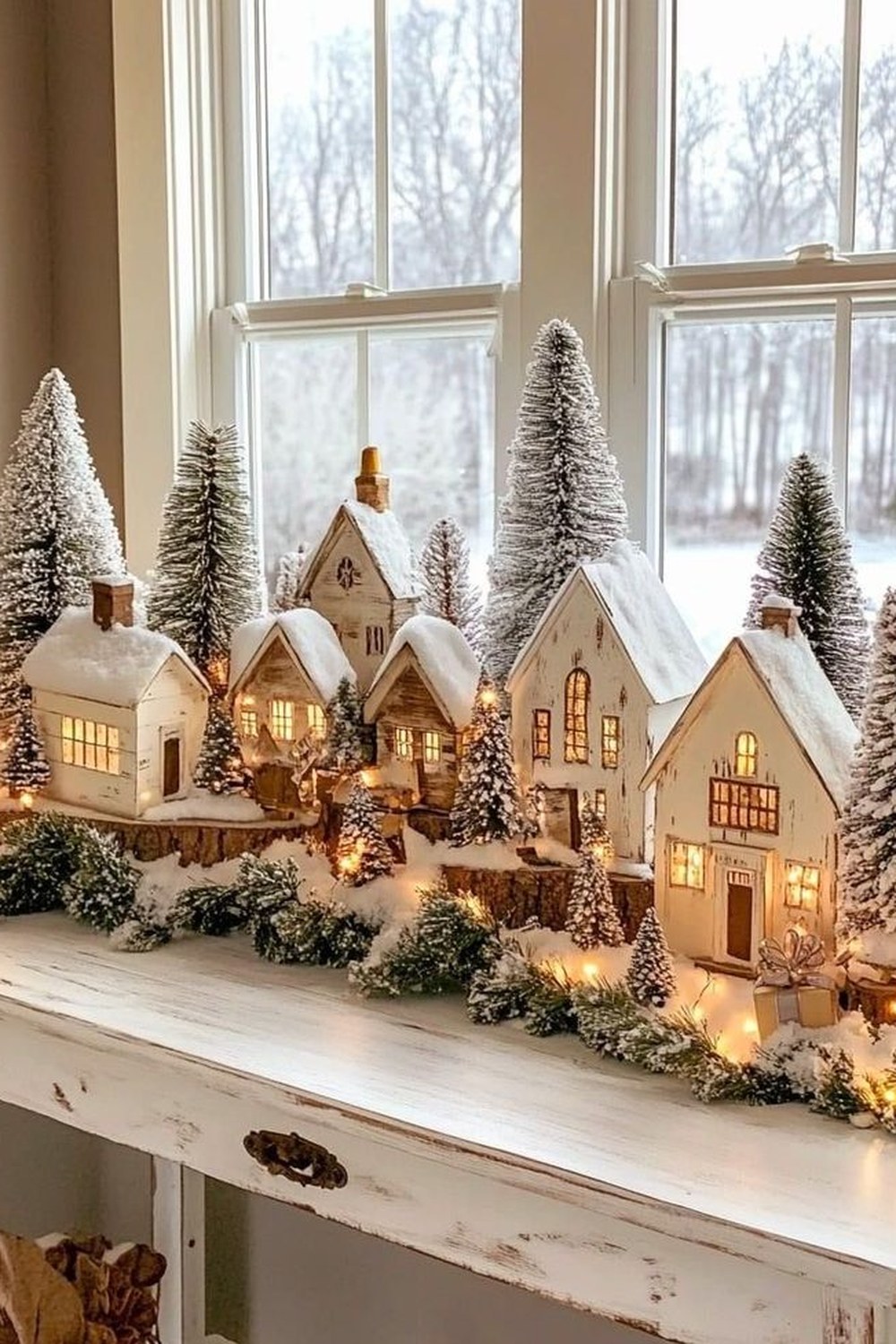
A deep windowsill holds a quieter kind of village: a single line of houses and trees with no scenery at all. From inside, the display borrows the real sky as its backdrop, so the scene changes with the weather and darkens into silhouette at exactly the moment the little windows switch on. From the street, it is the friendliest lit window in the neighbourhood.
Styling tip: choose houses with windows on the street side only, and face them all inward. The glow is for the room; the pavement sees the rooftops and chimneys, which looks tidier through glass.
5. The Dresser Village: A Town Among the Everyday Dishes
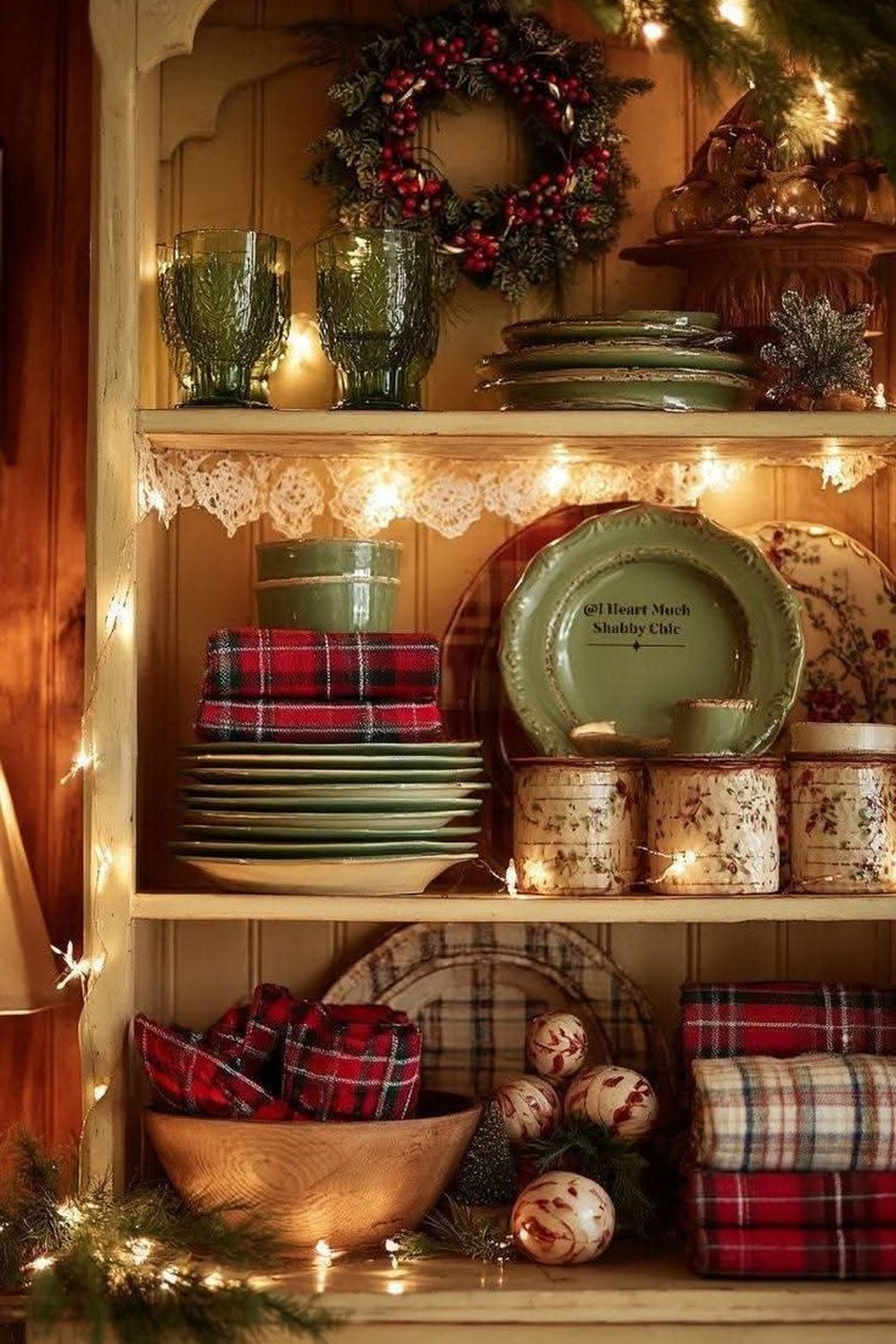
The kitchen dresser is display furniture already — the village simply moves in for December.
Where a kitchen or dining room has a dresser or hutch, clear one shelf and let the village live among the everyday plates and jugs on the others. A small cluster of houses at eye level, a drift of snow against the crockery, bottle brush trees standing in cups: the mix of the useful and the miniature is what makes it charming rather than staged, and the kitchen — the warmest room in December — gets a display of its own.
Styling tip: keep the village shelf at or above eye level if the kitchen is busy. Steam, splashes and small reaching hands are all kinder to houses they have to look up at.
6. The Mirror-Backed Village: Double the Windows, Double the Glow
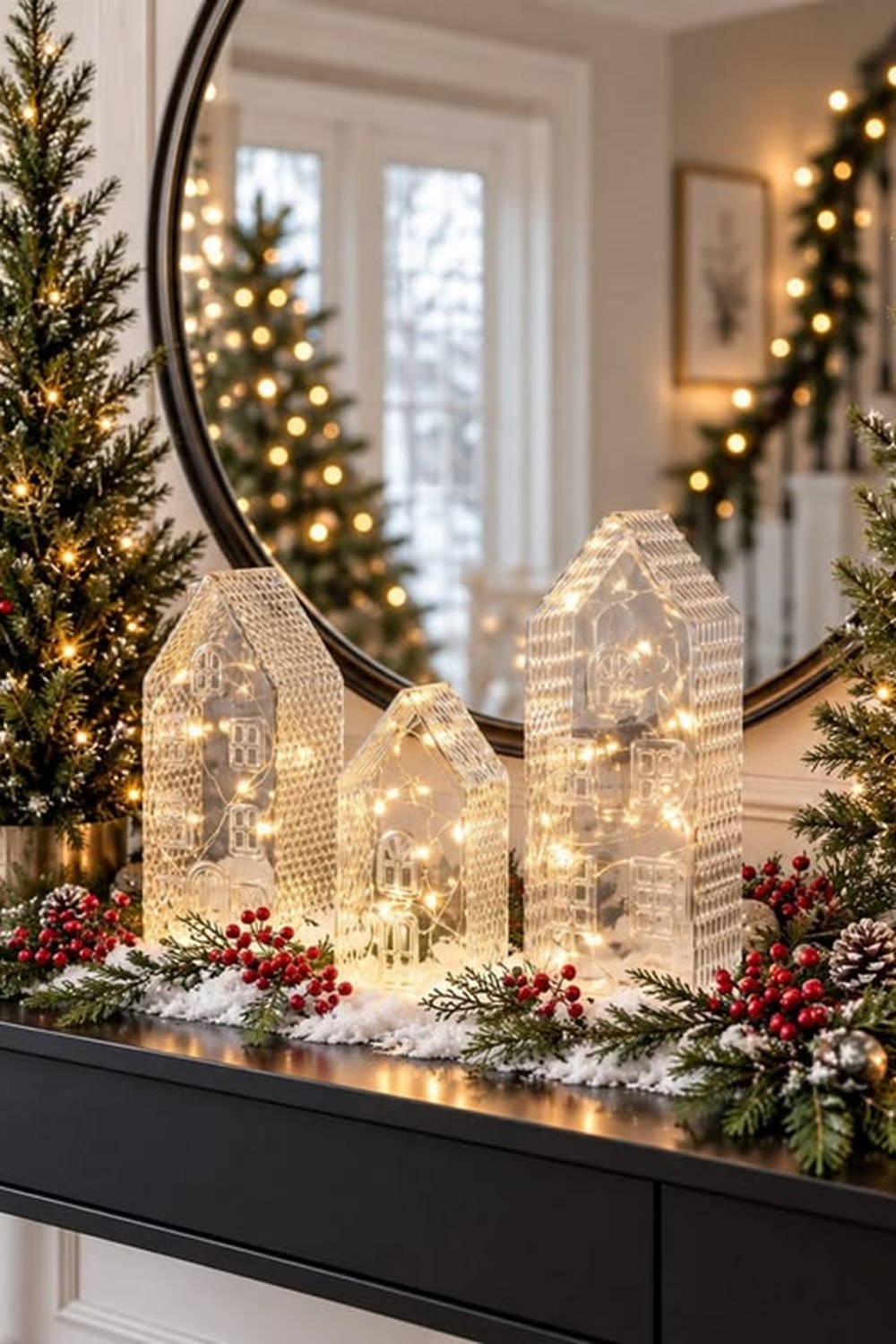
Stand the town in front of a mirror and you get two villages for the price of one.
A mantel mirror, a leaning mirror on a sideboard, or even a large framed picture with glass will double everything behind the village: every lit window appears twice, the snow doubles in depth, and a modest collection suddenly looks like a substantial town. The reflection also catches candlelight from the room and throws it back into the scene, which is why mirror-backed displays look professionally lit with no extra effort.
Styling tip: angle houses very slightly rather than square to the mirror. Perfectly straight rows make the reflection obvious; a gentle, higgledy arrangement lets the eye accept the doubled town as simply a bigger one.
7. The Firebox Village: A Hamlet Inside an Unused Fireplace
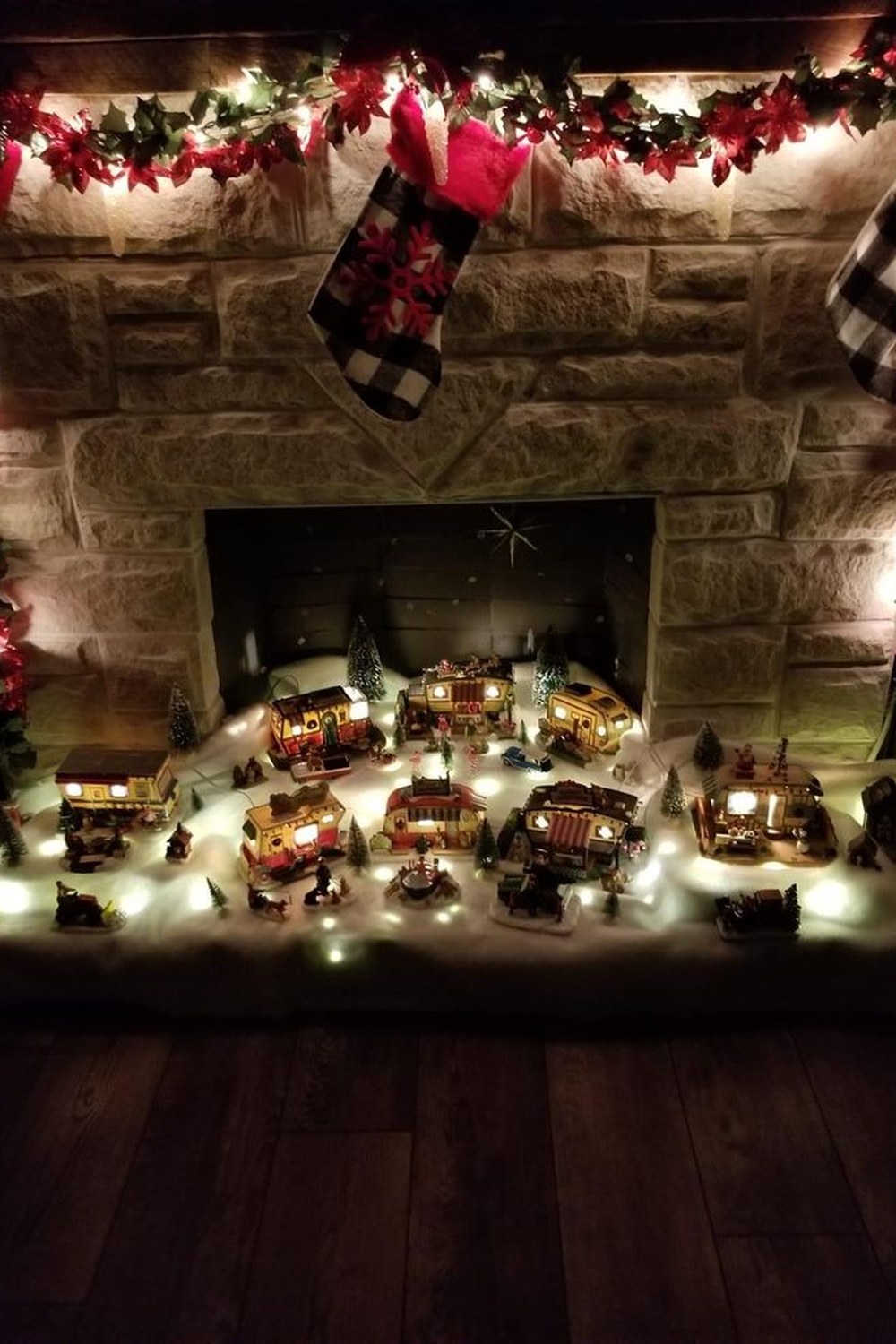
An empty grate is a ready-made stage — floor-level, framed, and already the room's focal point.
If your fireplace is decorative or simply unused in December, sweep the firebox clean, line it with snow batting and build a small hamlet inside it: three or four houses, a cluster of trees, a strand of warm fairy lights wound behind. The brick or cast-iron frame works like a proscenium arch, and a village at hearth level delights children and floor-sitting guests in a way no mantel display can.
Styling tip: only build here in a fireplace that will not be lit all season, and use battery lights throughout. One forgotten fire would end the village and possibly more; make it a cold-hearth display or none at all.
Lighting & Glow: Windows, Lamps & Warm Light
8. Warm Windows First: Light the Houses Before Anything Else
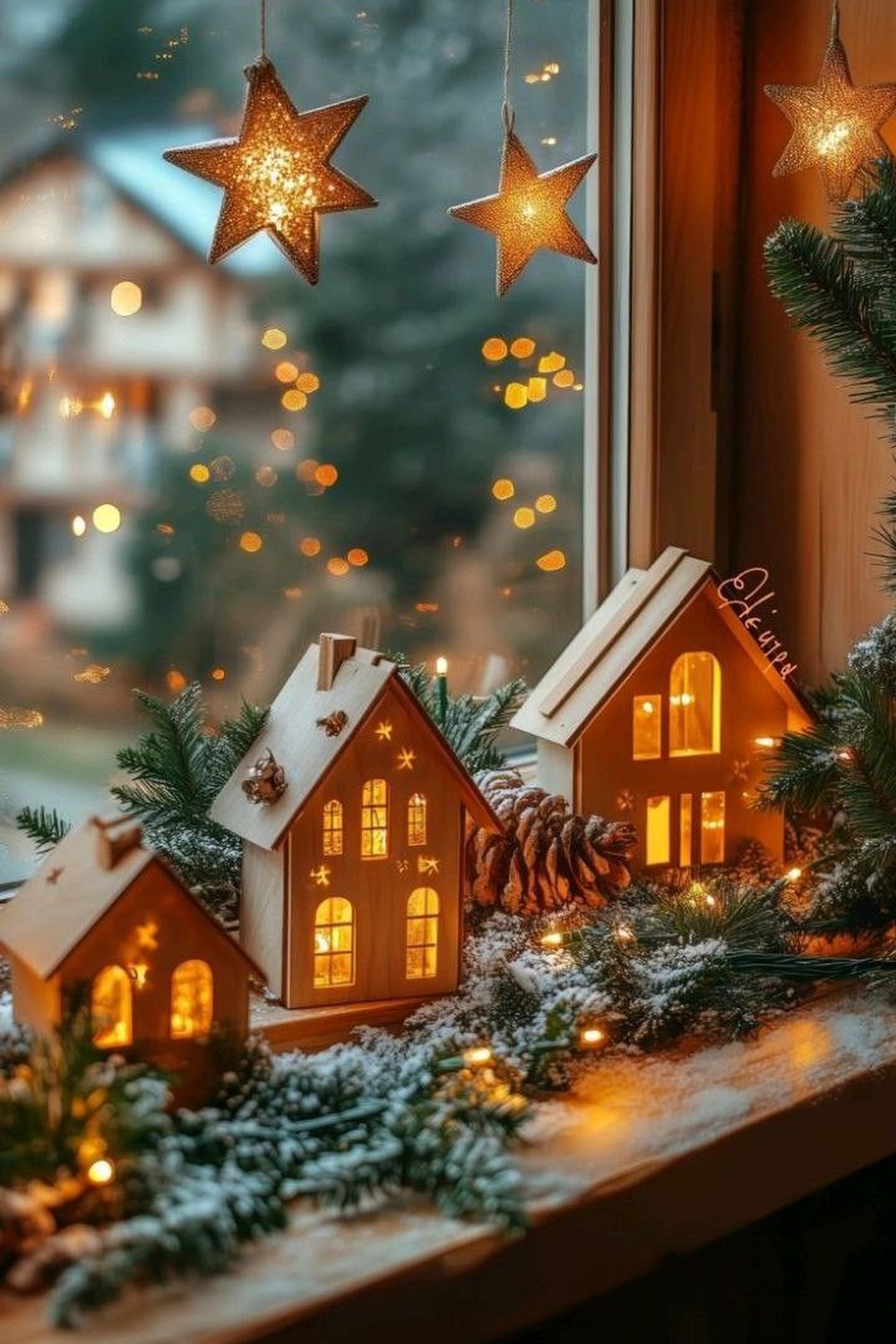
Switch the houses on and the room off — the windows are the display, everything else is scenery.
The moment that sells a village is windows glowing in a dim room, so light the buildings before you spend a thought on any other effect. Houses with built-in warm bulbs do this best; where a building is unlit, a battery tealight slipped inside or a puck light behind it gives the same amber window-glow. Arrange and rearrange with the house lights off and only the village lit — it is the view you are actually designing for.
Styling tip: check the colour of every bulb against the others. One cool-white house among warm ones looks like a dental clinic in a Dickens novel; matching warm tones make the whole town feel lived in by the same evening.
9. Mini Street Lamps: Lanterns Along the Village Streets
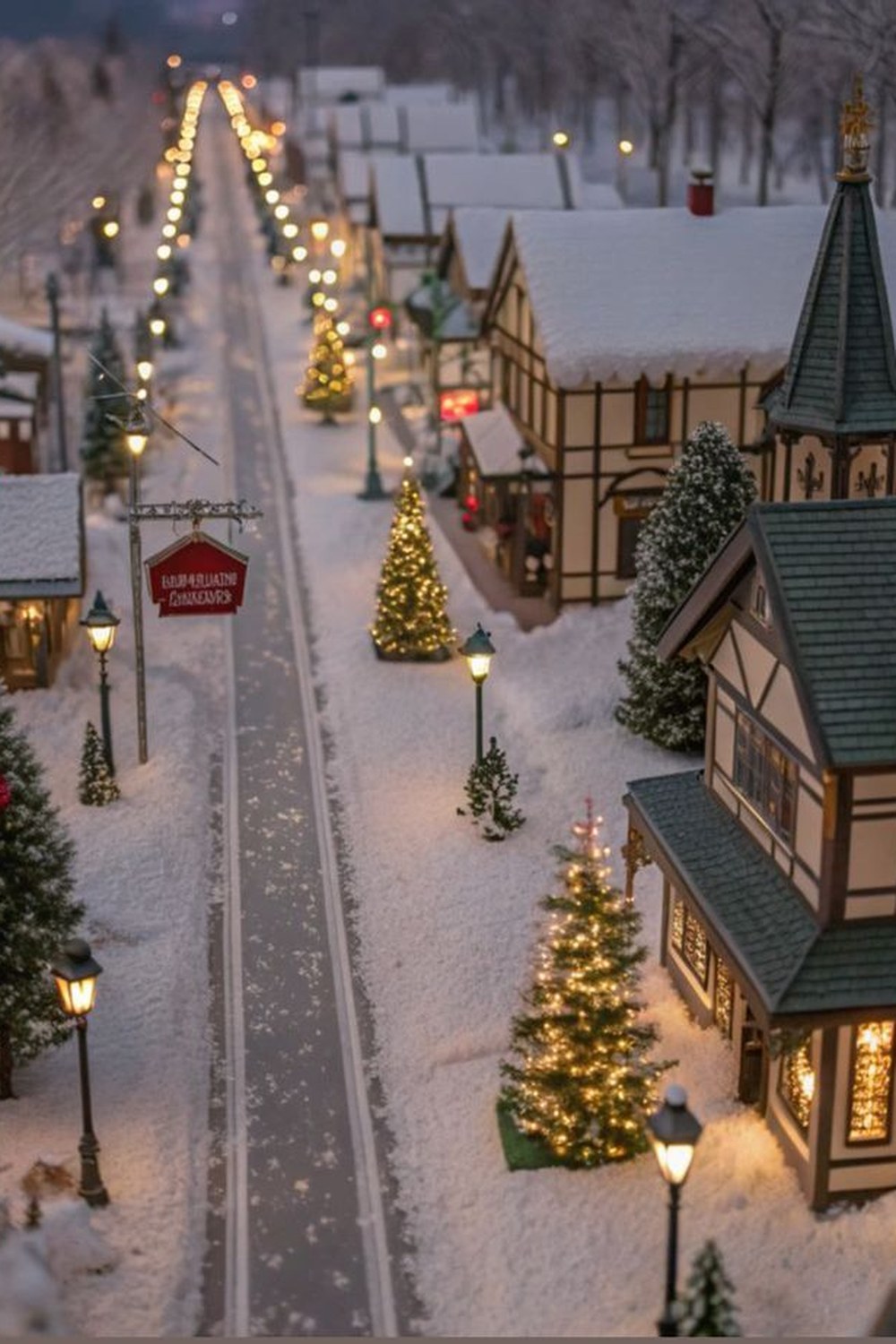
Tiny lamp posts do the storytelling — they say streets, evenings and people on their way home.
Miniature street lamps are small, cheap and disproportionately effective. Stand them along the front edge of the display, at street corners and beside the church door, and they instantly turn a row of houses into a town at nightfall. Their small points of light sit lower than the windows, giving the scene two layers of glow to read — rooftops and windows above, lamps and paths below.
Styling tip: space lamps unevenly, closer together on the "high street" and sparse at the edges. Real towns concentrate light where people gather; even spacing looks like a car park.
10. The Halo Strand: Fairy Lights Hidden Behind the Back Row
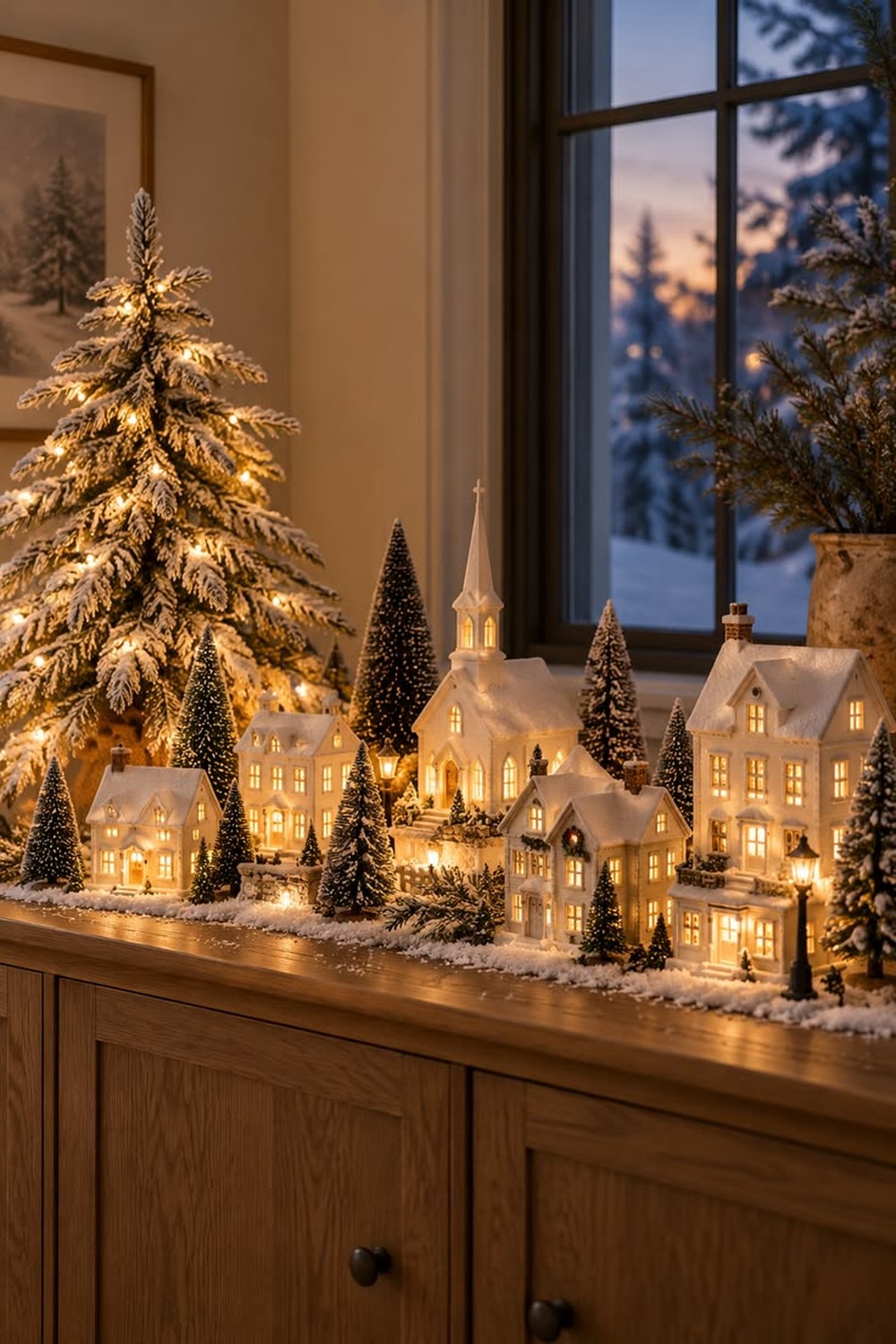
A strand of warm fairy lights behind the houses gives the whole town a halo against the wall.
Wind a strand of warm white fairy lights along the wall or mantel back, hidden behind the tallest row of buildings. The light spills up and around the rooftops, silhouetting chimneys and gables, and lifts the entire display off its background so the village reads clearly from across a dark room. It is the oldest trick in village styling and the one visitors assume took hours.
Styling tip: raise the strand on small hooks or a row of stocking holders rather than laying it flat. Light aimed slightly upward throws a bigger, softer halo; light lying on the shelf just makes a bright puddle nobody sees.
11. The Candlelit Backdrop: Real Flames Behind Glass, Behind the Town
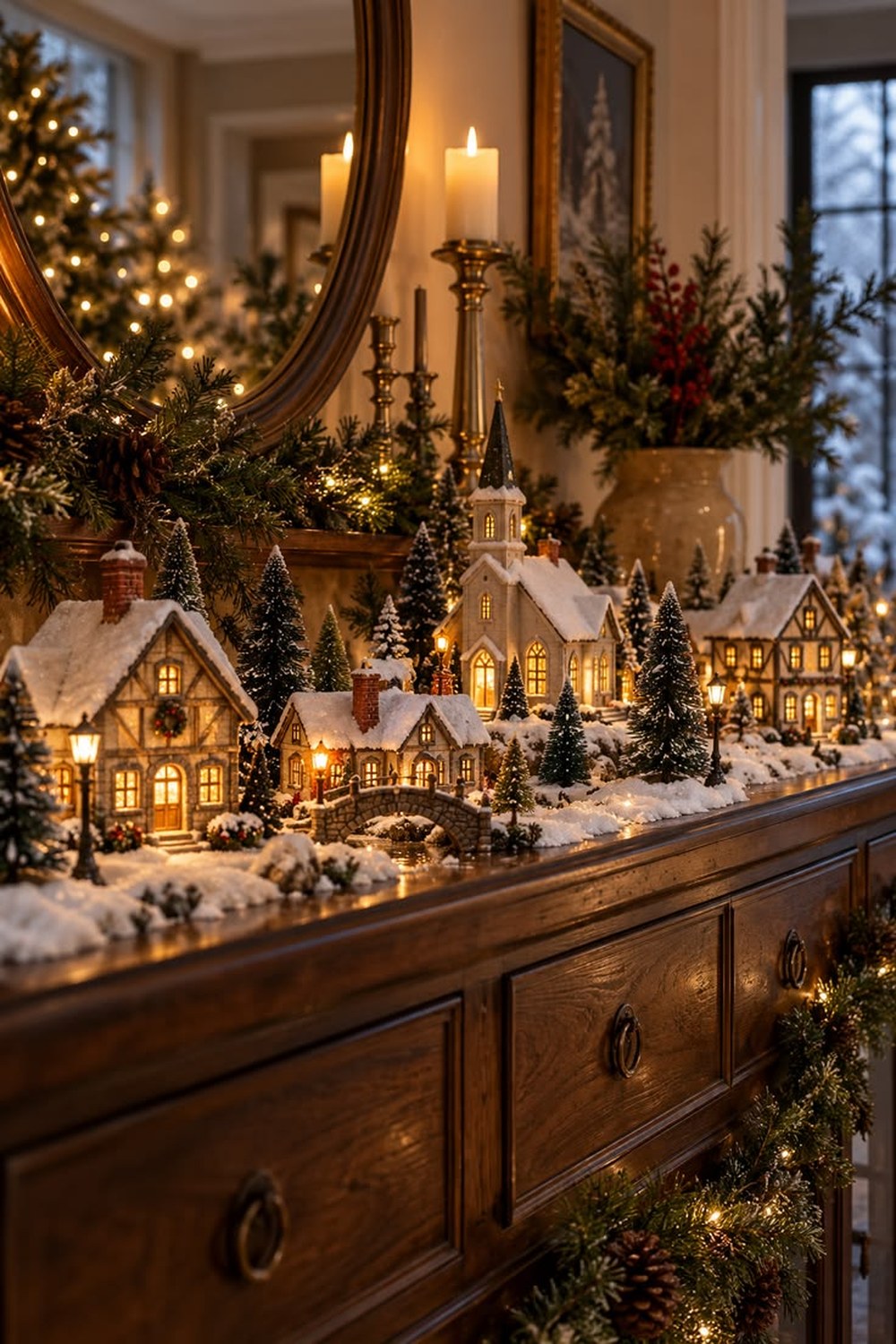
Real candlelight behind the village — in lanterns and hurricanes, well back from the snow.
For the deepest, warmest glow of all, set two or three real candles in glass hurricanes or closed lanterns on the surface behind the display. The flicker moves, which no bulb can copy, and it plays across the rooftops so the town seems to shimmer. The glass keeps flame and miniature scenery properly apart, and flameless candles give a safer version of the same moving light for busy households.
Styling tip: keep every flame at least a hand's width behind the nearest house and never among the trees or batting. The backdrop should be a glow, not a hazard — if you would not leave the room, swap to flameless without regret.
12. Lit Bottle Brush Trees: Fireflies in the Village Forest
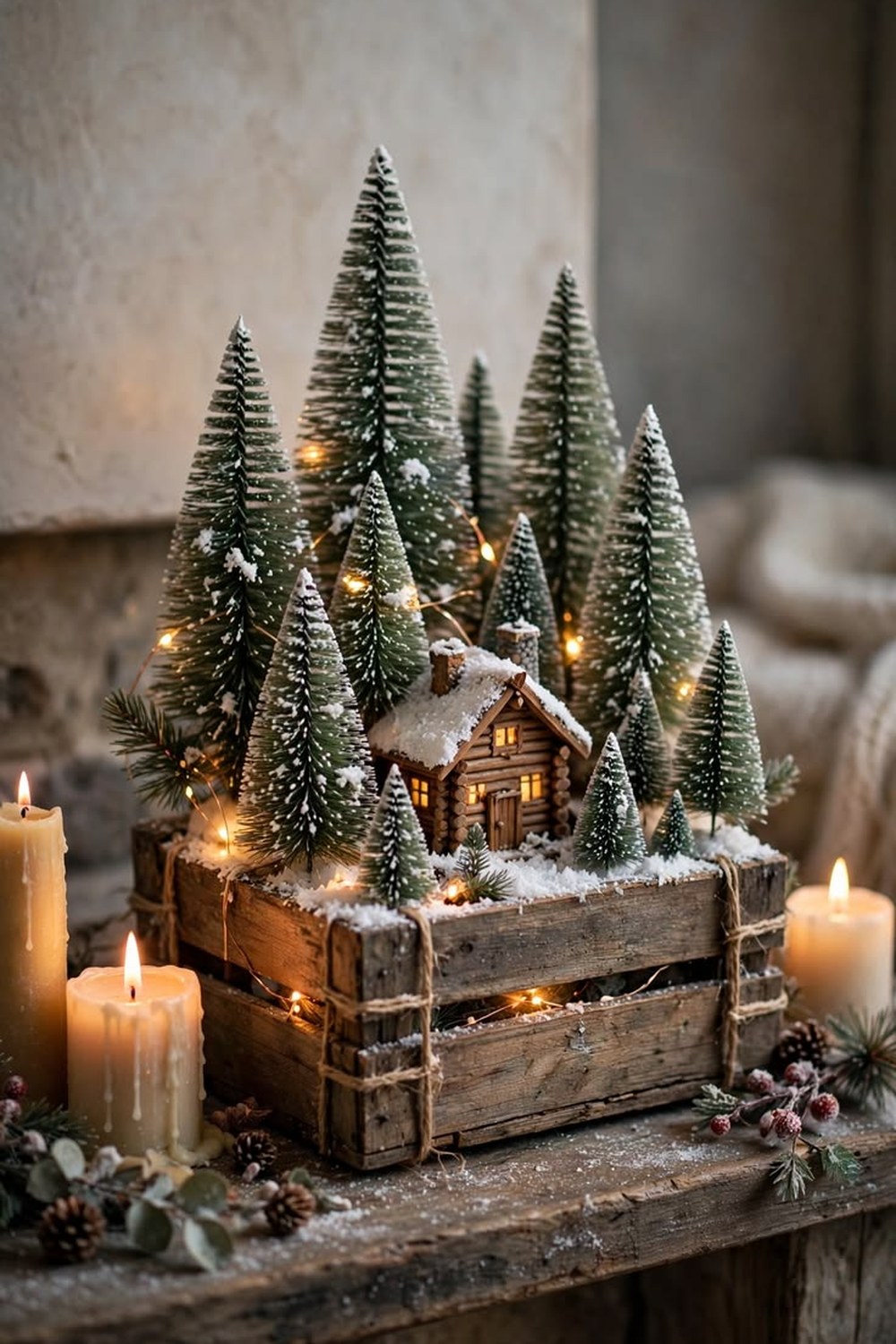
Weave micro lights through the trees and the forest between the houses starts to sparkle.
Bottle brush trees are usually scenery; lit, they become part of the lighting design. Wind a copper-wire micro light strand through a cluster of trees, or stand two or three oversized brush trees wound with their own battery lights at the village edges. The tiny points of light scattered through the "forest" soften the contrast between the lit houses and the dark corners of the display.
Styling tip: use the copper-wire strands with the smallest bulbs you can find, and bury the wire inside the branches. Visible chunky bulbs on a miniature tree break the scale spell instantly.
13. Timers at Dusk: The Village That Lights Itself
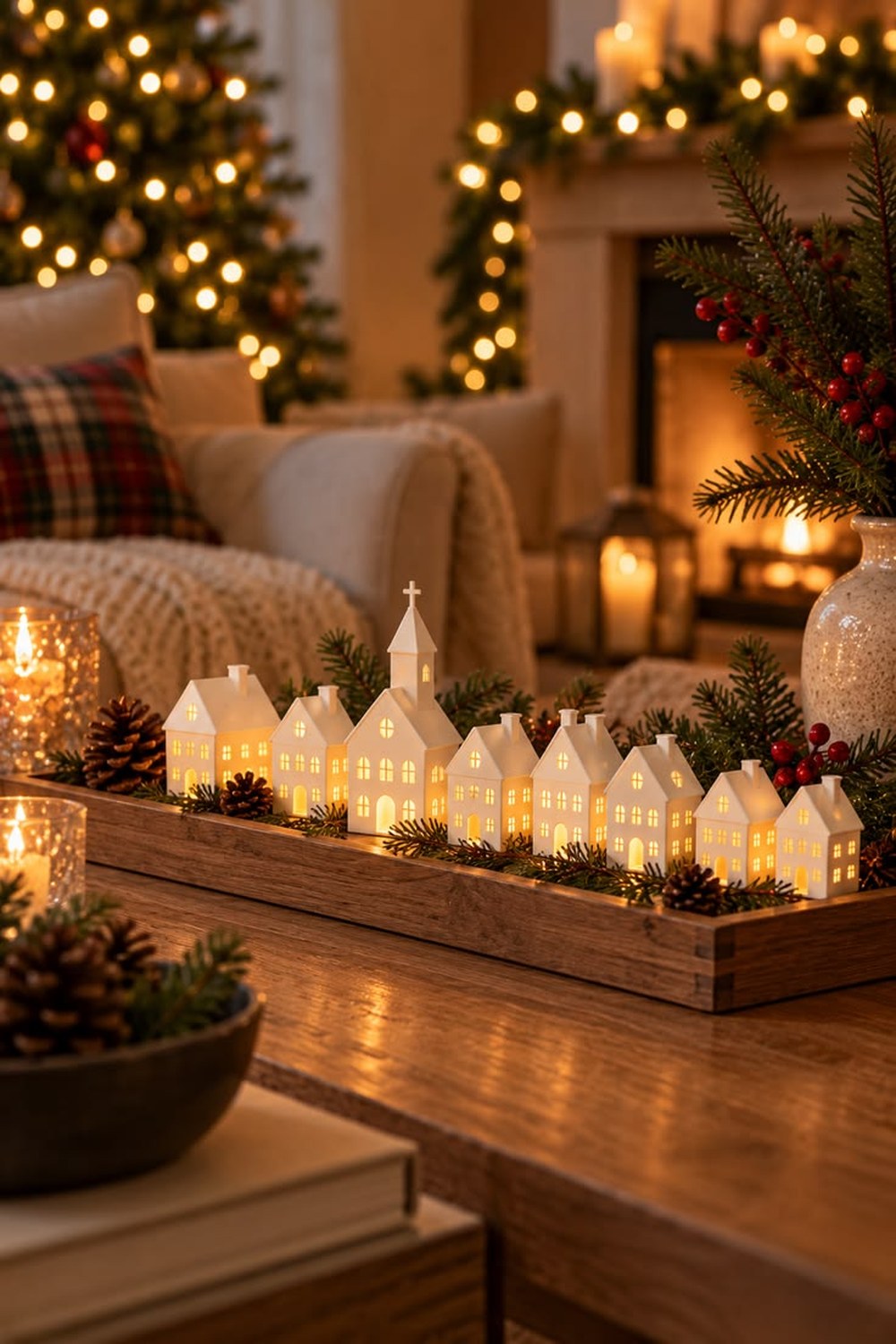
The best village is the one already glowing when you come downstairs.
Put every village light — houses, lamps, halo strand — on timers set for dusk, roughly four in the afternoon in midwinter, and off at bedtime. The display becomes part of the house's rhythm rather than a chore: the town lights itself as the light fails, visitors are greeted by a scene already alive, and no battery is wasted glowing at an empty room all day. It is a small piece of organisation that makes the whole display feel magical instead of managed.
Styling tip: stagger two timers by fifteen minutes — houses first, then lamps and halo. A town that lights in stages, windows then streets, mimics a real evening settling in.
14. One Warm Temperature: Every Bulb in the Village Agrees
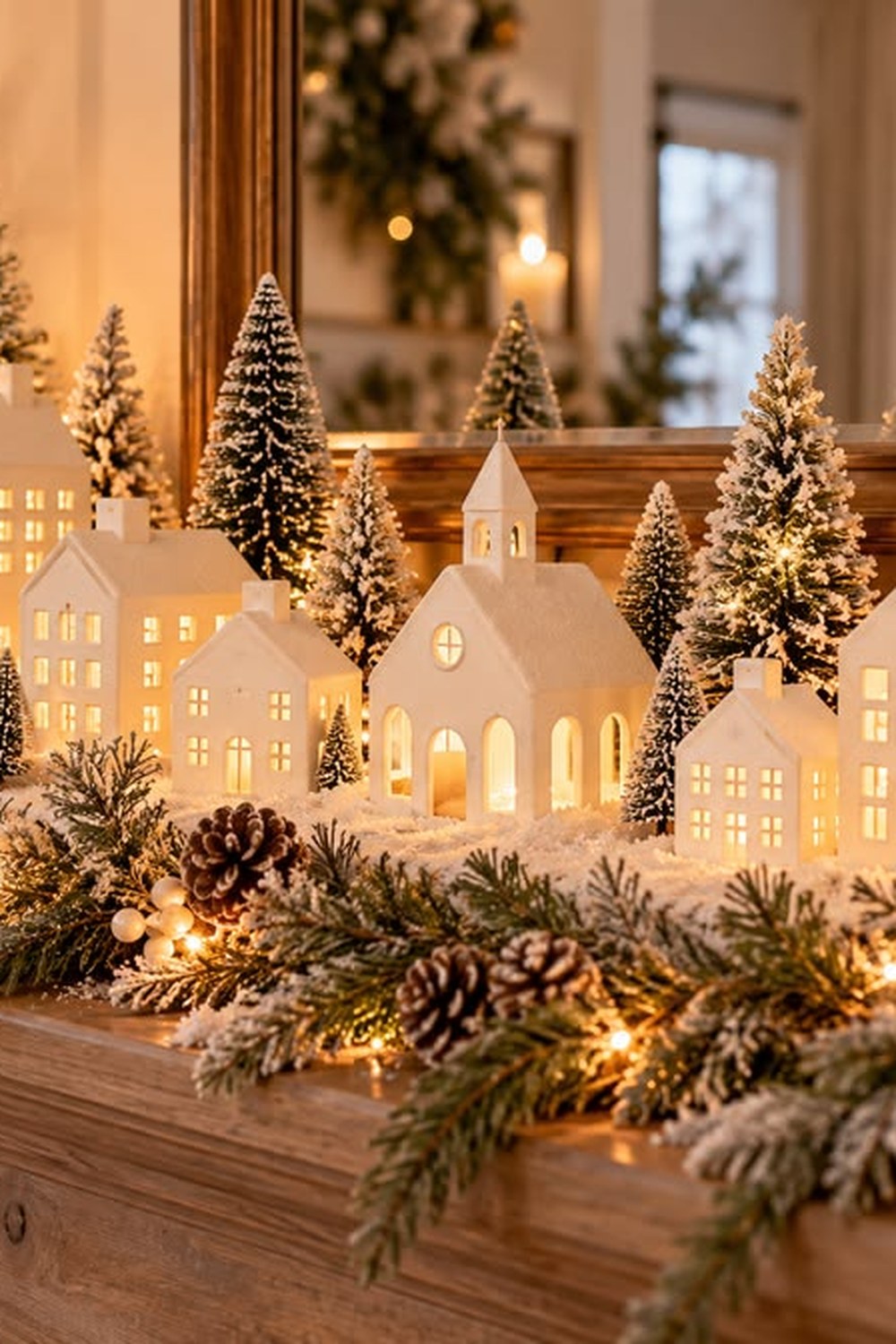
Warm white everywhere, nothing blue, nothing harsh — one temperature is what makes it feel like one town.
Treat the village's light like a paint colour: choose warm white and hold every bulb, tealight and strand to it. Mixed temperatures are the most common reason a loving display photographs badly — a yellow cottage beside a blue-white one looks like two villages arguing. When everything glows the same honeyed tone, even a modest collection reads as one coherent, lamplit place.
Styling tip: do the phone-camera test at dusk. Screens exaggerate colour clashes, so if the glow looks even on your phone, it will look perfect to the naked eye.
Snow, Streets & Layered Scenery
15. The Snow Blanket Base: Batting Before Buildings
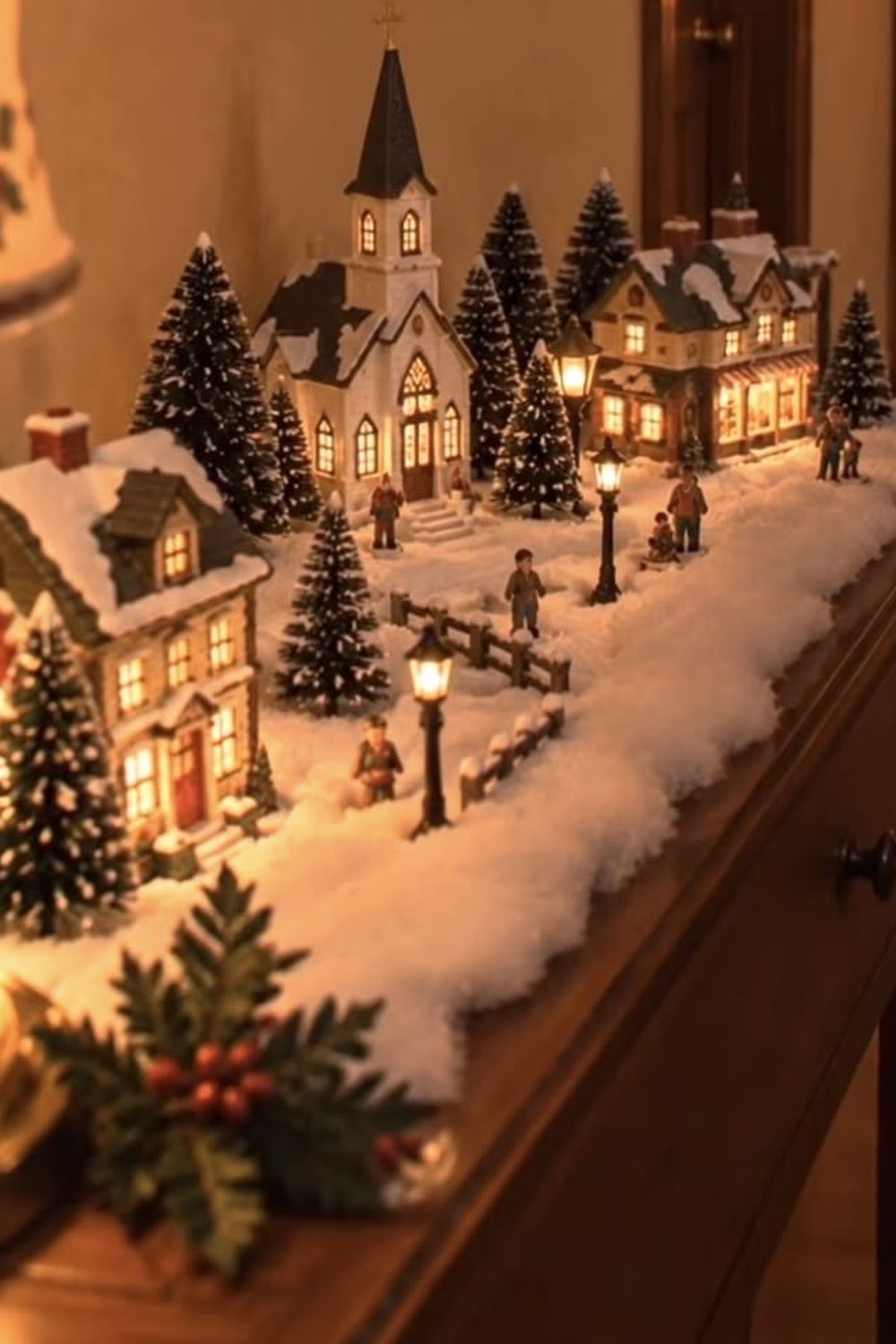
Every convincing village starts with weather — one unbroken fall of snow under everything.
Quilt batting, sold in craft shops by the metre, makes the most realistic village snow: soft, slightly uneven, and thick enough to swallow the base of every house so buildings sit in the scene rather than on it. Lay it over the whole surface — and over any risers — before a single building is placed, and press gentle hollows where streets will run. A sprinkle of loose fake snow or a dusting of glitter snow over the top adds sparkle in lamplight.
Styling tip: tear batting edges rather than cutting them. A torn, feathered edge melts invisibly into the surface; a scissors-straight edge announces itself as a blanket every time.
16. Terraced Streets: A Hillside Town in Three Levels
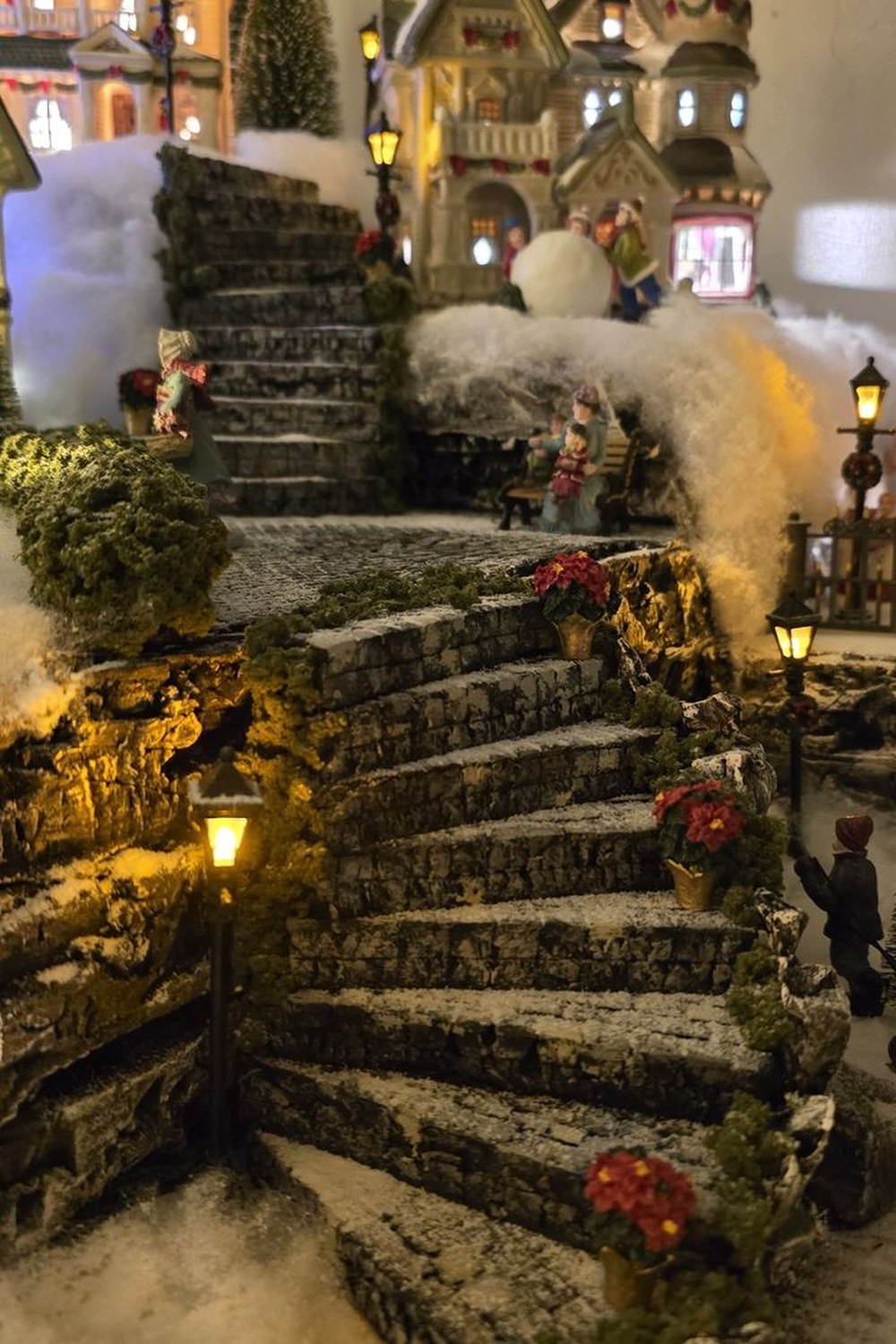
Build on levels and the streets have somewhere to go — up the hill to the church.
Where tiers give the village height (idea 3), terraces give it geography. Arrange three broad levels like hillside streets, connect them with winding paths of flattened snow or felt, and place a tiny staircase or a lamp where each path changes level. Shops belong on the lowest, flattest terrace — the high street — with houses climbing above them and the church or a single grand house at the summit.
Styling tip: keep the front terrace shallow and the back ones taller. Depth is what you are building; a display that rises like theatre seating photographs beautifully and lets every window be seen.
17. Paths and Lanes: Streets You Can Follow with Your Eye
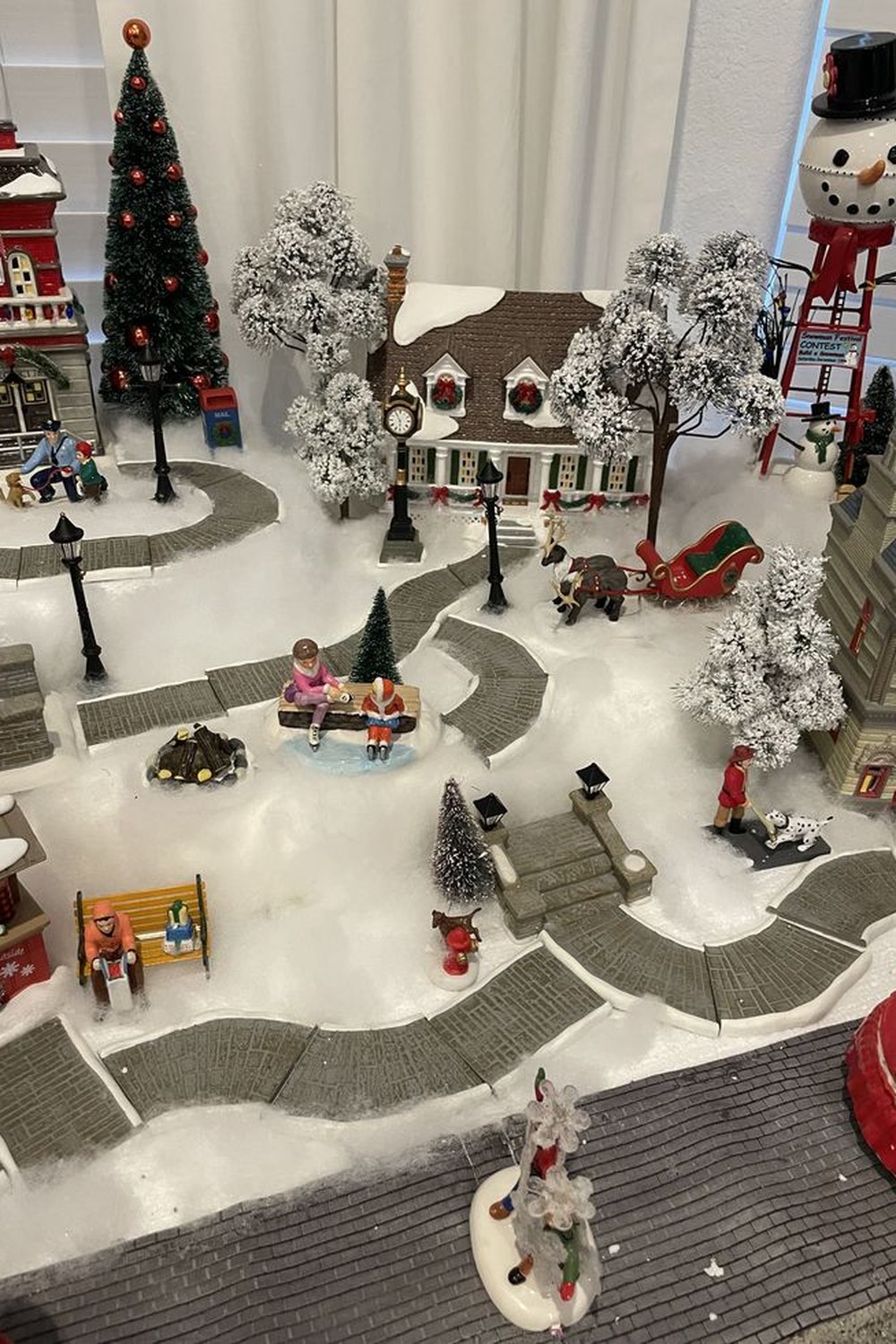
A village without streets is a warehouse of houses — give the eye a lane to wander down.
Press paths into the snow between buildings using strips of brown felt, cork or fine gravel-coloured card, or simply smooth a lane through the batting with the back of a spoon. Curved paths work far better than straight ones: a lane that bends behind a cottage and reappears beside the church makes the town feel bigger than the shelf it stands on, because the eye assumes there is more of it hidden.
Styling tip: end at least one path at the display's front edge. A lane that arrives at the viewer's side invites you into the scene; paths that stop at houses keep you outside looking at a model.
18. The Bottle Brush Forest: Trees by the Dozen
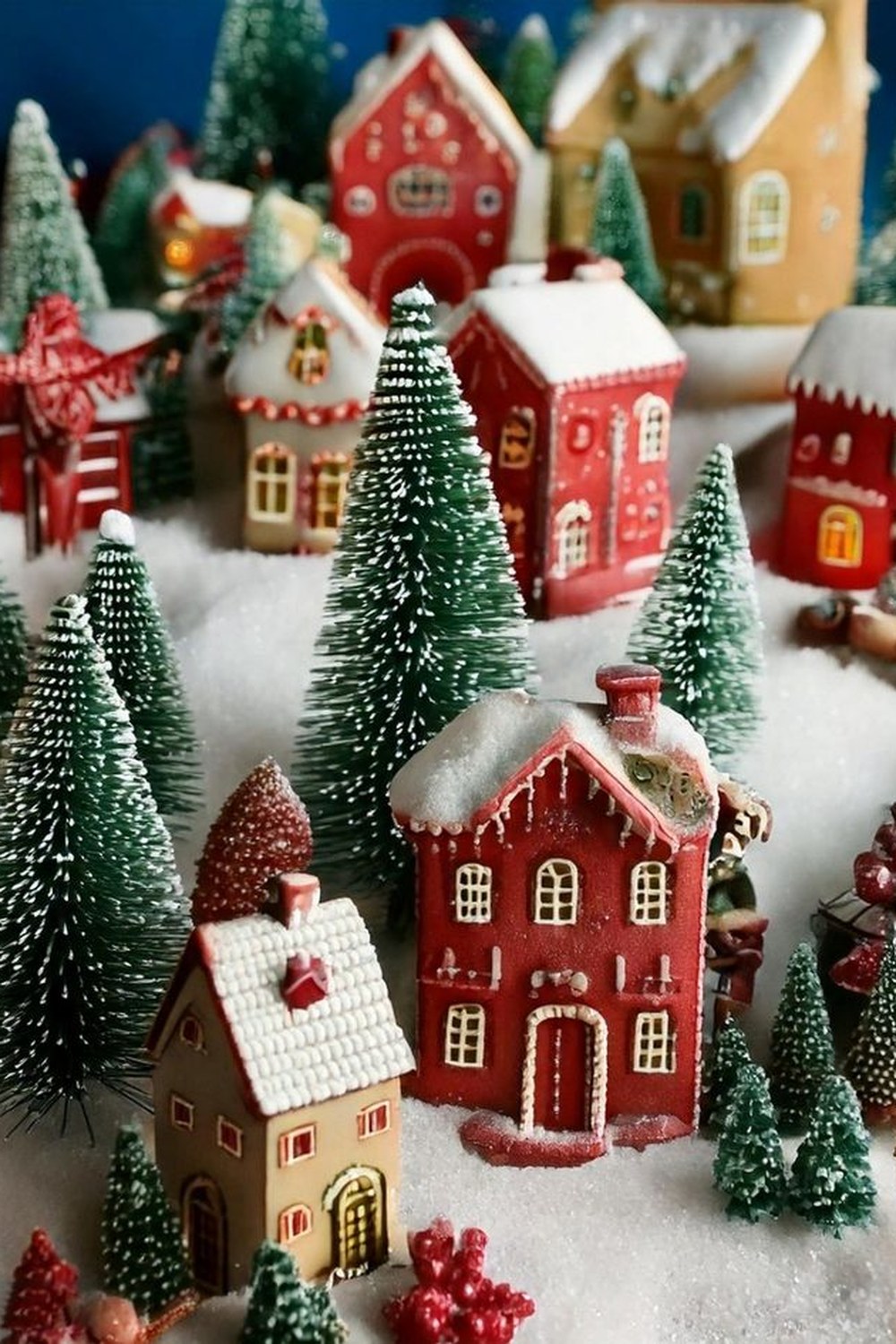
Buy trees by the bag and plant them everywhere — the forest is what separates town from countryside.
Bottle brush trees are the cheapest scenery there is, and villages eat them: clusters between houses, a wood behind the church, single sentries flanking front doors, a snowy avenue along the main street. Mix two or three sizes and at least two finishes — plain green, snow-dusted, the odd white or silver — and push them into the snow at slight angles, as trees actually grow.
Styling tip: plant in odd numbers and uneven clusters, never in rows flanking every door identically. A wood is a crowd, not a guard of honour — one tree leaning very slightly is worth five standing to attention.
19. The Frozen Pond: A Mirror of Ice at the Village's Heart
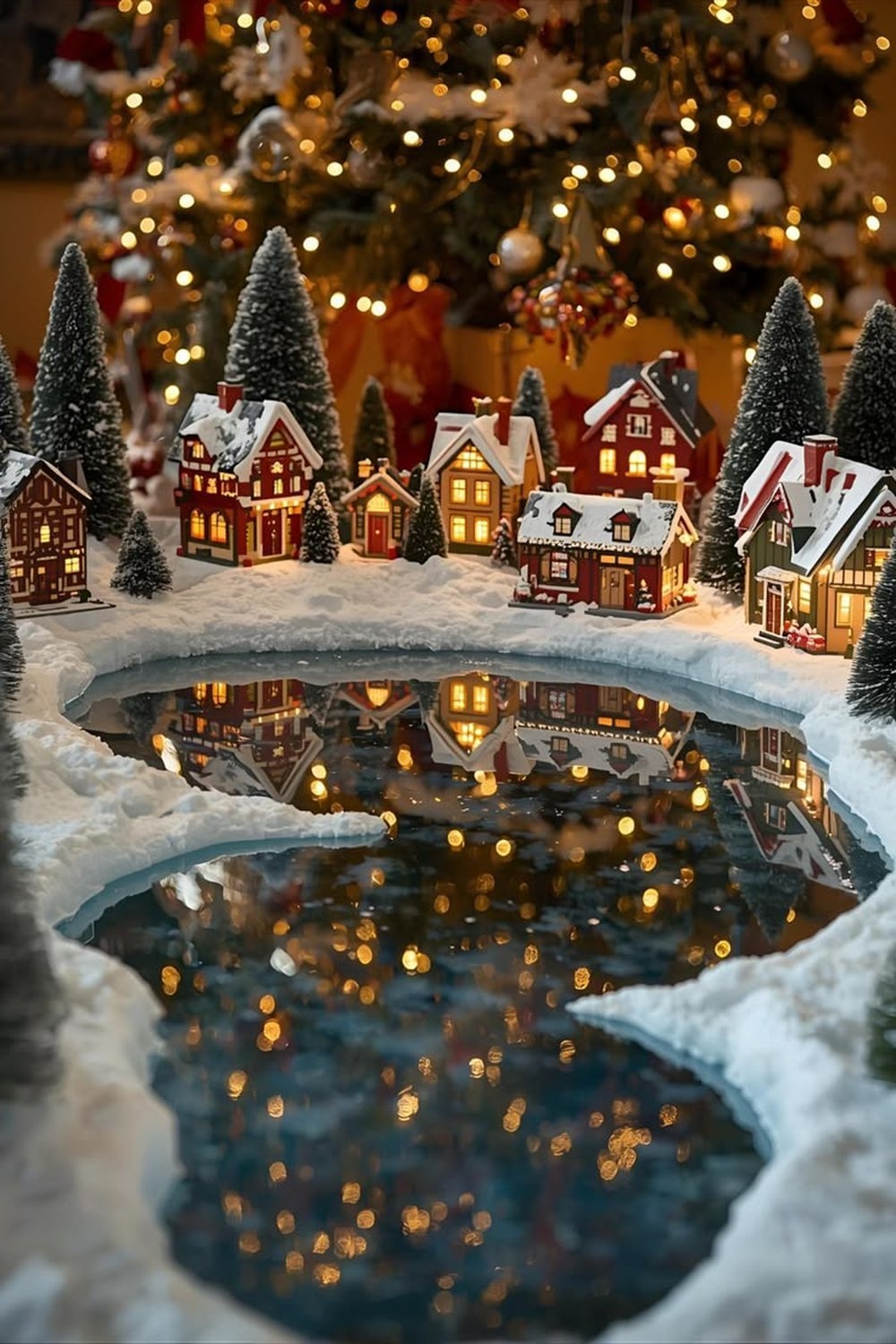
A small mirror laid in the snow becomes a frozen pond — and doubles the lights for free.
Lay a small round or oval mirror flat in a hollow of the snow, ring it with trees and a bench or two, and you have the village pond. It reflects the lit windows and lamps around it, adding shimmer no bulb can fake, and it gives the scene a centre that is not a building — a breathing space where the eye rests. A scrap of pale blue or silver card under clear plastic works almost as well.
Styling tip: dust the pond's edges with loose snow so the mirror's rim disappears. An ice edge that feathers into the banks sells the illusion; a visible mirror edge breaks it in one glance.
20. Fences, Bridges and Benches: The Small Furniture of a Town
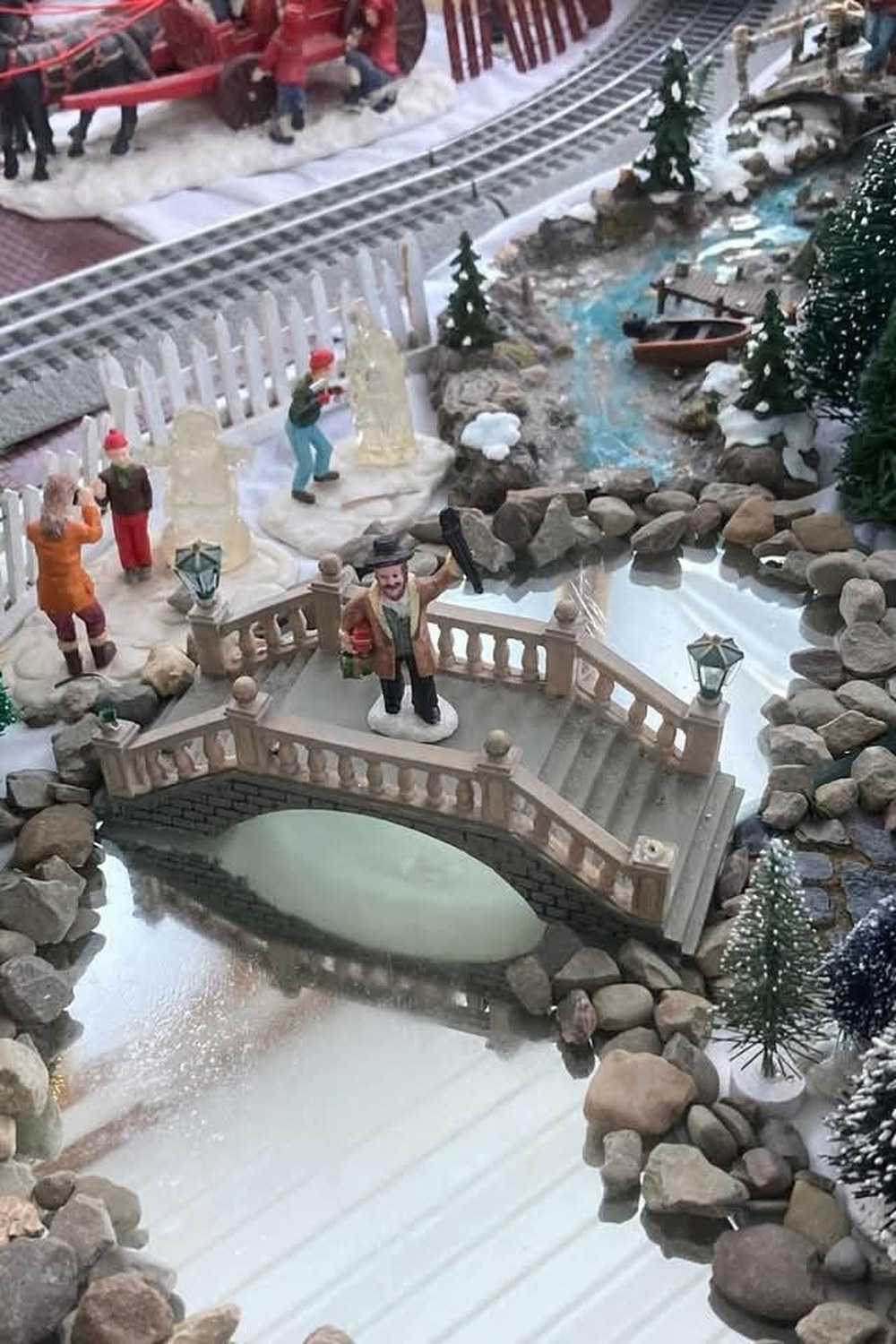
Picket fences, a footbridge, a bench by the pond — the tiny furniture is what makes visitors lean in.
Miniature accessories — white picket fencing along front gardens, a small bridge over the pond or a stream of silver card, benches, a post box, a wishing well — are where a village stops being buildings and starts being a place people live. Scatter them sparingly and group them where life would happen: the fence at the cottage garden, the bench facing the pond, the bridge on the path between two streets.
Styling tip: ration yourself to one accessory type per street. A fence here and a bench there reads as a town; every accessory everywhere reads as the accessory shop.
21. Snow-Dusted Roofs: A Light Hand with the White
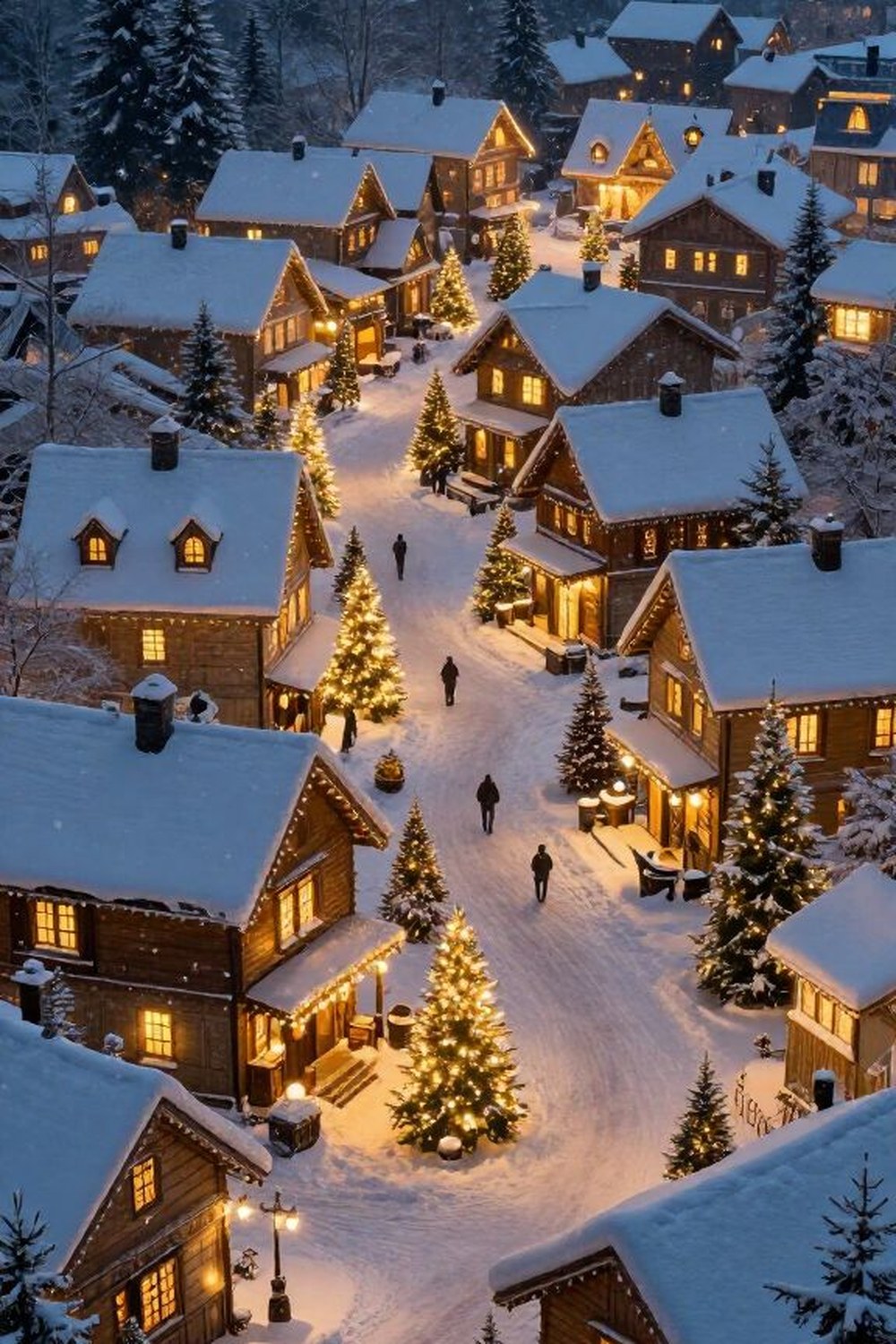
Snow belongs on the roofs too — but a dusting, not a burial, or the rooftops disappear.
Finish the weather by dusting rooftops, chimney tops and tree branches with fake snow spray, white flocking or a dry brush of white paint. Aim for the look of a recent light fall: snow sitting on upward faces and ledges, the walls and windows clear beneath. In lamplight the white roofs catch a faint glow from the windows below and the whole town reads as freshly snowed-on rather than stored in cotton wool.
Styling tip: dust from directly above, the way snow actually falls. Spray at an angle and the walls get frosted too, which reads as a blizzard scene — charming, but a different village.
Village Stories: Shops, Churches, Trains & Skating Ponds
22. The Church at the Centre: The Tallest Building Sets the Scene
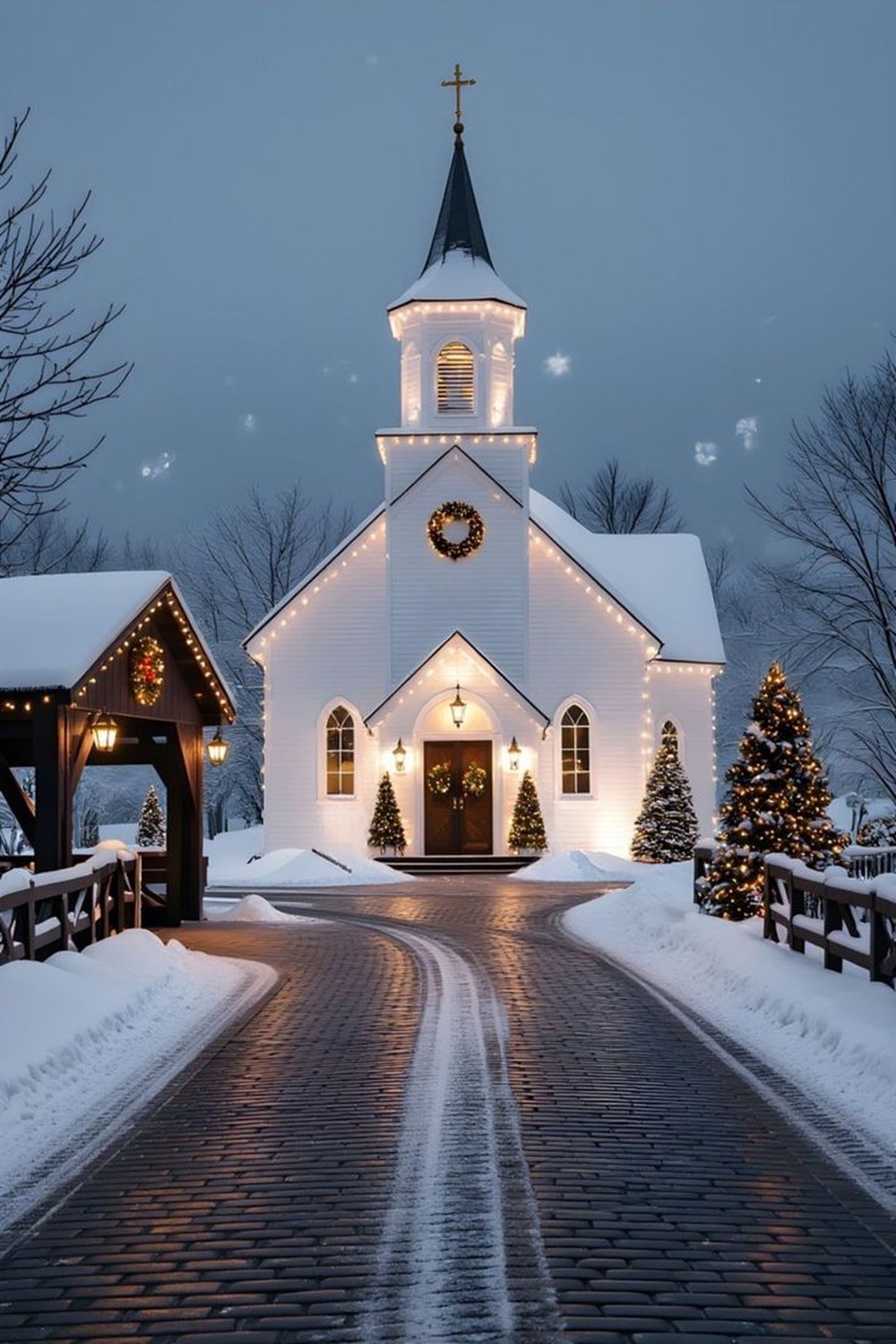
Every old town grew around its church — give yours the high ground and the tallest roof.
A village church or chapel, with its steeple and tall glowing windows, is the natural centrepiece of any display. Set it on the highest tier or at the centre of the mantel, give it clear space around it — a small green of snow, a ring of trees, its own lamp — and let the cottages gather at a respectful distance. Its height anchors the composition and its long windows give the strongest single glow in the town.
Styling tip: put the church slightly off-centre rather than dead middle. A focal point just left or right of centre makes the eye travel across the whole village to reach it, and the scene feels larger.
23. The High Street Shops: Bakery, Toy Shop and Sweet Shop in a Row
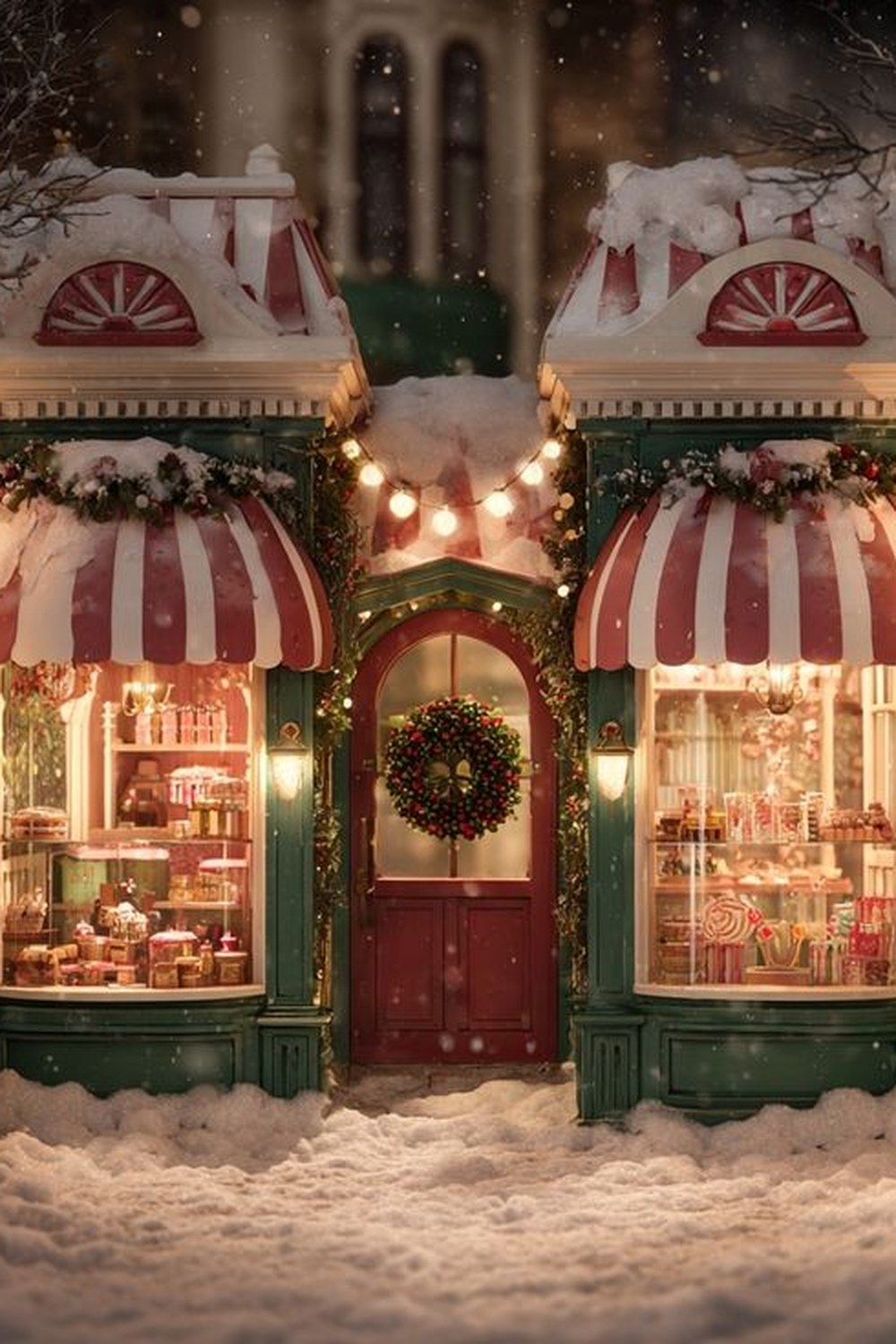
Shop windows are the brightest in any village — line them up and the town has a beating heart.
Group the village's shops along one flat stretch of street: a bakery, a toy shop, a sweet shop, perhaps a bookshop or a pub. Shopfronts have the biggest windows and the most inviting light, so a row of them creates the display's brightest, busiest quarter — the part of town that is still awake. Awnings, tiny signs and a pavement of smooth snow complete the high street read.
Styling tip: put the warmest-glowing shop in the middle of the row and let brightness taper toward the ends. A bright centre with quieter edges is how real streets look at night, and it draws the eye exactly where you want it.
24. The Village Train: A Miniature Railway Around the Town
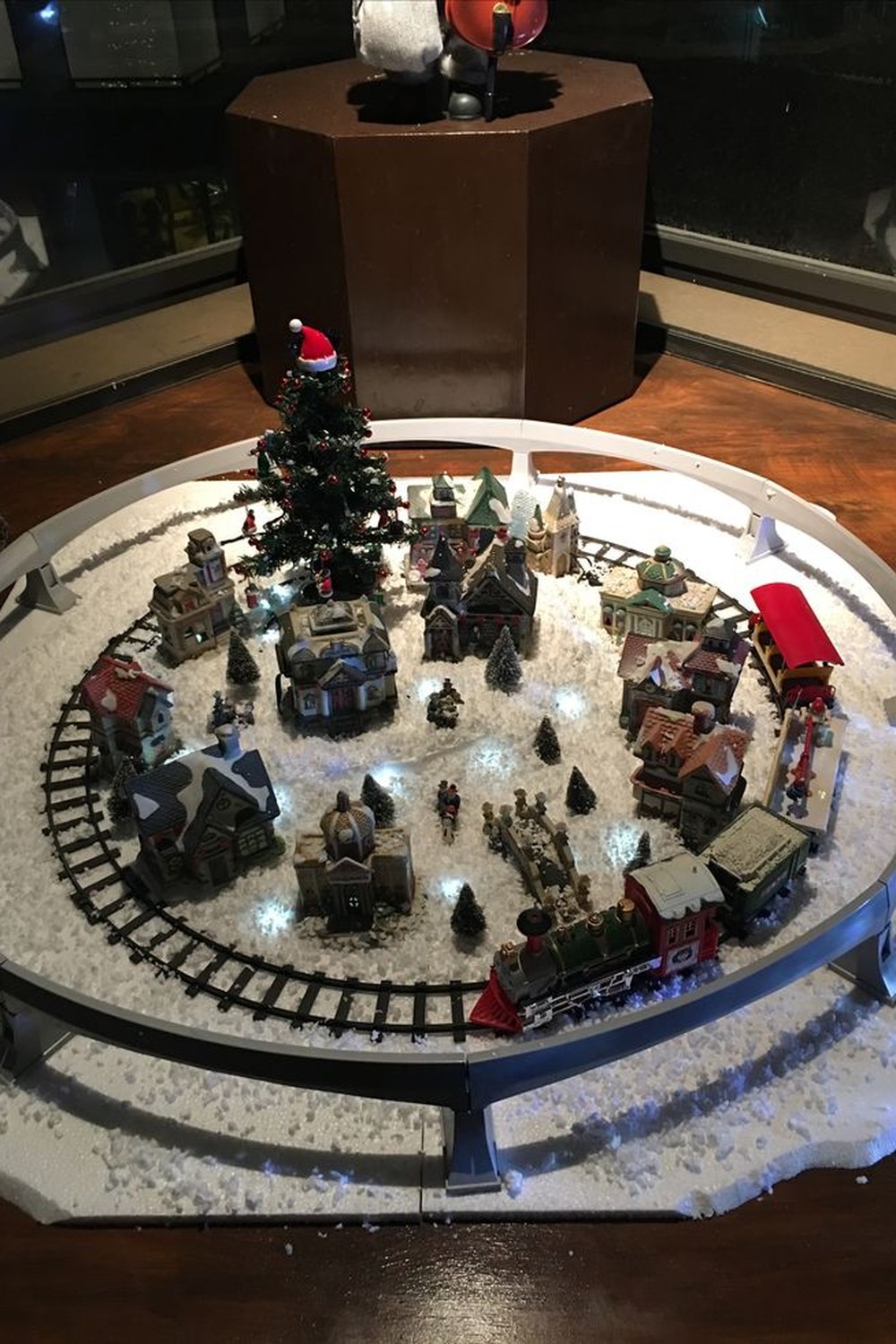
Nothing moves in a village except the train — and one moving thing makes the whole town feel alive.
A small train set circling the display — on the table around the village, or on a broad shelf looping behind the back row — transforms the scene. Lay the track first, before the snow and buildings, so the train's route decides where the streets cannot go, and add a tiny station near the shops. Children will watch the loop for whole evenings, and every pass behind the church feels like a story restarting.
Styling tip: give the train one tunnel or one pass behind the tallest buildings. A train that disappears and returns is twice as watchable as one in view the whole time, and the hidden stretch is where batteries and derailments are easiest to manage.
25. The Skating Pond: Tiny Figures on the Ice
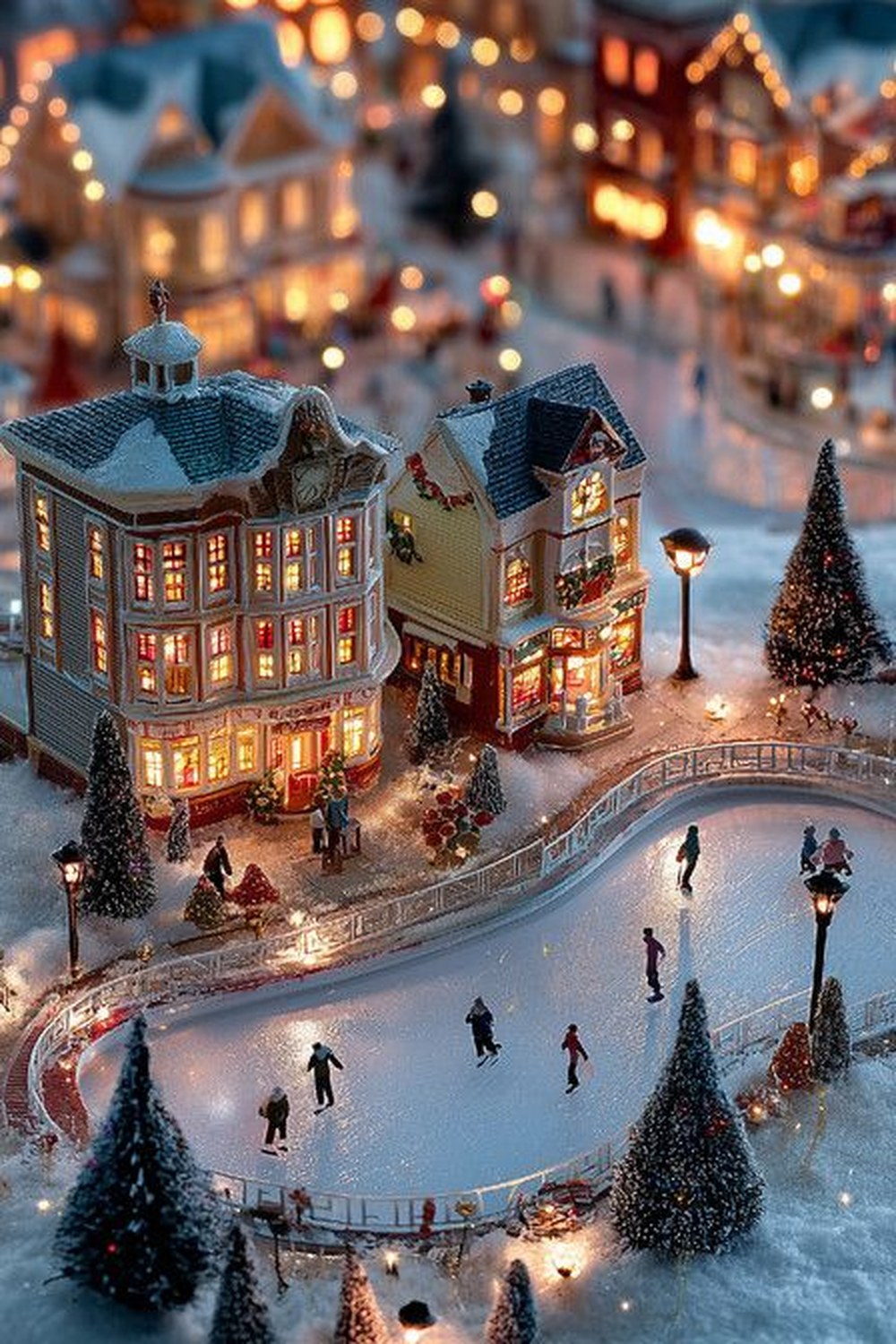
Put skaters on the pond and the village stops being architecture — it becomes a December afternoon.
Dress the frozen pond (idea 19) with miniature figures: two or three skaters mid-glide, a couple standing at the edge with a dog, children on a sledge nearby. Figures are the fastest route from display to story, because the eye immediately invents who these people are. Keep the group small and the poses natural, and let the surrounding lit windows suggest everyone else is indoors by the fire.
Styling tip: place skaters off-centre on the ice, heading in slightly different directions. A neat ring holding hands reads as a decoration; scattered skaters read as a real pond on a real afternoon.
26. Carollers by the Lamp Post: A Scene in One Square Foot
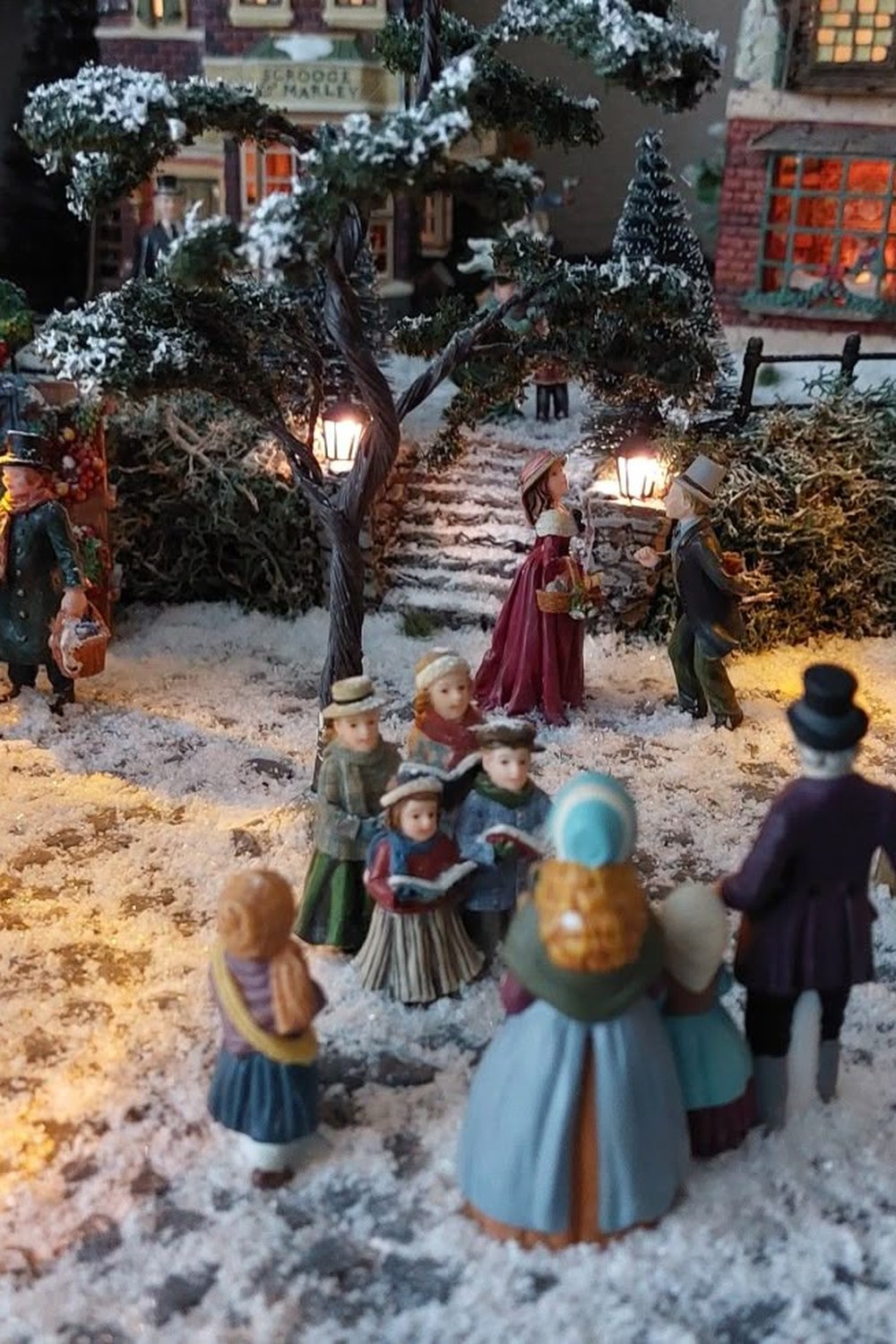
Four tiny singers, one lamp, a cottage door — the smallest complete story a village can tell.
Gather a set of carol-singer figures beneath the brightest street lamp, facing the door of the nearest cottage, and you have a vignette with a beginning, a middle and an audience of one lit window. Grouped scenes like this are how large villages stay readable: instead of thirty buildings competing, the eye hops from one little story to the next. A choir by the church door or children building a snowman work in exactly the same way.
Styling tip: always aim a scene at something — a door, a window, the pond. Figures facing a lit doorway are performing; figures facing the viewer are on display, and the spell thins.
27. The Christmas Market Square: Stalls Around the Village Tree
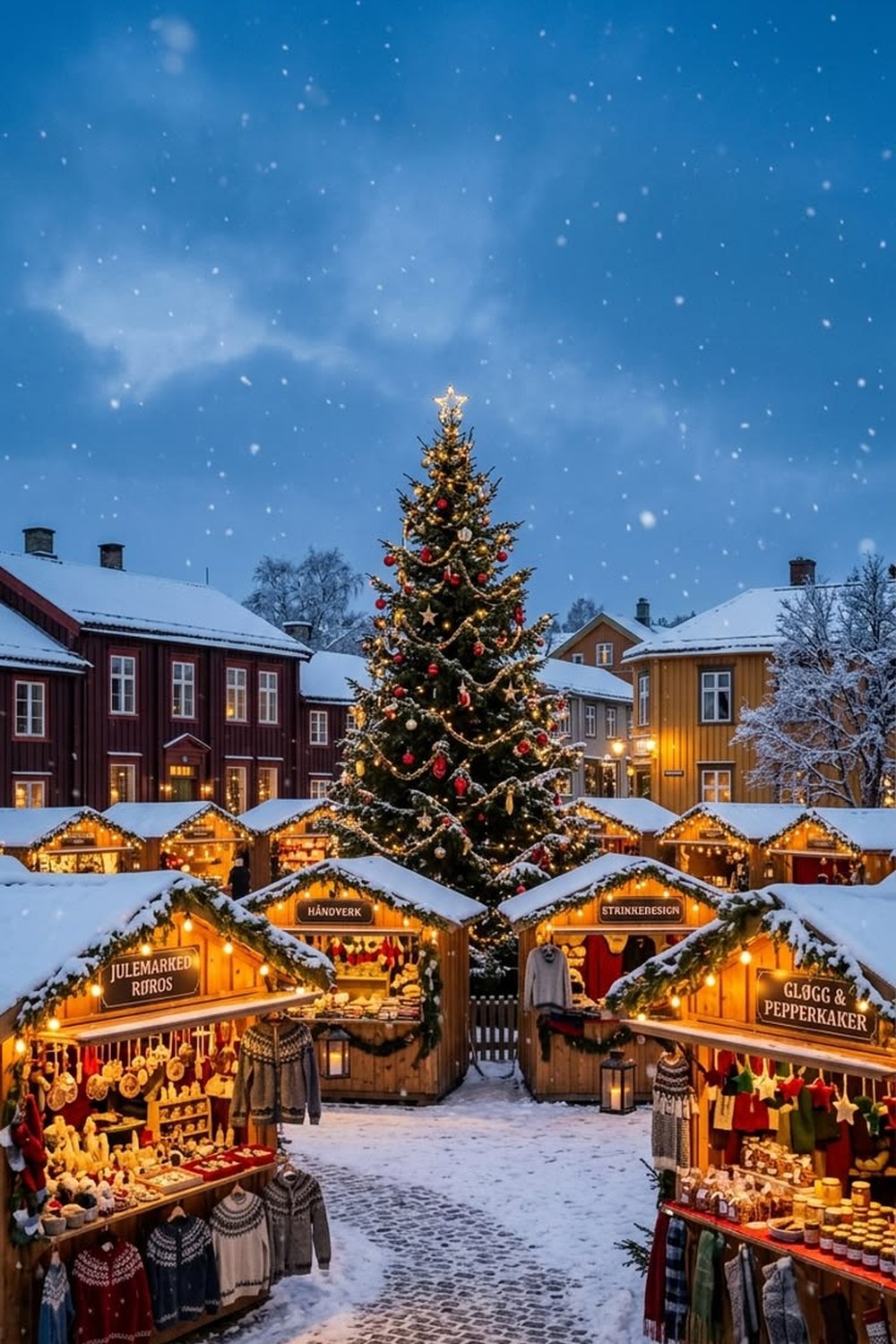
A square of little stalls around one big tree — the market does the festive heavy lifting.
If your village has a flat central space, turn it into a Christmas market: a ring of miniature stalls with striped awnings, a decorated tree at the centre strung with its own micro lights, and figures browsing between them. The market concentrates colour, light and people into the middle of the display, leaving the surrounding streets quieter and snowier by contrast — exactly the balance a real town square strikes.
Styling tip: keep stall awnings in one or two colours only. Market squares photograph wonderfully but clutter fast; a disciplined palette of red-and-cream or green-and-cream reads as charming rather than chaotic.
28. One House a Year: The Village That Tells Your Family's Story
The best villages are not bought, they are accumulated — one house for every year that mattered.
Build the village the slow way: one new building a year, chosen to mark something — a house that resembles your own street, a shop for a new baby's first Christmas, a lighthouse the year of a seaside holiday. The styles will differ slightly and the scales will never be perfect, and that is precisely the charm: the town becomes a shelf of family history that happens to light up. Write the year and the reason underneath each base, in pencil, where only you will see it.
Styling tip: photograph the village each year before you add the new building. The annual photograph becomes its own tradition, and it is the easiest way to remember arrangements that worked when you rebuild next December.
Unusual Homes for a Village: Bookcases, Staircases & Under the Tree
29. The Bookcase Village: A Street Between the Novels
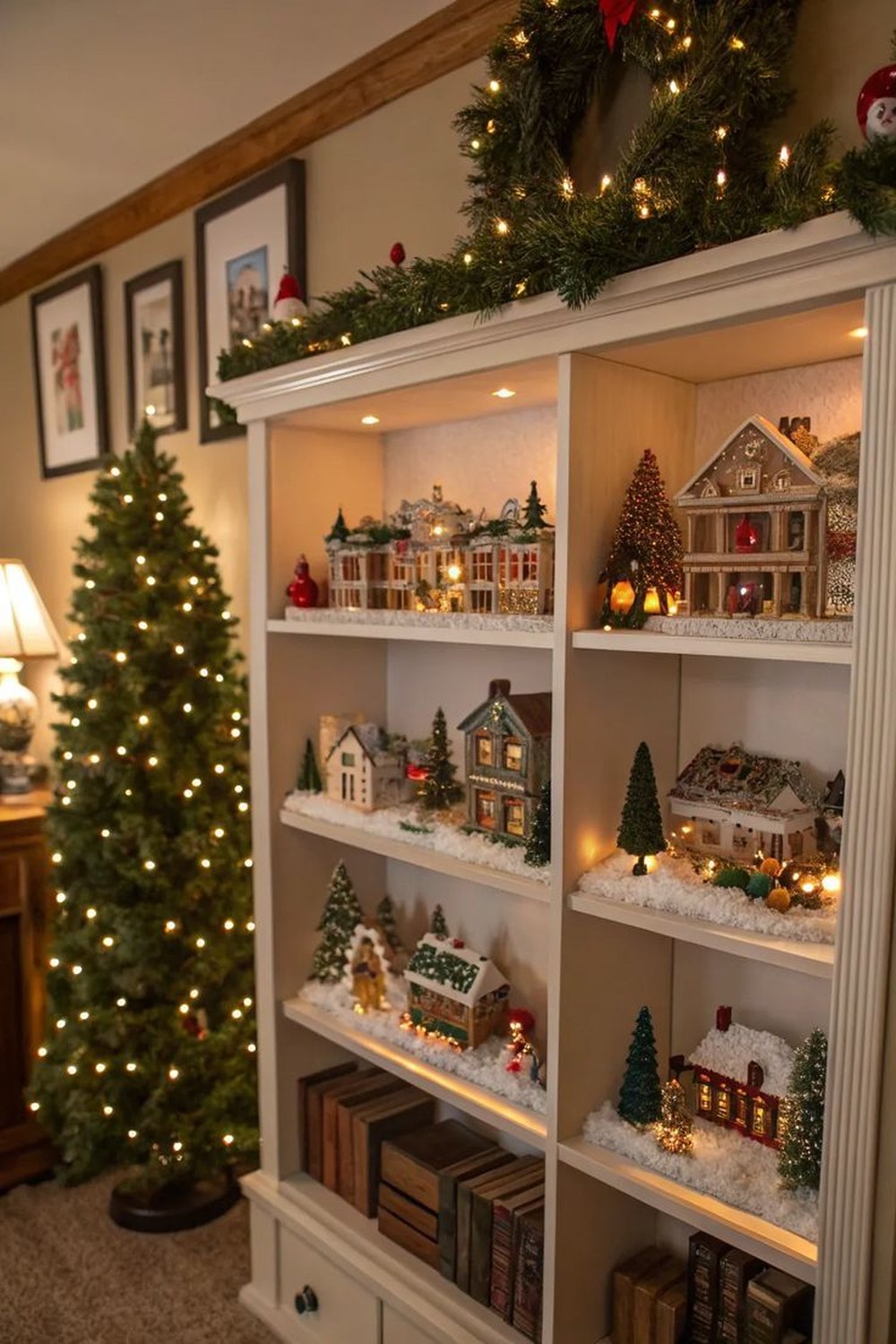
Clear one shelf of the bookcase and a street appears — books make the best backdrop a village can have.
Bookshelves were made for villages: deep shelves, a back panel to glow against, and a ready-made sense of a world contained. Clear one shelf at sitting eye level, lay the snow, and stand the houses among a few upright books left at each end like the town's old stone walls. The surrounding shelves of books frame the scene so completely that even a five-house village looks deliberate and finished.
Styling tip: choose the shelf just below eye level when standing. A village you look very slightly down on reads as a landscape; one you look up at reads as a row of objects on a high shelf.
30. The Staircase Village: Houses Climbing the Steps
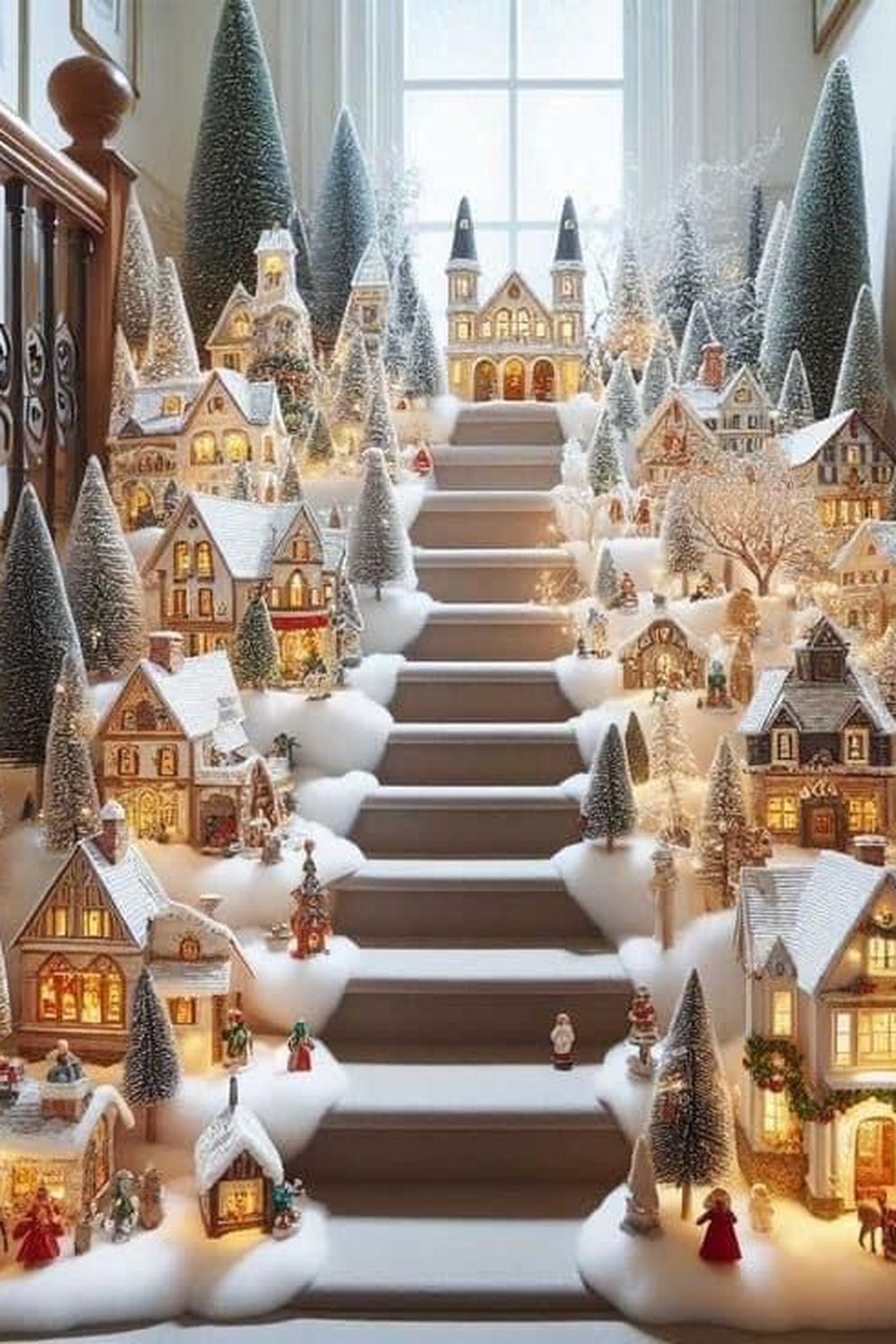
One or two houses on a step, a tree on the next — the village climbs the stairs with you.
On a wide staircase, set a small scene on the outer end of every second or third step: a house and a drift of snow on one, a cluster of trees on the next, a lamp at the turn. The village unfolds as you climb, which makes it the most interactive display in this guide, and at dusk the lit windows stepping up into the dark of the landing look genuinely magical.
Styling tip: keep scenes tight against the wall and the walking line completely clear, with every light battery-powered. Stair decor belongs at the edge and under nobody's feet — if a step feels narrower, that scene moves to the hall table.
31. The Village Under the Tree: A Town at the Trunk
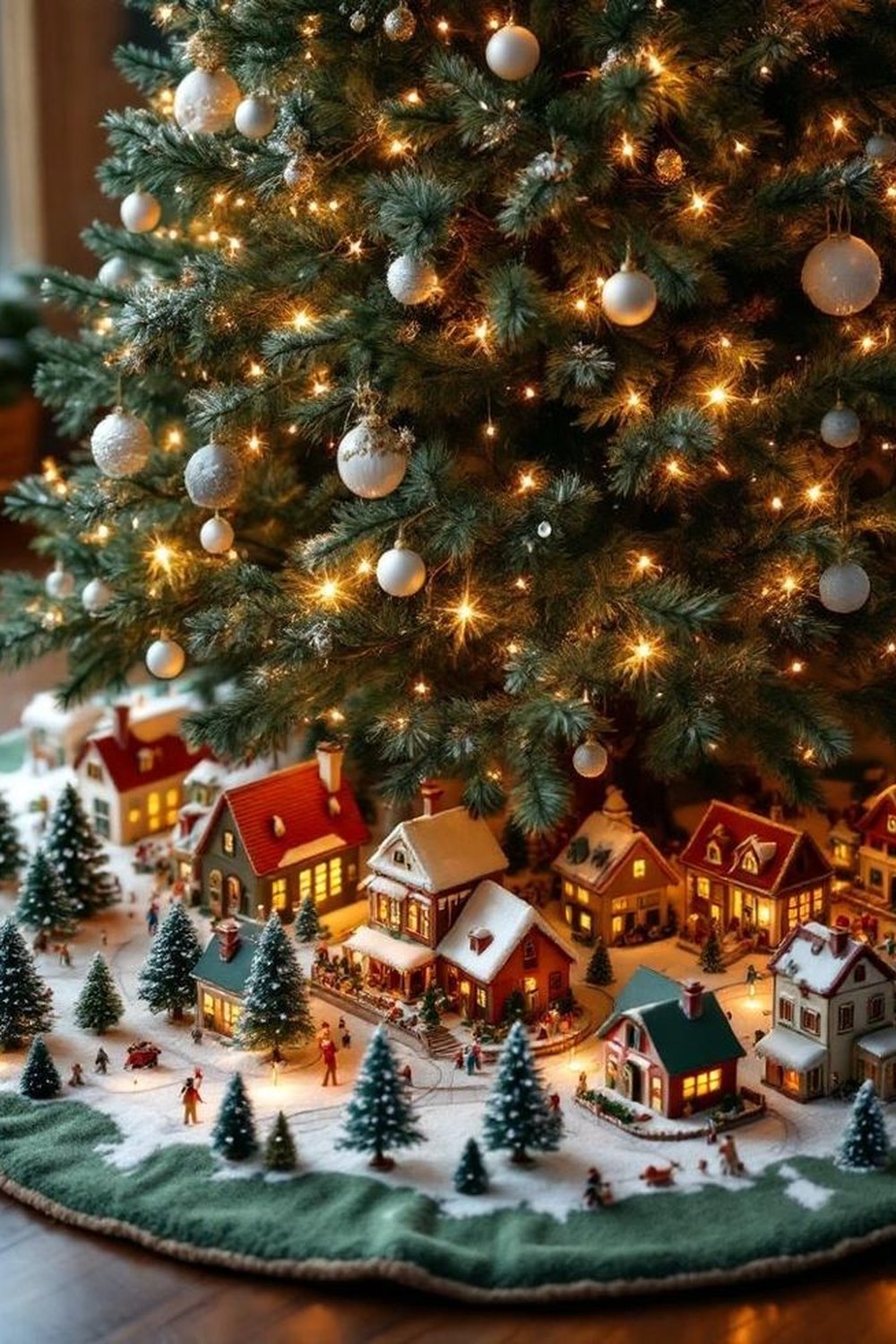
The floor around the tree is the largest empty "shelf" in December — build the village there.
Spread the snow in a generous ring or crescent around the tree's base and build the village on the floor: houses among the wrapped gifts, streets that disappear behind the trunk, the train (idea 24) circling the whole scene if you have one. The tree becomes the village's mountain and its sky at once, and the lights above and the windows below make the most layered display most homes can achieve.
Styling tip: leave a clear path of floor in front for presents to arrive and small feet to kneel. A village under the tree will be admired at close range all month, so build it to be looked down into, not just across at.
32. The Table Centre Village: Dinner Around a Tiny Town
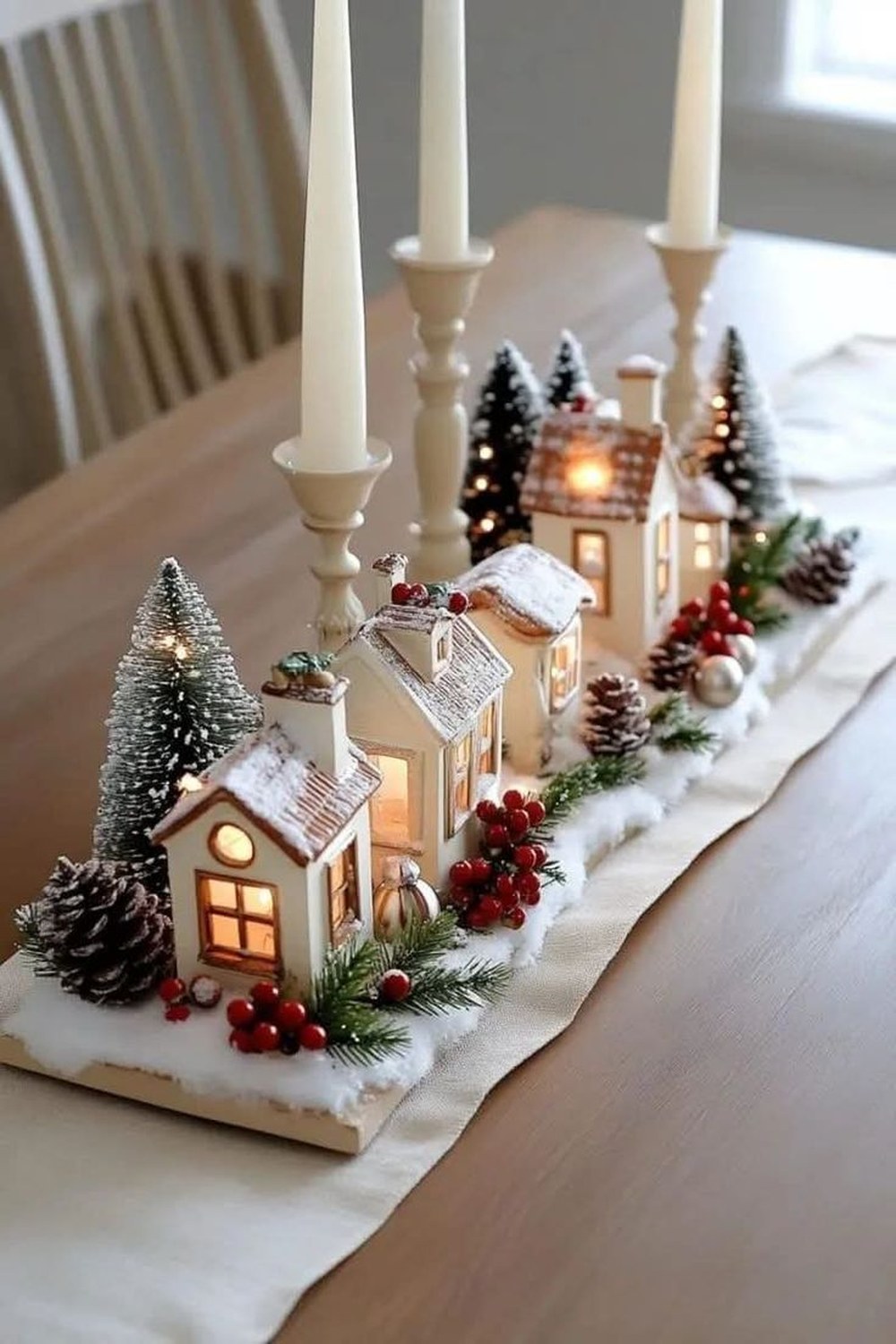
A low village down the middle of the table — guests dine inside the scene all evening.
For a celebration meal, build a shallow village along a table runner: low cottages and shops, a church kept short or laid at one end, battery lamps and tealights doing all the glowing. Kept below seated eye level, it never blocks conversation, and candlelight plus window-glow on the snow gives the table a warmth no floral centrepiece can match. It dismantles in ten minutes when the table needs its full width another day.
Styling tip: build the village on the runner itself, in sections, so it lifts away in two pieces. A table display that cannot be moved quickly will be resented by whoever is serving the meal.
33. The Cloche Village: One Perfect Scene Under Glass
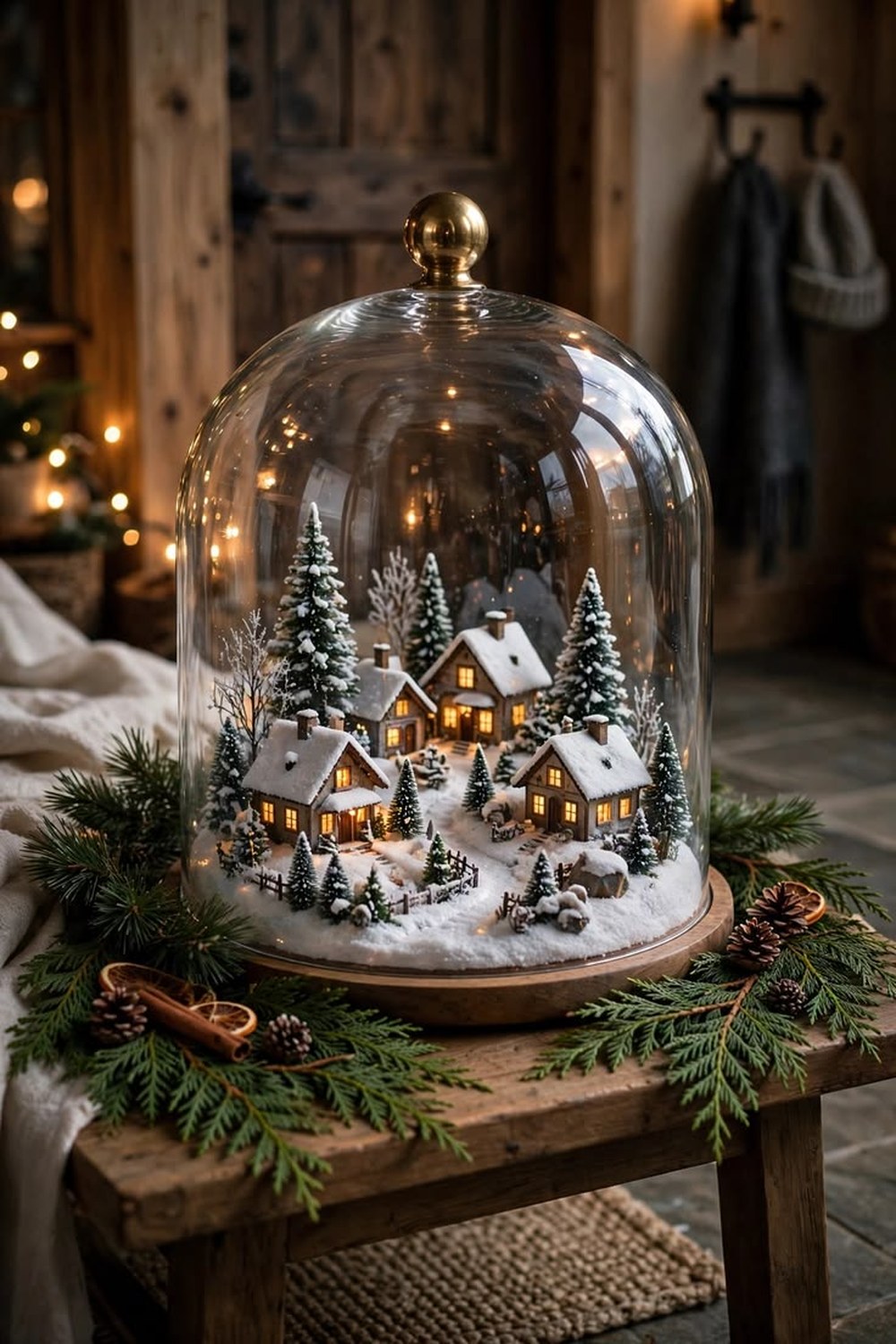
A single cottage under a glass dome — the whole village idea distilled into one object.
For small homes, desks and bedside tables, shrink the village to its essence: one small lit house, two bottle brush trees, a drift of snow and a fence or a lamp, all on a wooden base under a glass cloche. The dome magnifies the glow, keeps dust off all season, and turns a five-minute arrangement into something that looks inherited. It is also the safest village in a house with cats.
Styling tip: use the smallest battery light you can find and hide its pack under the snow at the back. A visible battery box under glass is the one detail that gives the whole trick away.
34. The Picture Ledge Village: A Skyline on the Wall
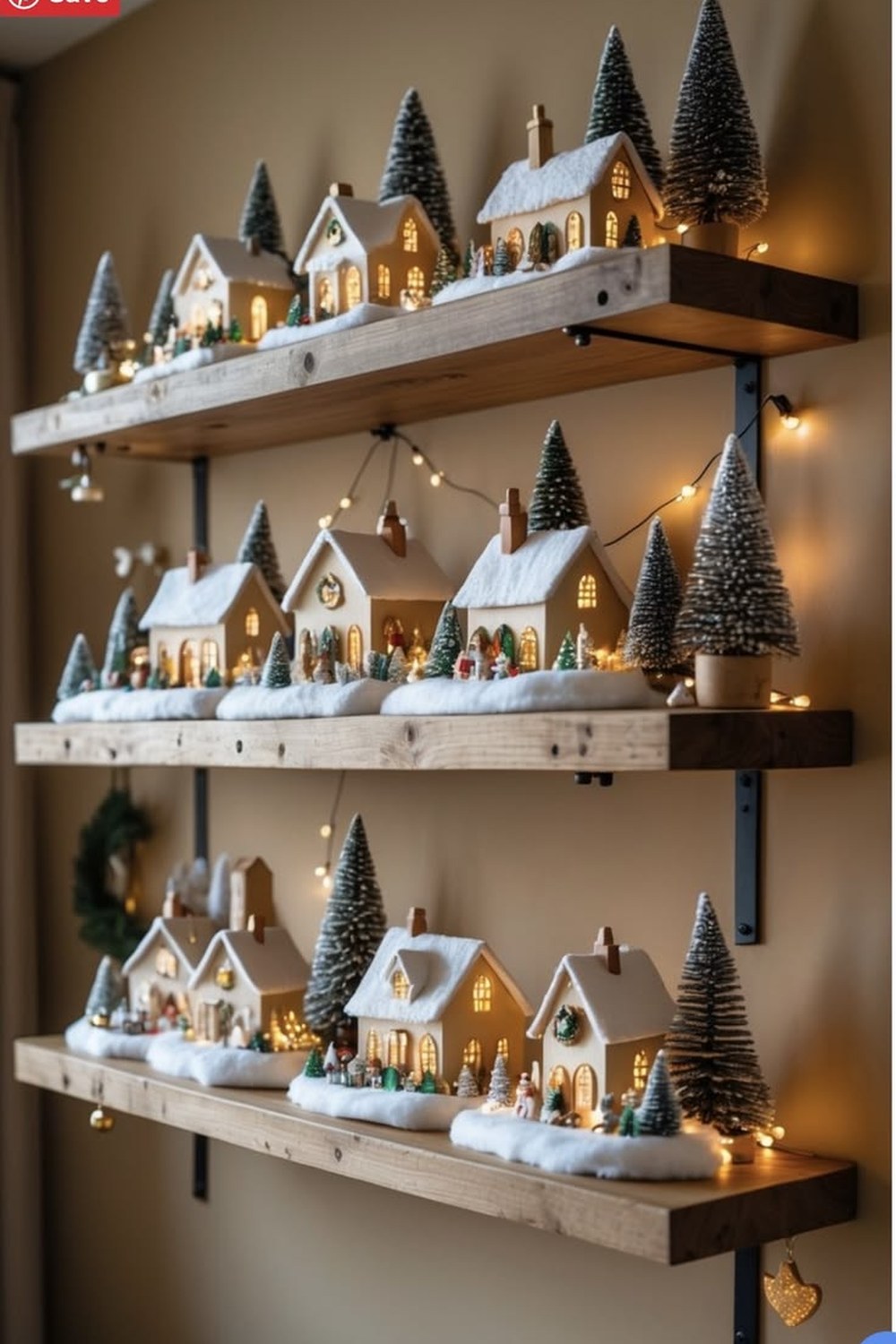
Picture ledges hold a skyline better than pictures — one long silhouette of roofs and lit windows.
A picture ledge or shallow floating shelf makes a striking modern village: houses in a single row, close together like a town skyline, lit windows in a line at picture height. Because there is no depth for scenery, lean fully into silhouette — snow only as a thin strip, trees as dark shapes between rooftops, and the glow doing everything. It suits hallways and above-sofa walls where a deep display would crowd the room.
Styling tip: vary the rooftops deliberately — tall, low, steeple, chimney — against the plain wall. On a ledge the skyline is the scenery, and a varied roofline is what the eye reads as "town".
35. The Vintage Suitcase Village: A Town That Travels
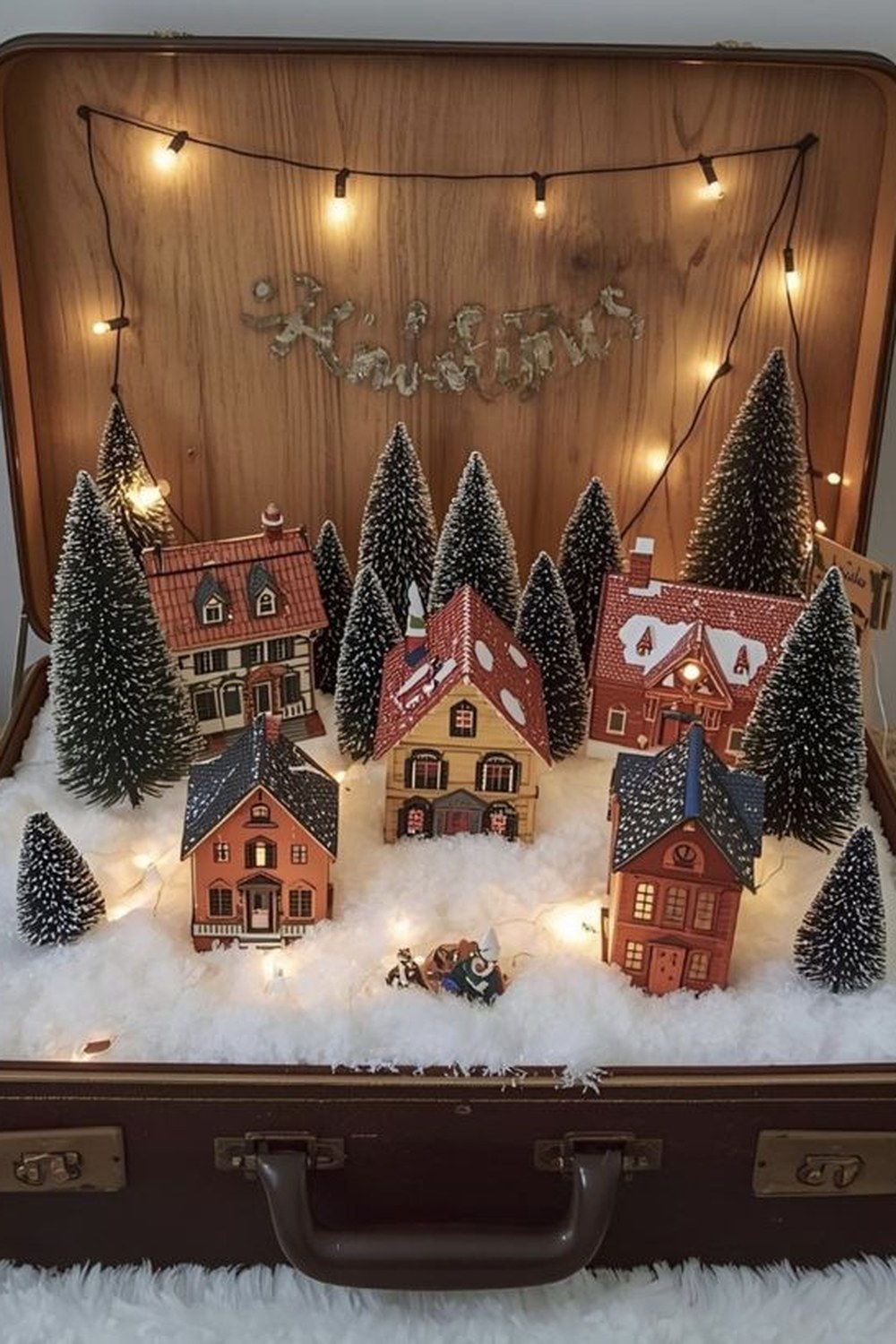
An old suitcase opened flat holds a whole village — and packs it away in January in one lift.
Build the village inside the open base of a vintage suitcase or a deep wooden tray with a rim: snow in the corners, houses, trees and lamps arranged inside, the lid propped behind as a backdrop — even lined with a starry paper sky. The display contains its own mess, moves from table to sideboard in one carry, and at season's end you simply close the lid on the scenery and store the town whole, ready to reopen next December.
Styling tip: fix the first layer — snow, paths, the biggest houses — with a dab of reusable putty before you start. A portable village shifts in transit, and putty keeps the streets where you built them.
Essential Decor Takeaways
- Build for the second moment: a village is designed for dusk, so arrange it with the room lights down and only the village lit.
- Location first: mantels, consoles and dressers suit rows and streets; sideboards and tables suit tiered, layered towns; shelves and stairs suit small, unfolding scenes.
- Height is everything: risers, cake stands and tiers under the snow turn a row of houses into a hillside town with real streets and sightlines.
- Keep every light warm white and put the whole display on timers, so the town glows at the same amber temperature and lights itself each evening.
- Scenery does the quiet work: a continuous snow blanket, curved paths, dozens of bottle brush trees and one frozen pond make buildings into a place.
- Stories beat stock: a church on the hill, shops on the high street, skaters on the pond and carollers at a door give the eye a narrative to follow.
- Grow it slowly: one house a year, photographed each December, turns a decoration into a family record that happens to light up.
Frequently Asked Questions
What are the best christmas village display ideas for a small home?
Think shallow and think single-row. A windowsill row, a picture ledge skyline, a cloche village on a side table, or five houses on one bookcase shelf all give you the lit-window magic without needing a table of their own. Choose houses with warm built-in lights, keep scenery to snow and a few bottle brush trees, and let one small, well-lit scene do the work of a whole town.
How do I make my Christmas village glow properly after dark?
Light in layers and keep it all warm white. Start with the houses' own window light, add miniature street lamps along the streets, hide a fairy light strand behind the back row for a halo, and — at a safe distance behind glass — consider real or flameless candles for flicker. Put everything on timers set for dusk, and check the effect with the room lights off before you call it finished.
How many houses do I need to start a village display?
Three to five buildings make a genuine scene if they are well arranged: one tall focal piece such as a church, two or three cottages, and plenty of trees and snow around them. Scenery and spacing matter far more than numbers — a small village with tiers, paths and a pond looks richer than twenty houses crowded in a row. Add one building a year and the town grows with your family.
How should I store village houses so they last for years?
Keep each house in its original box if you have it, or wrap it in tissue inside a sturdy lidded box with the accessories for its scene bagged alongside. Store batteries removed, keep boxes somewhere dry and temperature-steady rather than a damp garage or hot attic, and photograph the finished display each year — the photograph is both a keepsake and your rebuilding plan for next December.
A Christmas village earns its place because it is never only decoration — it is the lit window you pass on the way to bed, the tiny street children inspect at eye level, the town that grows by one house and one memory a year. Save your favourite christmas village display ideas from this list, begin with the shelf or mantel you already have, light it warm, and let dusk do the rest. For more seasonal inspiration, follow TheStylingHub on Pinterest, where we pin fresh tree, mantel, table and colour-story ideas all season long.